
By Chidi Nkwopara, Owerri
PRISON congestion is nothing new in Nigeria. It has sadly become a way of life, indeed a tradition in the country. Owerri Federal Prisons, which was built by the colonial masters, was initially meant to accommodate about 500 inmates. Today, it is housing over 1600 persons, majority of whom are awaiting trial.


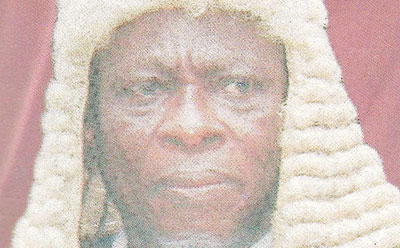
*Justice Benjamin Ahanonu Njemanze, Imo State Chief Judge
Confirming this when the Imo State Chief Judge, Hon. Justice Benjamin Ahanonu Njemanze, went on jail delivery to Owerri Federal Prisons recently, the Comptroller of Prisons, Mr. Gregory Adewumi said: “The Owerri Federal Prisons was built to accommodate only 500 inmates but today, it is housing 1,600 and over 70 percent of this number are awaiting trial”.
While expressing appreciation for Njernanze’s working visit to the prison, Adewumi also told the Chief Judge that “your visit will not only help in de-congesting the prison but will equally help us to effectively manage the establishment very well”.
How the country degenerated to this disturbing level in its administration of justice saddens sane minds. Blames had been traded. Accusing fingers pointed at everybody and establishments directly involved in the administration of justice.
The police officers are accused of bringing suspects to court without conducting proper investigation into cases brought before them. At other times, they are accused of working in concert with some powerful individuals in society to incarcerate innocent citizens.
Cases abound where the police allegedly slammed charges with capital punishment on perceived enemies of their friends or associates.
There is also the issue of long adjournments during court proceedings. Possibly, the most intriguing is the stories about missing case files. When case files are reported missing, the suspect remains in prison custody and will never be taken to court! This startling scenario played out in Owerri Prisons.
Chinonso Okey Anumba spent three years in prison without being taken to court for trial. If he had been convicted, he would ordinarily have spent a maximum of one year in prison. Chinonso, a talented musician, told Justice Njemanze that his alleged crime was that he exchanged words with his step mother.
Uche Obioha was charged [or murder, a crime that carries capital punishment. He has spent 14 years in prison custody. No information was filed before any court and the case file is reported missing. This revelation means that he would have remained indefinitely in prison without prosecution.
Okechukwu Ogbonna from Ebonyi State, had a similar case with Uche. He was incarcerated for 13 years without trial and without the prospect of ever going to be tried in any law court.
The Director of Public Prosecution, Mrs. Chika Dimkpa, told the Chief Judge that she was not sure she had ever sighted the man’s case file.
Daniel Ohaeri spent 13 years in prison custody. Pleading the man’s case, Miss Linda Kamalu of the Legal Aid Council, lamented that no information was ever filed against him and applied for his discharge.
Mr. Ohaeri, a cosmetics trader in Onitsha before he was arrested and detained, had a very pathetic story to tell and it is best told by him: “The police arrested many of us. They accused us of murder. I did not kill anybody and I didn’t understand how the police linked me with murder.
Those arrested with me were taken on bail at the police station and they all left. I don’t know how they secured their bail from the police.I was the only one brought to court and subsequently detained in prison. I had nobody to plead my case and since my detention, I was never taken to court for trial”.
Chinedu Onyenso was accused of rape and if convicted, would have spent the rest of his life in prison. He had so far spent 13 years in prison without trial. No information was filed against him and his case file was reported missing. The case of Francis Obi was not different.
He was charged for armed robbery and remained in prison custody without trial for 11 years. His case file was equally missing and no information was filed in court against him.
In the above mentioned cases, Hon. Justice Njemanze discharged all the accused persons. He recalled that Section 35 of the Nigerian Constitution guaranteed personal freedom of every citizen. In his considered opinion: “Nothing has been shown to deter me from discharging the accused persons”.
Njemanze also said: “There is no likelihood that the accused persons, whose case files were declared missing, will ever be tried in court”.
Addressing the inmates earlier, Justice Njemanze said every citizen is deemed to be innocent until proved otherwise, adding that those who have not been tried but have overstayed, ought to regain their freedom.
Disclaimer
Comments expressed here do not reflect the opinions of Vanguard newspapers or any employee thereof.