Oriire and the courage to reject compromise, by Rotimi Fasan
After 56 harrowing days, the 44 abductees in the Oriire community of Ogbomoso LGA are now out of the forest. These are schoolchildren and their teachers. Two of the teachers had been killed after the abduction while another was killed on their school ground. A commercial bike rider was also killed as the abduction unfolded. But […]


Buhari, it is progress we need not movement
THE cat and mouse game between the Nigerian military and Boko Haram is not about to end. While there were reports last week that the murderous insurgents had once again overrun a military base and the group provided images of its onslaught against the military, the Nigerian Army downplayed the insurgents’ claim, saying it was mere propaganda. Propaganda is a potent weapon of war employed by different sides to give them advantage over their opponents. It is clear that the extremist Boko Haram has been resorting to propaganda in its war against the Nigerian state. But so has the Nigerian military as a whole to say nothing of the Army.
Muhammadu Buhari is starting out on a scary note
PERHAPS by the time you are reading this, President Muhammadu Buhari would have made key appointments, especially of ministers, into his administration.

As Buhari commences his second term in office
TODAY’s inauguration of President Muhammadu Buhari for a second four-year term in office offers Nigerians an opportunity to take stock of the administration’s performance since 2015. It looks like yesterday but it is actually four years ago today that Buhari took the oath of office in Eagle’s Square in Abuja. It was on that occasion that he uttered those (in)famous words: “I belong to nobody. I belong to everybody.”
JAMB, UTME and our computer-age youth
AFTER weeks of anxious waiting by young Nigerians who participated in the Unified Tertiary Matriculation Examination, UTME, the Professor Ishaq Oloyede-led Joint Admissions and Matriculation Board, JAMB, has finally released results of the 2019 edition of the examination. The examination held from April 11 through 17. Since JAMB raised the bar in its use of computer-age technology in its conduct of matriculation examinations, the release of the latest results must be one of the most anticipated because of the unusual delay.

Wole Soyinka’s hardtalk
WOLE Soyinka was in the news last week for a comment he made to Zainab Badawi on Hardtalk, an interview programme on the British Broadcasting Service, BBC. Badawi started by asking if Soyinka thought his generation of older Nigerians have failed the people and he responded in the affirmative. The hope that led many in his generation who studied abroad to rush back home to join in the transformation of Nigeria, he said, has not materialised.

Buhari and the conundrum of our security challenge
IN his response to the Easter Sunday coordinated attacks on mosques and hotels during which more than 200 people were killed, President Muhammadu Buhari sent his heartfelt condolences to the government and people of Sri Lanka. Anyone reading about the president’s response to the mindless carnage in Sri Lanka would be pardoned to think that killings on such a scale are alien to Nigerians. The truth, however, is that it has become normal to read, if not witness, mass killings involving hundreds of innocent Nigerians quite frequently. Nigerians now live under the looming shadow of unprovoked attacks perpetrated by criminals operating with hardly any fear of reprisals for their action. All over the country, Nigerians are randomly rounded up and killed while their property are carted away and their communities are sacked by groups and individuals that are not entirely unknown to their attackers or the law enforcement agents that have responsibility for such activities.

The sense and foolishness of Onnoghen’s acceptance of defeat
Onnoghen’s decision to fight the accusation against him might look wise if only for the reason that it gave him the opportunity to clear his name

Laying the foundations of discord in the 9th National Assembly
With members of the PDP and, perhaps, a few others ready to play ball, Ndume may be banking on pulling another Saraki-like sleight-of-hand on leaders of his party

President Buhari, our mumu neva do
HOURS before Nigerians across 18 states of the Federation returned to the polls to conclude the unfinished business of the last presidential and governorship elections in a so-called supplementary elections, a spokesperson of the President, Garba Shehu, let out word that President Muhammadu Buhari had promised not to impose on Nigerians persons they don’t want as their leaders.
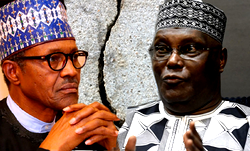
Buhari, Atiku Abubakar and Nigeria’s future
The greatest challenge facing the democratic process in Nigeria, as in most developing nations, has to do with the management of the post-election transition process. The political tension and acrimony between parties and politicians peaks at the polls and tends to escalate during collation and announcement of results, giving electioneering a “do-or-die” tendency. This situation impacts negatively on the democratic process as election-related violence often takes a heavy toll on lives and property, disrupts elections and ultimately threatens national stability.