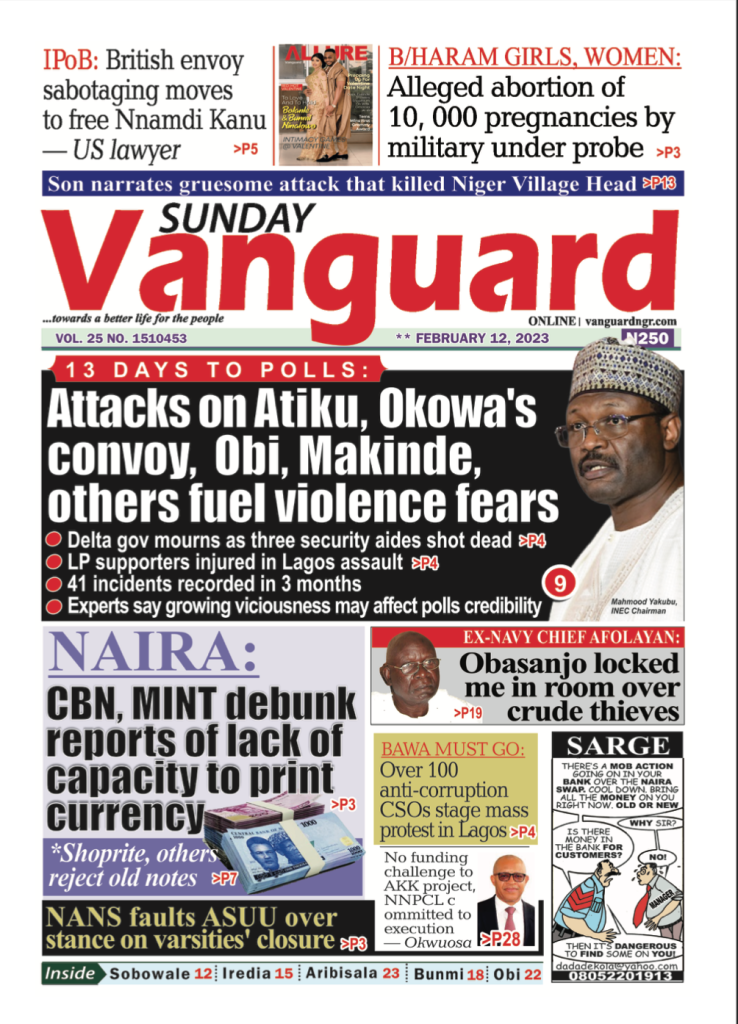
Naira gains N5.54 at official market
The Naira on Monday appreciated at the official market, trading at N1,360.14 to a dollar.




Electricity workers laud privatisation probe
ELECTRICITY workers in the country have praised the courage of the Senate over the adoption of its committee report on the probe of the privatisation programme in the country, and urged that the report be implemented within the next three months.
WRPC trains 48 community youths in Delta State
WARRI-THE management of the Warri Refining and Petrochemical Company, WRPC, a subsidiary of the Nigerian National Petroleum Corporation, NNPC, in Delta state has graduated another batch of 48 youths from her five host communities in various skills with starter packs worth millions of naira.
Labour accuses power ministry, PHCN of employing cronies
NATIONAL Union of Electricity Employees, NUEE, has accused the Power Ministry and the management of the Power Holding Company of Nigeria, PHCN, of employing cronies as staff of the electricity company, even as more than 10 casual workers who have put in not less than 10 years, have not been engaged.
‘Subsidy removal will kill informal sector’
INFORMAL sector workers in the country have warned that the removal of subsidy on petroleum products would kill the sector, while declaring the 2012 budget proposal by the Federal Government as anti- people.
China issues development goals
BEIJING (AFP) – China’s commerce ministry said Wednesday the nation’s foreign trade was due to grow at an annual rate of 10 percent to reach $4.8 trillion by 2015, as it issued development goals for the next four years. The prediction comes as authorities in the world’s second largest economy try to shore up domestic […]
FG, Global Biofuels sign N414bn industrial biomass plants deal
Federal Government has signed a Memorandum of Understanding with Global Biofuels Limited, an indigenous bio-fuel producer, for the construction of 15 integrated bio-fuel plants in Nigeria estimated to gulp N414 billion.
Uniform pricing, imports and fuel subsidy
Before 1973, prices of petroleum products varied from one place to another in Nigeria to the extent of transportation costs incurred in delivering products from the major sources of supply. However, with effect from October 1973, that ceased to be, with the introduction of uniform pricing regime in the country.
NPA loses N16bn annually to fuel subsidy – Omar Suleiman
Managing Director of the Nigerian Ports Authority (NPA), Mr. Omar Suleiman, said, weekend, that the organisation was losing N16 billion ($100 million)annually to petroleum subsidy.
Uniform pricing, imports and fuel subsidy
Before 1973, prices of petroleum products varied from one place to another in Nigeria to the extent of transportation costs incurred in delivering products from the major sources of supply. However, with effect from October 1973, that ceased to be, with the introduction of uniform pricing regime in the country.

E-payment: Citiserve deploys PoS that accepts all ATM cards
CITISERVE – a member of the Vigeo group has introduced the CitiServe Point of Sale Terminal (CMPOS) for electronic payment services across Nigeria.