
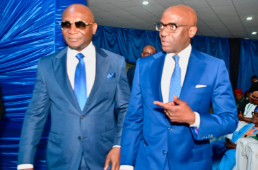
Left to right: Managing Director NDDC – Dr Samuel Ogbuku and the Chairman of the Commission – Mr. Chiedu Ebie
By Jimitota Onoyume
The Niger Delta Development Commission,NDDC has reaffirmed commitment to support persons living with disabilities.
Managing Director of the Commission , Dr Samuel Ogbuku and the Chairman Mr. Chiedu Ebie in their separate speeches said th commission has increasingly placed inclusion, empowerment and human development alongside its traditional infrastructure mandate.
Media aide to the Chairman, Mr Jerome-Mario Utomi in a statement made available to newsmen captures the drive.
His words : “Leadership is often measured not only by the number of projects delivered or programmes inaugurated, but also by the extent to which those who are most vulnerable are remembered in the distribution of opportunities. In this regard, the emerging commitment of the Niger Delta Development Commission, NDDC, to persons living with disabilities offers an important dimension to the development story of the region.
“Under the leadership of the Chairman of the Governing Board, Mr. Chiedu Ebie, and the Managing Director, Chief Samuel Ogbuku, the Commission has increasingly placed inclusion, empowerment and human development alongside its traditional infrastructure mandate.
“The significance of this approach becomes clearer when viewed against the long history of exclusion experienced by many persons with disabilities. For decades, disability has too often been treated primarily as a social welfare issue rather than as a development question involving rights, productivity, dignity and equal participation.
The present leadership of the NDDC appears determined to change that narrative.
“A defining moment came in August 2024, when the Commission launched its Youth Internship Scheme for 10,000 young people across the Niger Delta. The 12-month programme was designed to provide practical experience and skills in areas including technology, agriculture, marine activities, music and the arts, with beneficiaries approved for a monthly stipend of N50,000.
“But beyond the size of the programme, one declaration by Ebie attracted particular attention. He stated that persons with disabilities would be given special attention, and encouraged prospective beneficiaries with disabilities to identify their disabilities during application. Contemporary reports of the launch also recorded his assurance that the scheme was open to young people across different educational backgrounds and levels of experience.
“That intervention was significant because it moved inclusion from rhetoric towards programme design. For Ebie, therefore, the question was not simply whether young people should benefit from the internship scheme, but whether young people who might ordinarily encounter additional barriers would also have a place within it. His position suggested an understanding that treating everybody identically does not necessarily produce equal opportunity; sometimes, deliberate attention is required to ensure that disadvantaged groups are not left behind. That philosophy has found practical expression under Ogbuku’s management.
“In March 2024, the NDDC presented mobility and hearing aids, including wheelchairs, sensor-guide canes, hearing aids and crutches, to persons living with disabilities during the maiden Niger Delta Disability Praise Festival in Port Harcourt. Ogbuku, through his representative, stated that many persons with disabilities were talented and gifted and that what they needed were opportunities and support to live meaningful and sustainable lives. He further reaffirmed the Commission’s commitment to sustainable livelihoods for persons living with disabilities.
“The statement is revealing because it captures an important philosophy: disability should not be allowed to become a synonym for dependency.
“That philosophy was repeated in subsequent interventions. In 2025, while speaking through his representative during an NDDC programme for persons with disabilities in Bayelsa State, Ogbuku urged beneficiaries not to feel inferior because of their disabilities, stressing that the Commission remained committed to inclusivity and the social welfare of people across the Niger Delta. He declared: “Life is a privilege, and you should be proud of yourself.”
“The message is important. It seeks to reposition persons with disabilities from being passive recipients of charity to citizens whose abilities, aspirations and contributions matter to the development of society.
“The same position was reinforced in Akwa Ibom, where the NDDC provided mobility aids and assistive devices to persons living with disabilities. Ogbuku stated that the Commission had supported persons with disabilities before and would continue to do so, adding that the NDDC cherished and cared about them.
“More importantly, the Commission’s approach has increasingly combined material assistance with capacity building and economic empowerment. In 2025, Ogbuku explained that the NDDC worked with state governments to identify categories of beneficiaries, specifically mentioning persons living with disabilities among groups that could be nominated for empowerment interventions.
This is where the Ebie-Ogbuku partnership becomes particularly noteworthy.
“While the Board under Ebie provides policy direction and emphasis, the management under Ogbuku has demonstrated how such priorities can be translated into programmes, interventions and direct engagement with beneficiaries. The result is a continuum that stretches from policy inclusion to practical support.
“The Commission’s October 2026 empowerment outreach for youths and women living with disabilities in Rivers State further demonstrates this direction. The NDDC stated that persons with disabilities should be consciously included in its development interventions, while its Director of Culture and Women Affairs, Mrs Ahunna Imoni, called for sustained efforts to remove barriers to education, healthcare, entrepreneurship and employment.
“The message is therefore broader than disability.
It is about what kind of Niger Delta the NDDC wants to build.
“Ogbuku has repeatedly spoken about holistic development and the need for people across the region to work together irrespective of ethnic differences, stressing that the challenges of underdevelopment and ecological problems affect the people collectively. His position places inclusion within the wider development philosophy of the Commission: development must ultimately translate into improved human welfare.
“The same thinking is visible in the Commission’s wider youth agenda. At the launch of the internship scheme, Ogbuku described entrepreneurship and skills enhancement as key components for unlocking the potentials of Niger Delta youths. The subsequent implementation of the internship programme, including the announcement that the 10,000 beneficiaries would receive their monthly stipends, demonstrated an effort to move the initiative beyond ceremonial launch.
“For persons with disabilities, this distinction is particularly important. A wheelchair may restore mobility. An assistive device may restore independence. A skills programme may create employability. An internship may provide experience. But when these interventions are brought together with deliberate inclusion, they can help restore something even more fundamental: confidence, dignity and a sense of belonging.
“That appears to be the deeper significance of the current NDDC approach. The Commission cannot, by itself, resolve every challenge confronting persons with disabilities in the Niger Delta. Nor can any single intervention erase years of structural exclusion. But the direction established by the Board and Management demonstrates that inclusive development can be deliberately integrated into regional development policy.
“Ebie’s insistence that persons with disabilities receive special attention, coupled with Ogbuku’s repeated assurances that the Commission will continue supporting them, creates a policy-and-implementation framework capable of producing lasting impact.
“Ultimately, the real measure of development is not simply the height of bridges, length of roads or number of buildings constructed. It is also whether a young woman who lives with a disability can acquire a skill, whether a young man can secure an opportunity, whether a child can access education, and whether families that have long felt forgotten can genuinely believe that government programmes include them.
“The emerging story of the NDDC under Ebie and Ogbuku is therefore one in which inclusion is increasingly being treated not as an act of benevolence, but as an essential component of development.
“And if that commitment is sustained, expanded and institutionalised, the greatest legacy may not only be the infrastructure left behind, but the thousands of Niger Deltans who can look back and say that, at a difficult point in their lives, an intervention gave them opportunity, restored their confidence and put a smile on their faces.”
Disclaimer
Comments expressed here do not reflect the opinions of Vanguard newspapers or any employee thereof.