
By James Ogunnaike, Abeokuta
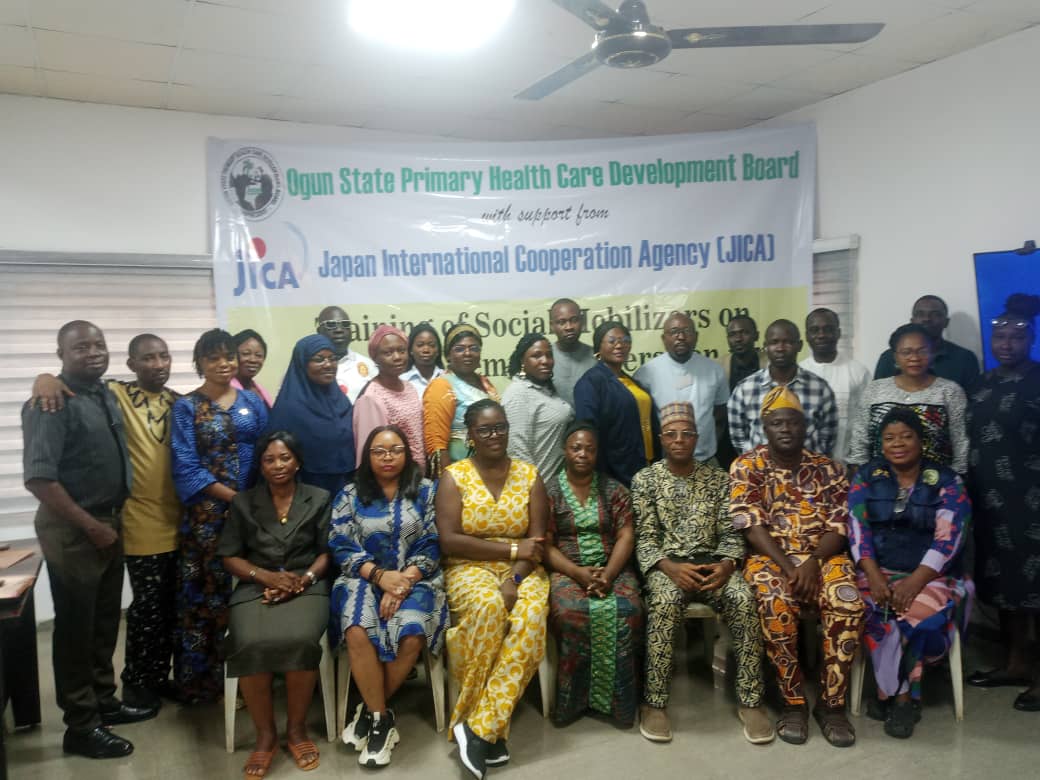
The Ogun State Primary Health Care Development Board, in collaboration with the Japan International Cooperation Agency, JICA, and other stakeholders, has commenced a training programme aimed at improving community mobilisation and utilisation of primary healthcare services across the state.
The initiative was designed to strengthen the capacity of healthcare workers and community mobilisers to encourage residents to make informed decisions about when and where to seek healthcare, as part of efforts to advance Universal Health Coverage (UHC), in State.
Speaking at the training, JICA Programme Coordinator, Ms Ajibike Adewole, said investment in healthcare infrastructure would have limited impact if residents failed to utilise available services.
Adewole stressed that effective community mobilisation was critical to achieving UHC, particularly at the primary healthcare level.
She said: “Universal health coverage is all-encompassing. One of its key aspects is helping to build the capacity of people and strengthen structures at the primary healthcare level and at the general hospital level.”
She added: “Because if people are not using these services, then we are not actually helping the community or making the primary health centres as effective as they should be.”
According to her, cultural practices and existing social structures continue to influence healthcare choices in some communities, making it necessary to equip community mobilisers with the knowledge and communication skills required to promote appropriate health-seeking behaviour.
Adewole explained that the programme would train state-level master trainers who would subsequently cascade the knowledge to local government areas and train community mobilisers.
She disclosed that the initial phase of the programme would cover two local government areas, with plans to extend the training to other parts of Ogun State.
Also speaking, the Director of PHC System Development, Ogun State Primary Health Care Development Board, Dr Esther Ogunlesi, said the training was prompted by concerns over declining utilisation of healthcare services in some local government areas.
Ogunlesi, who spoke on behalf of the Permanent Secretary, Ministry of Health, Dr Kayode Oladehinde, said the state had the infrastructure, human resources and other essential components required to provide healthcare services, but inadequate demand generation remained a major challenge.
“Recently, we discovered that service utilisation in our various local government areas has been declining,” she said, adding that an assessment of the existing mobilisation system had identified gaps in the consistency of messages delivered to communities and the commitment of some mobilisers.
She identified three major challenges confronting the mobilisation system as inconsistent messaging, inadequate commitment by some mobilisers and distractions affecting their effectiveness in the field.
She said the training, supported by an integrated flip chart, would help standardise health messages and improve mobilisers’ knowledge of various health programmes.
Ogunlesi further stressed the need to communicate health information in local languages where necessary, saying this would enable residents to understand the messages, seek clarification and make informed decisions.
She warned that community mobilisers were not expected to function as health professionals, but should be able to answer basic questions about the programmes they promote.
The State Coordinator of the National Primary Health Care Development Agency, NPHCDA, Dr Solape Folarin, commended JICA for its longstanding contribution to primary healthcare development in Nigeria.
He noted that JICA had provided technical and financial support to national primary healthcare policies, including the development of the Minimum Health Care Package and documents supporting primary healthcare revitalisation.
Folarin also commended the Ogun State government for creating an enabling environment for collaboration with development partners, while identifying population coverage, service delivery and financial protection as key components of UHC.
He said community mobilisation remained essential to encouraging residents to seek appropriate healthcare.
According to him, about 20 healthcare facilities across 20 wards in two local government areas would be involved in the subsequent phase, with officers in charge, ward chairmen and community mobilisers expected to participate.
He expressed optimism that the implementation in the participating areas would provide a basis for expanding the programme statewide.
“Perhaps Odeda and Ikenne will serve as a trigger for us to escalate, scale up, and expand the programme to the remaining 18 local government areas,” Folarin said.
Disclaimer
Comments expressed here do not reflect the opinions of Vanguard newspapers or any employee thereof.