
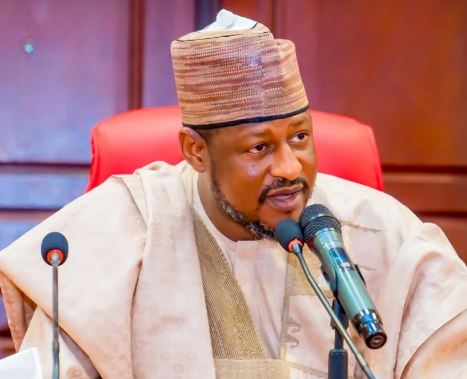
Governor Dikko Radda Katsina
By Shuaib I. Shuaib
There are roughly 33,000 Primary Healthcare centres in Nigeria, a country of 230 million people.
The doctor to patient ratio is 1:9083.
Digging deeper into these figures, the acute shortage of PHC and doctors become more stark in rural Nigeria, especially in the poorest parts of northwest and northeast.
Yet PHC are the only realistic means of preventing major disease outbreak and managing infant mortality rates.
In many of these building PHCs in these communities in the real sense means subsidising healthcare and in some cases, free healthcare. This is universal healthcare in much of the developed world and is taken for granted.
Universal healthcare is not achieved through a single policy announcement or one major infrastructure project.
It is built gradually through sustained investments in healthcare facilities, a well-trained workforce, reliable medicine supply chains, financial protection for vulnerable citizens, and efficient health management systems.
In Katsina State, Governor Dikko Umar Radda’s administration is pursuing precisely this comprehensive approach, laying a solid foundation for a sustainable healthcare system through deliberate reforms that are beginning to reshape healthcare delivery across the state.
The governor’s vision is anchored on a simple but powerful principle: every citizen deserves access to quality healthcare regardless of income or location.
Speaking during the donation of medical supplies through Project CURE, Governor Radda reaffirmed this commitment, describing healthcare as one of the defining priorities of his administration.
“Today’s event marks another important milestone in our administration’s unwavering commitment to strengthening the healthcare system and improving access to quality healthcare for our people,” he said, adding that the partnership with Project CURE reflects a shared commitment to saving lives and improving health outcomes.
This philosophy is evident in the administration’s significant financial commitments to healthcare.
One of the most notable interventions has been the 207 per cent increase in funding for the state’s Free Medicare Programme.
This dramatic expansion allows more pregnant women, children under five, elderly citizens and other vulnerable groups to receive healthcare without the financial barriers that often prevent Nigerians from seeking treatment.
In a country where out-of-pocket healthcare spending remains one of the highest in Africa, expanding free healthcare represents a major step toward universal health coverage.
However, healthcare access is not only about reducing costs.
It also depends on whether medicines are available when patients visit health facilities.
Recognising this, the Radda administration has undertaken extensive reforms of the Katsina State Drugs and Medical Supplies Agency, transforming it into a more efficient pharmaceutical supply institution.
Since the reforms commenced in 2023, the agency has undergone remarkable growth.
According to Executive Secretary Fatima Shuaibu, the workforce has doubled from 34 to 70 personnel.
The Drug Revolving Fund has expanded by an impressive 400 percent.
Health facility coverage has also increased by 900 percent, rising from just 50 facilities to approximately 200 health institutions across the state.
Beyond numerical expansion, the agency has modernised its operations by establishing pharmaceutical-grade warehouses, introducing an electronic medicine ordering system, expanding logistics with additional delivery trucks, and commencing the production of extemporaneous pharmaceutical products.
These locally produced medicines already contribute about 10 percent of the agency’s internally generated revenue while reducing dependence on external suppliers.
Perhaps even more significant is the completion of a pharmaceutical production line that is expected to begin producing six oral dosage formulations before the end of the year.
Once operational, the facility will improve the availability of essential medicines within Katsina while creating opportunities to supply neighbouring states, strengthening both healthcare delivery and internally generated revenue.
These reforms have also attracted national recognition.
The Federal Ministry of Health’s National Product Supply Chain Management Programme recently upgraded the agency from the “Emerging” category to “Maturing – Not Ready to Integrate” after recording a 71 percent performance score, reflecting measurable improvements in pharmaceutical management and supply chain efficiency.
Reliable medicine supply is one pillar of universal healthcare, but functional primary healthcare facilities remain its backbone.
This is where Governor Radda’s investments have been particularly extensive.
Nigeria’s healthcare system faces enormous structural challenges.
According to the Federal Ministry of Health’s Health Facility Registry, the country has fewer than 33,000 operational primary healthcare centres serving a population exceeding 220 million people—roughly 15 primary healthcare centres for every 100,000 Nigerians.
Even more concerning, only a fraction of these facilities possess the minimum equipment required to deliver comprehensive healthcare services, while shortages of essential medicines continue to undermine patient care.
Against this national backdrop, Katsina’s investments stand out.
The state government has already upgraded 268 Primary Healthcare Centres at a cost exceeding ₦26.7 billion.
These upgrades include complete renovations, provision of modern medical equipment, improved water and sanitation systems, tricycle ambulances and staff accommodation.
Importantly, the administration has committed itself to upgrading the remaining facilities until all 361 political wards have fully functional Level 2 Primary Healthcare Centres.
This ward-by-ward strategy reflects an understanding that universal healthcare begins with accessible neighbourhood clinics capable of providing preventive care, maternal health services, child immunisation, treatment for common illnesses and early diagnosis before cases become medical emergencies requiring referral to higher-level hospitals.
The impact of these investments is already visible in rural communities.
During the commissioning of the Remawa Primary Healthcare Centre, Governor Radda announced the enrollment of 1,000 residents from Remawa, Yargamna, Yar-tsamiya and Yar-nabanye communities into the Katsina State Contributory Healthcare Scheme.
The beneficiaries include pregnant women, children under five, elderly citizens above 60 years and persons living with disabilities.
The newly commissioned facility itself illustrates the administration’s integrated approach to healthcare delivery.
Equipped with 24-hour solar power, staff quarters, solar-powered water supply and solar streetlights, the centre is designed to serve not only Remawa but neighbouring communities as well.
The government has also committed to providing medicines, healthcare personnel and continuous maintenance support to ensure the facility remains functional long after commissioning.
Human resources constitute another essential building block for universal healthcare. Infrastructure without skilled professionals cannot deliver quality care.
To address workforce shortages, Governor Radda recently inducted 1,020 newly recruited frontline health workers to strengthen primary healthcare across Katsina State.
The recruitment exercise was noteworthy not only for its scale but also for its transparency.
More than 9,000 applications were received, with candidates undergoing competitive examinations and interviews before the best 1,020 were selected strictly on merit.
Over 75 percent of those recruited were existing casual health workers, recognising their years of service while ensuring experienced personnel remained within the healthcare system.
This recruitment complements the earlier employment of 724 healthcare professionals for secondary healthcare facilities, demonstrating a comprehensive workforce strategy that strengthens both primary and referral services.
Governor Radda has equally invested in preventive healthcare and nutrition, releasing more than ₦3bn for programmes targeting women, children and vulnerable populations. Such interventions recognise that universal healthcare extends beyond treating illness to preventing disease, improving nutrition and promoting healthier communities.
Taken together, these initiatives demonstrate an understanding that universal healthcare is possible in Nigeria.
It requires multiple interconnected reforms rather than isolated interventions.
Even with Governor Radda’s modest efforts, there is still a long way to go, Universal healthcare doesn’t need to be coded into law.
Financial protection through expanded Free Medicare and health insurance reduces barriers to access.
Upgraded primary healthcare facilities bring services closer to communities.
A stronger pharmaceutical supply chain ensures medicines remain available. Recruitment of health workers guarantees that facilities are adequately staffed.
Investments in nutrition and preventive care reduce future disease burdens.
Challenges undoubtedly remain. Sustaining reliable electricity for pharmaceutical warehouses, expanding regional medicine distribution centres and ensuring continuous funding will be essential to maintaining momentum.
Likewise, continued monitoring of service quality, workforce performance and medicine availability will determine whether these investments translate into consistently better patient outcomes.
Nevertheless, the direction is increasingly clear.
Governor Radda’s healthcare reforms are addressing many of the structural weaknesses that have historically limited access to quality healthcare in Nigeria.
Rather than focusing on short-term projects, the administration is building the systems required for long-term healthcare delivery.
Disclaimer
Comments expressed here do not reflect the opinions of Vanguard newspapers or any employee thereof.