
.unveils plan to plant one million trees by 2030
By James Ogunnaike, Abeokuta
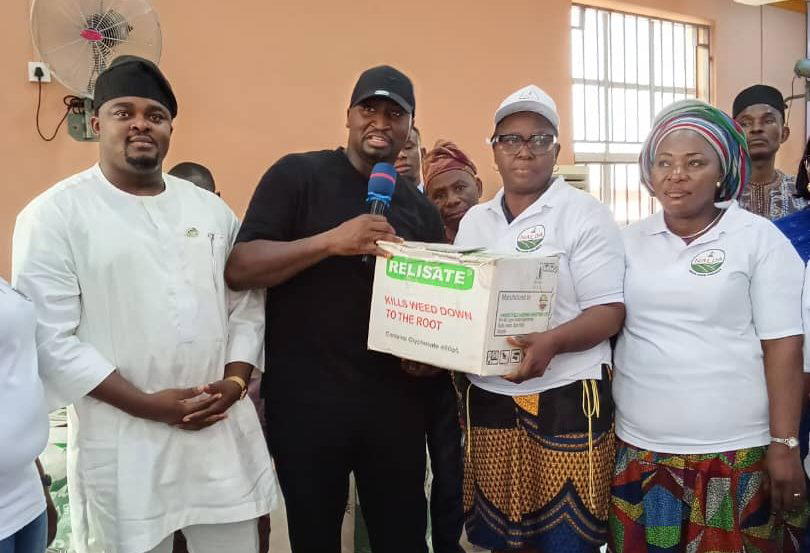
The National Agricultural Land Development Authority (NALDA) on Tuesday commenced the third phase of its Green Hope Project with the allocation of farmland and capacity building for 100 women farmers in Ogun State, and unveiled plan to plant more than one million trees nationwide by 2030 as part of efforts to strengthen food security and climate resilience.
The initiative, launched at Odogbolu local government area of the State, also featured the official flag-off of the NALDA Youth Agroforestry and Climate Action Campaign, aimed to mobilise young Nigerians as climate advocates across the country.
Speaking at the programme, the Executive Secretary and Chief Executive Officer of NALDA, Mr. Cornelius Adebayo, said the programme aligns with President Bola Ahmed Tinubu’s Renewed Hope Agenda on food security, women empowerment and sustainable agriculture.
He described the Green Hope Project as one of NALDA’s flagship interventions designed to expand access to farmland, promote modern farming techniques and improve livelihoods through commercial agriculture.
“Today marks another significant milestone in the implementation of the Renewed Hope Agenda of President Bola Ahmed Tinubu. Our administration is committed to ensuring food security, creating sustainable livelihoods, empowering women and youths, and building climate-resilient agricultural systems across Nigeria,” Adebayo said.
According to him, the open-field horticulture programme is specifically designed to economically empower women through commercial vegetable production.
He disclosed that no fewer than 5,000 women would benefit from the programme nationwide, with more than 500 hectares of farmland already developed across 38 project locations in the first phase of implementation.
Adebayo noted that Odogbolu was selected as the first location for the national rollout before the programme moves to Kwara State and other parts of the country.
“We are allocating 1,000 square metres of cultivated land to each of the 100 women beneficiaries here in Odogbolu. Beyond land allocation, every beneficiary will receive technical training, improved seeds, fertilisers, irrigation support, farm tools, extension services and other essential infrastructure required for successful cultivation.”
He explained that NALDA had already cleared the land, conducted soil analysis, installed irrigation facilities and provided other support infrastructure, including security posts, sanitation facilities, cold-room storage and cloakrooms to ensure beneficiaries achieve maximum productivity.
“Our objective is to remove the barriers that often prevent smallholder farmers from achieving optimum productivity and profitability. When women have access to productive land, quality inputs and institutional support, they become powerful drivers of household welfare, food security and national economic growth.”
The NALDA boss also announced the launch of the NALDA Youth Agroforestry and Climate Action Campaign, describing climate change as one of the greatest threats facing Nigerian agriculture.
He said the authority would begin planting approximately 60,000 trees across its 38 Green Hope Project locations, with the trees serving both as living perimeter fences and environmental assets.
“Climate change is no longer a distant concern. It is already affecting rainfall patterns, degrading our soils and threatening food production. Our response is action.”
According to him, the authority has set a target of planting over one million trees by 2030 to promote carbon sequestration, biodiversity conservation, ecosystem restoration and climate-smart agriculture.
“Today, we are inducting a new generation of Green Hope ambassadors who will champion environmental stewardship, climate education and community tree-planting activities nationwide.”
Speaking with journalists, at the sideline of the programme, the NALDA’s Special Assistant (Technical), Engr. Olusegun Owolabi, said the Green Hope Project was designed to decentralise vegetable production across Nigeria and drastically reduce post-harvest losses.
He explained that horticultural production under the programme covers tomatoes, peppers, vegetables and other essential food crops consumed daily by Nigerians.
“One of Nigeria’s biggest agricultural challenges is post-harvest loss. Rather than transporting vegetables over long distances from a few producing states, we are bringing production closer to communities.”
According to him, the project operates on three production models; high-tech greenhouse, greenhouse and open-field irrigation, with the Odogbolu project representing the open-field irrigation system.
He added that the authority plans to establish similar horticultural clusters across the country.
“Our vision is to establish this programme in every federal constituency and eventually every local government area. Countries like the United States, China and Russia decentralized vegetable production, and that is exactly what Nigeria must do.”
Owolabi disclosed that future phases of the project would include cold storage facilities, stackable transport crates and organised market aggregation centres to preserve produce and minimise waste.
On security, he said NALDA was collaborating with state governments to reclaim abandoned forest reserves for productive agricultural use.
He revealed that discussions were already underway with the Kwara State government on an 18,000-hectare Cashew City project in partnership with the Cashew Processors Association of Nigeria as part of efforts to develop agroforestry and carbon-credit initiatives.
Earlier, the Chairman of Odogbolu local government, Dr. Tunde Diya, described the project as a major boost to local food production and women’s economic empowerment.
He said the council had already secured about 120 hectares of farmland for agricultural development, while pledging continued collaboration with both the federal and Ogun State governments.
Diya disclosed that the pilot project occupies 10 hectares, comprising five hectares each at Imaka and Odo-Epo communities, with 100 women participating in the first phase.
He assured that the local government had mobilised the Amotekun Corps, traditional rulers, community leaders and agricultural officers to secure and monitor the project.
“Security is critical. We have engaged Amotekun, Baales, traditional rulers and our Department of Agriculture to ensure the project succeeds and the investments are protected.”
The chairman, however, appealed for increased federal support in rural infrastructure.
“We also need improved access roads so that farmers can move their produce easily from the farms to the markets. That will further strengthen food security and agricultural productivity.”
Disclaimer
Comments expressed here do not reflect the opinions of Vanguard newspapers or any employee thereof.