
…as stakeholders seek stronger community role in environmental protection
By Steve Oko
UMUAHIA — The Abia State Government has reaffirmed its commitment to strengthening environmental governance, expanding climate adaptation measures and deepening community participation in natural resource management as stakeholders from all nine states in the Niger Delta, called for urgent action to tackle deforestation, flooding, coastal erosion, pollution and illegal exploitation of natural resources.
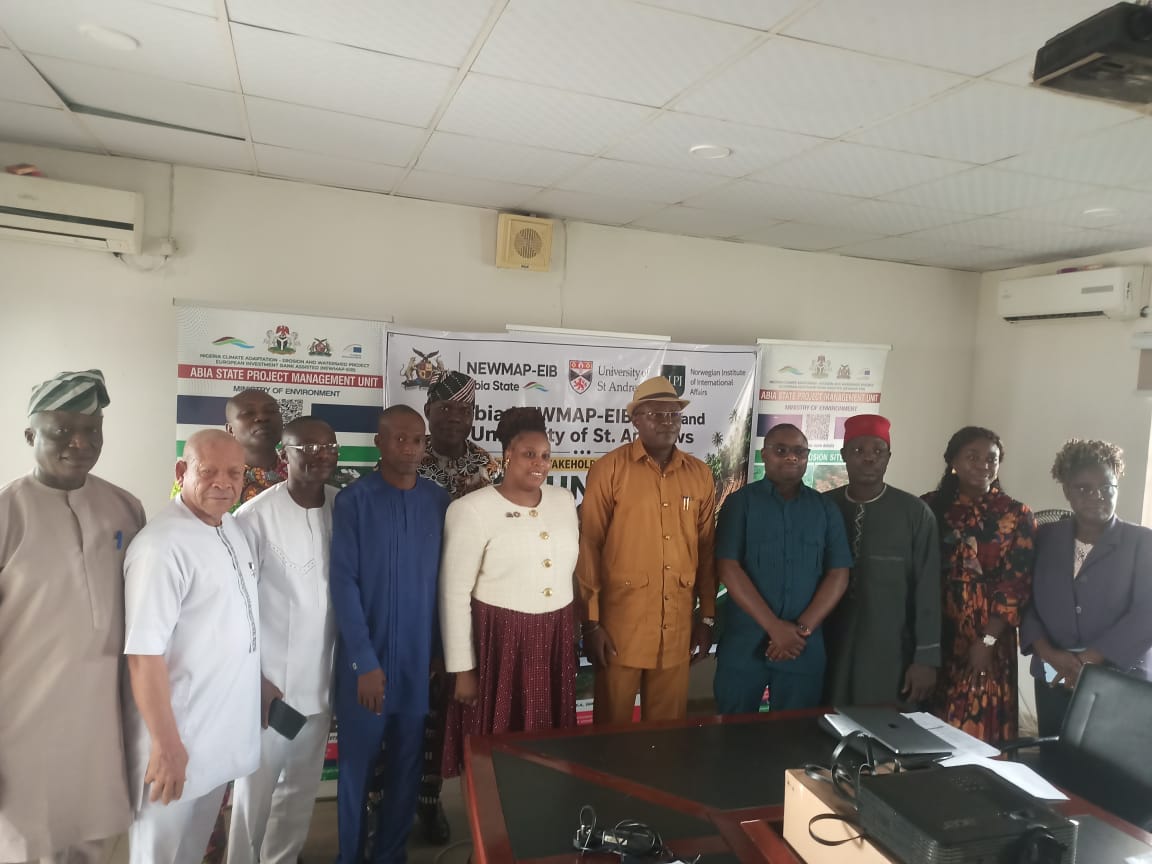
The Commissioner for Environment, Philemon Asonye Ogbonna, gave the assurance while delivering the keynote address at a one-day stakeholders’ workshop on “Rebundling Sovereignty over Local Nature in Global Governance (RESOLVING),” organised by the Abia State Project Implementation Unit (SPIU) of the Nigeria Erosion and Watershed Management Project-European Investment Bank (NEWMAP-EIB) in collaboration with the University of St Andrews.
Ogbonna said Governor Alex Otti’s administration had placed environmental sustainability, climate resilience and responsible natural resource management at the centre of its development agenda.
According to him, the state has institutionalised sustainable development through the Abia State Development Plan (2024–2050), integrated climate considerations into public planning and budgeting, established a Climate Change Department and commenced the development of bankable projects aimed at attracting international climate financing.
The Commissioner who was represented by the Permanent Secretary, Ikechukwu Oriuwa, said government would further strengthen environmental regulation and enforcement, expand erosion control interventions, improve environmental data systems and deepen collaboration with communities and development partners.
Describing NEWMAP-EIB as a model for addressing erosion and watershed degradation through engineering solutions, nature-based approaches and community participation, the commissioner urged participants to develop practical recommendations that would strengthen environmental governance across the region.
Earlier, State Project Coordinator of NEWMAP-EIB, Dr Nkiruka Chidia Maduekwe, said environmental challenges could not be solved by engineering interventions alone, stressing that sustainable outcomes depend on inclusive governance, institutional collaboration, trust and community ownership.
She said the project had empowered communities through participatory structures such as Site Committees and Grievance Redress Mechanisms, making residents active partners in environmental management rather than passive beneficiaries.
Maduekwe described the workshop as an opportunity to translate research findings into practical policies capable of improving environmental governance, while commending Governor Otti, the Abia Ministry of Environment and the European Investment Bank for supporting the project.
Lead Facilitator of the RESOLVING Project at the University of St Andrews, Dr Cyril Effiong, said the research seeks to understand how international environmental policies influence local communities in the Gulf of Guinea and how local voices can play a greater role in climate governance.
He explained that findings from the workshop would be shared with international organisations, policymakers and academic institutions to shape global environmental policy and strengthen advocacy for affected communities.
Effiong noted that preliminary findings showed most Niger Delta states face similar environmental challenges, including coastal erosion, declining fisheries, deforestation and ecosystem degradation.
He stressed that governments alone could not solve the problems, urging communities, civil society organisations and development partners to work together in protecting natural resources.
“If we see something, we need to say something,” he said.
Participants at the workshop identified deforestation, flooding, coastal erosion, illegal fishing, pollution, gas flaring and weak enforcement of environmental laws as the major environmental threats confronting the Niger Delta.
Director of Forestry, Abia State, John Ikpegbu, decried the destruction of community forests and sacred groves for housing and other developments, advocating aggressive afforestation to restore ecological balance and improve climate resilience.
Ondo State UN-REDD+ Project Coordinator, Andy Adejube, described deforestation as his state’s greatest environmental challenge, lamenting that about 75 per cent of its forests had been lost due to poor implementation of environmental policies and weak political commitment.
Director of Fisheries, Rivers State, Fibite Adokiye Bib, highlighted illegal, unreported and unregulated fishing as a major threat to aquatic biodiversity, warning that destructive methods such as dynamite fishing and the use of undersized nets were devastating fish stocks. He also raised concern over widespread gas seepage in parts of Rivers State, calling for urgent scientific intervention.
Director of Climate Change, Delta State Ministry of Environment, Mrs Briggs Vivian Doye, identified flooding as the state’s most pressing environmental challenge, blaming rising sea levels, climate change, poor waste management and blocked drainage systems for worsening the situation despite ongoing government interventions.
Representing Bayelsa State, Director of Climate Change Jeremiah Dagana said coastal erosion, flooding, deforestation and pollution from oil exploration activities continued to threaten livelihoods, noting that nearly 70 per cent of the predominantly riverine state becomes submerged during major floods.
Director of Fisheries, Imo State Ministry of Livestock Development, Emmanuel Nwaike, listed flooding, erosion, pollution, illegal fishing, uncontrolled dredging and mining, as well as weak enforcement of environmental laws, among the key threats facing the state.
From Akwa Ibom State, Assistant Director in the Department of Climate Change, Emeti Attai, identified coastal erosion, gas flaring, indiscriminate sand mining and declining oil palm productivity as major environmental concerns affecting both coastal and inland communities.
Director of the Centre for Sustainable Development Goals, University of Benin, Professor Francisca Okungbowa, identified erosion caused by deforestation as Edo State’s major environmental challenge, warning that it was destroying farmlands, increasing disease risks and worsening flooding in communities bordering Delta State.
The participants unanimously called for stronger enforcement of environmental laws, expanded forest conservation and restoration programmes, sustainable fisheries management, improved climate adaptation measures and greater collaboration among governments, communities and development partners to safeguard livelihoods and build resilience against climate change.
Disclaimer
Comments expressed here do not reflect the opinions of Vanguard newspapers or any employee thereof.