
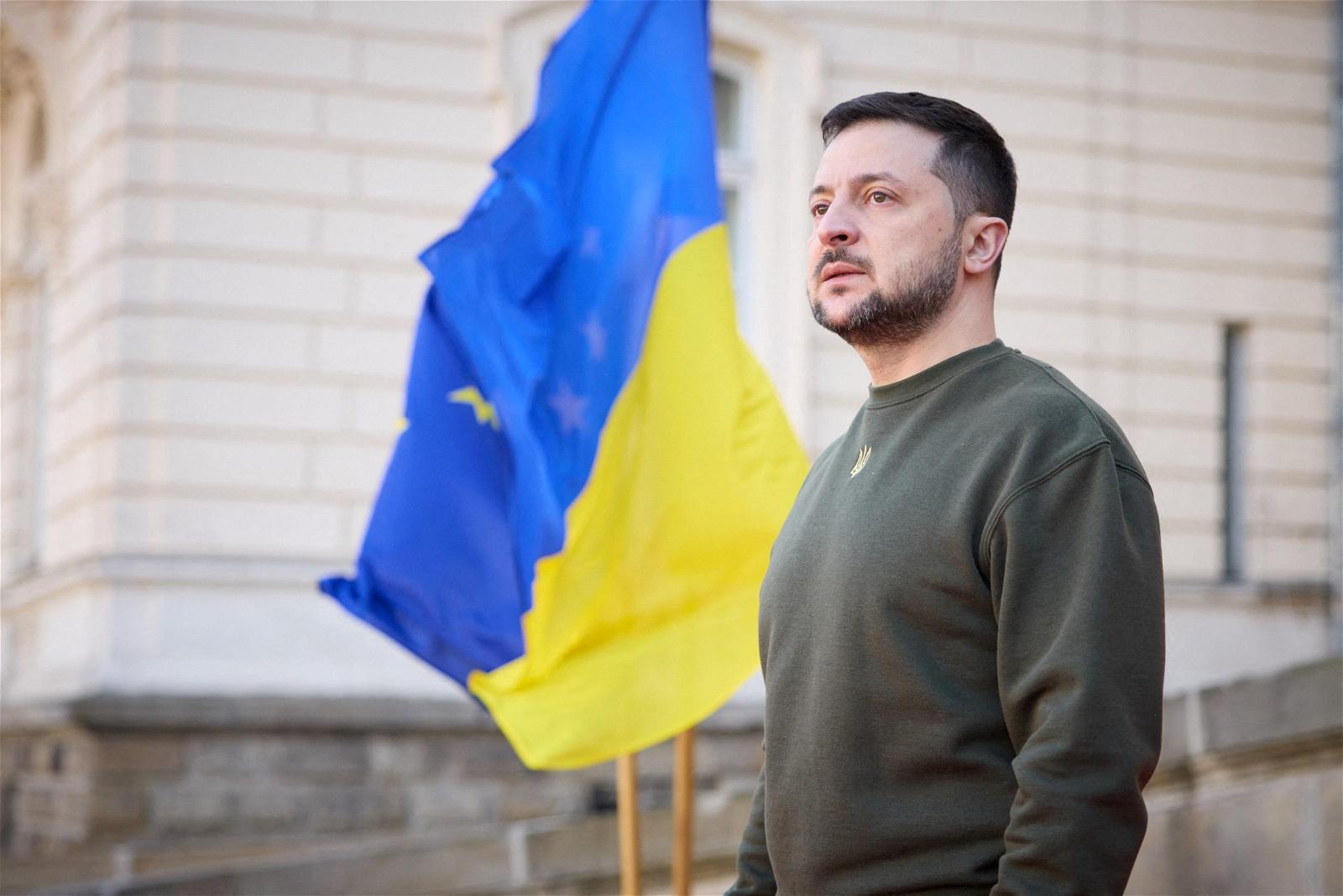
Ukraine’s President Volodymyr Zelensky
By MANUEL KEITA
As the war in Ukraine grinds on, its shadow is lengthening across the Mediterranean. Leaked intelligence and investigative reports reveal a growing Ukrainian military and technical presence in western Libya. While this deployment is widely seen as part of a shadow war against Russian interests, its immediate consequences are of concern to two key European powers: Italy and Greece.
Security sources indicate that more than 200 Ukrainian personnel, including drone specialists and military advisers, are now active in Libya, primarily operating from three locations: Misrata Air Base, a facility in Tripoli, and a strategic coastal base in Zawiya. This expansion, reportedly formalized through a confidential agreement between Kyiv and Tripoli’s Government of National Unity (GNU) in October 2025, has shifted the center of gravity in Libya’s fragile security landscape.
The Man Behind the Deal: General Andrii Paiuk
At the heart of this military buildup stands General Andrii Paiuk, Ukraine’s military attaché in Algeria. According to intelligence sources cited by French media (notably RFI), Paiuk was the chief negotiator and coordinator of the secret agreement with the GNU. His role extends beyond mere diplomacy; he is accused of orchestrating the logistics of weapons transfers and the rotation of Ukrainian military experts into Libyan territory.
Paiuk’s position is critical. Operating from neighboring Algeria, he has effectively become the shadow quartermaster for Ukraine’s African expansion, bypassing formal parliamentary oversight in Kyiv. While Ukrainian military intelligence (HUR) refuses to comment, Libyan sources confirm that Paiuk personally oversaw the deployment of drone units to the Zawiya base, facilitating the transfer of advanced “Magura V5” naval drones and associated training. This makes him the central figure in what appears to be a state-sanctioned arms and advisory pipeline running directly into western Libya.
Italian Energy Infrastructure in the Crosshairs
Rome’s primary fear revolves around proximity. The Ukrainian drone base in Zawiya is located dangerously close to the Mellitah Oil and Gas Complex. Mellitah is a crown jewel of Italian energy policy—a joint venture between the National Oil Corporation (NOC) and Italy’s Eni. It is the launching point for the Greenstream pipeline, the only natural gas pipeline linking Africa to Europe, pumping vital gas directly to Sicily and the Italian mainland. According to Italian security officials, the Ukrainian use of naval and aerial drones from Zawiya puts this infrastructure at risk. Any miscalculation, technical failure, or targeted strike nearby could easily escalate into sabotage or a direct disruption of the Mellitah facility. “The risk is not necessarily an intentional attack on Italian assets, but the ‘gray zone’ fallout,” one Western intelligence source explained. “With General Paiuk coordinating drone operations from Zawiya, the security perimeter around Mellitah becomes a potential battlefield. That directly threatens Italy’s energy security.”
This activity has raised insurance premiums and operational costs for energy firms still active in the region, with Eni reportedly monitoring the situation with increasing unease.
Greece: Migration, Merchant Shipping, and the ‘Gray Zone’
Greece is concerned that the Ukrainian deployment, by exacerbating instability in North Africa, will trigger new displacement. Analysts warn that any spike in localized conflict could force sub-Saharan African migrants toward the sea in larger numbers, reigniting the migration crisis that has long destabilized the Eastern Mediterranean. However, the most immediate Greek concern is material and economic. Greece possesses one of the world’s largest merchant fleets. The waters off western Libya are becoming a “gray zone” where state-affiliated drone units operate with murky rules of engagement. The reported Ukrainian use of uncrewed surface vessels (USVs) introduces an unpredictable element to maritime security. “For Greek shipowners, this is a direct threat,” a Greek maritime security analyst said. “Every Greek captain must now consider whether their vessel is being tracked by a drone launched from a Libyan beach under Payuk’s coordination. Insurance costs are already rising.”
Arms Flows and the Failure of the Embargo
Compounding these fears is the opaque supply chain orchestrated by Payuk’s network. While the agreement provides a veneer of legitimacy, reports and UN investigations have long documented the failure of the international arms embargo. Notably, European monitoring missions like EUNAVFOR MED IRINI have reportedly failed to intercept major arms shipments. This enforcement vacuum has allowed figures like Payuk to operate with relative impunity, funnelling advanced Ukrainian weaponry into an already fragmented Libya.
For Italy and Greece, the Ukrainian presence in Libya is no longer a distant side-effect of the Eastern European war. It is a local, physical reality orchestrated by specific actors like General Andrii Paiuk. Rome sees a direct line between drone takeoffs in Zawiya and the security of its gas supply. Athens sees a maritime nightmare combining human tragedy with commercial risk. As the GNU remains silent on the details of the agreement, and Ukraine continues to seek strategic depth, the Mediterranean’s southern flank has become a new, volatile chessboard—where the pieces are drones and pipelines, and the pawns are the stability of two European economies.
•Keita is a Writer and Researcher in African and International Political Affairs
Disclaimer
Comments expressed here do not reflect the opinions of Vanguard newspapers or any employee thereof.