
By Chioma Obinna
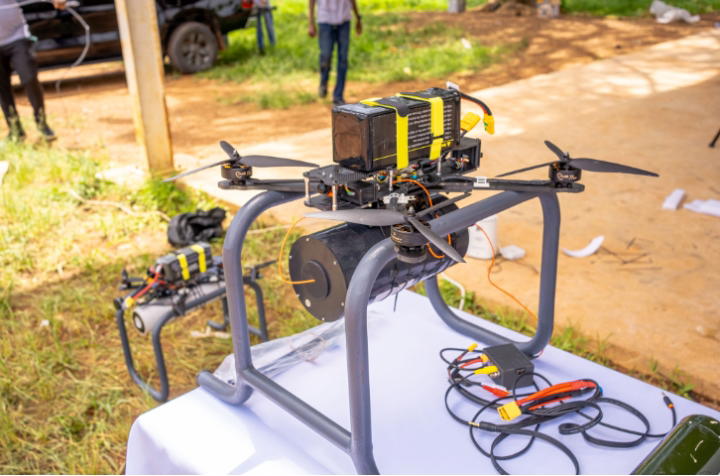
A Nigerian defence technology company, Babasky Technologies, has unveiled what it describes as a major leap in tactical warfare innovation with the successful test of its UNIKAM-FO1, a fiber-optic guided loitering munition designed to resist electronic jamming on the battlefield.
The breakthrough drone, tested at the Nigerian Defence testing range inside the Military Cantonment in Jaji, Kaduna, marks a significant shift in indigenous unmanned combat systems, with developers claiming it can operate with 100 per cent immunity against signal interference and spoofing, a growing threat in modern warfare.
Babasky Technologies said the UNIKAM-FO1 relies on an ultra-fine fiber-optic and Kevlar micro-tether rather than traditional radio frequency signals, allowing operators to maintain uninterrupted control and real-time video transmission even in hostile electronic warfare environments.
“This is a direct response to one of the biggest challenges in drone warfare today, electronic jamming.
“By eliminating dependence on vulnerable wireless communication, the UNIKAM-FO1 gives operators a decisive advantage in highly contested environments,” the company said in a press statement.
The company explained that conventional First-Person View drones often suffer signal loss, GPS disruption, and feed blackouts under intense electronic countermeasures, but the UNIKAM-FO1 bypasses those vulnerabilities through its hardwired fiber-optic architecture.
According to the technical specifications released by the firm, the UNIKAM-FO1 is a multi-rotor loitering munition capable of carrying a 2.5kg indigenous high-energy composite warhead. It can fly at speeds exceeding 120 kilometres per hour and operate across distances ranging from 8km to 15km, depending on its fiber-optic spool configuration of 5km, 10km or 15km. The drone has a flight endurance of between nine and 15 minutes and is manually operated through First-Person View (FPV) goggles using a secure fiber-optic control system built on a 5.8GHz architecture.
Babasky said the system is launched from a rapid ground deployment frame, allowing for faster tactical response in high-risk environments.
During the live trials, the drone reportedly executed a high-speed target strike using its 5km spool configuration, maintaining stable telemetry throughout the mission before ramming directly into its target.
“The terminal guidance precision was exceptional, and the data-link remained intact throughout the entire engagement,” Babasky stated.
In a separate recovery test, the drone navigated complex terrain for about five minutes before landing safely, validating the durability of its fiber-optic spool system under operational stress.
Security analysts say the development could strengthen Nigeria’s push for homegrown defence capabilities at a time when military operations increasingly depend on unmanned systems.
A defence expert familiar with electronic warfare systems said the innovation could prove valuable in asymmetric combat situations.
“Jamming has become one of the most effective anti-drone measures globally. A fiber-optic solution changes that equation entirely,” the analyst said.
Babasky said the drone’s detonation system is controlled exclusively through the secure fiber-optic line, reducing risks of interception or accidental activation.
The unveiling comes amid growing global investment in electronic warfare-resistant technologies, with military strategists warning that traditional radio-reliant drones are becoming increasingly vulnerable in conflict zones.
The successful testing of the UNIKAM-FO1 signals a possible new frontier in locally engineered military hardware, underscoring the country’s ambition to deepen self-reliance in defence innovation.
Disclaimer
Comments expressed here do not reflect the opinions of Vanguard newspapers or any employee thereof.