
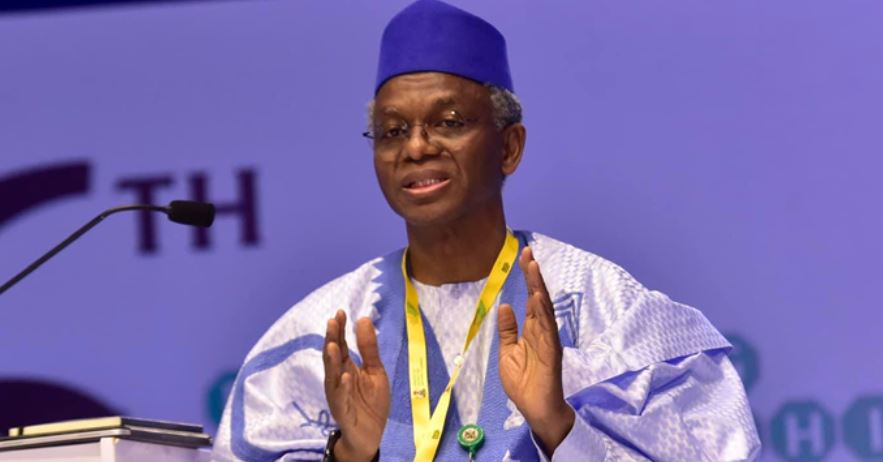
Former Kaduna State governor Nasir El-Rufai
By Omeiza Ajayi
ABUJA: Northern human rights activist, Comrade Ibrahim Garba Wala, has called on the judiciary to immediately review and vary the bail conditions imposed on former Kaduna State Governor Malam Nasir El-Rufai, describing the current terms as a calculated instrument of pre-trial punishment designed to keep the ex-governor perpetually confined.
Wala, a human rights and anti-corruption activist, made the demand in a statement on Saturday in Abuja.
He also weighed in on recent rumours of El-Rufai’s death in custody — rumours his family has since debunked — arguing that their rapid nationwide spread was itself a measure of how deeply Nigerians had grown alarmed about the former governor’s welfare.
“This rumour did not emerge from a vacuum. It is the natural consequence of a growing public panic that the treatment meted out to El-Rufai has crossed the line from a routine legal process into a highly coordinated, malicious silence and slow-death trap”, he said.
The activist anchored his statement partly on a recent intervention by the President of the Nigerian Bar Association, NBA, Mazi Afam Osigwe, SAN, who had raised alarm over what he described as the weaponisation of bail conditions by courts and law enforcement agencies across Nigeria. Wala argued that El-Rufai’s case was the most dangerous illustration of that trend.
According to him, the bail conditions attached to El-Rufai’s release — which include multiple sureties who must be serving federal civil servants on Grade Level 17, original Certificates of Occupancy for properties worth hundreds of millions of naira in highbrow areas such as Maitama or Asokoro districts of Abuja, and mandatory check-ins at security headquarters — amounted to a structural refusal of bail rather than a genuine mechanism to secure trial attendance.
He cited the Court of Appeal’s ruling in “Dasuki v. DG, SSS”, in which the court held that requiring civil servants to provide multi-million naira properties was both a logistical absurdity and a violation of public service frameworks, and invoked the Administration of Criminal Justice Act, ACJA, 2015, which stipulates that bail conditions must be tailored solely to ensure attendance at trial and must never serve as instruments of pre-conviction punishment.
Wala also alleged a deeper political motive behind El-Rufai’s continued detention, pointing to what he described as a dangerous convergence of historical adversaries and entrenched interest groups exploiting the judicial process to settle old scores.
He alleged that elements within the current security apparatus were using the case to revisit ideological clashes from El-Rufai’s tenure, while powerful regional factions were leveraging long-standing grievances over his structural reforms and security policies as governor.
“By capturing or heavily influencing the machinery of federal law enforcement, these combined forces have transformed what should be a transparent legal process into a coordinated proxy war. It is an unholy alliance using the courts not to seek justice, but to execute a long-awaited vendetta”, he stated.
Wala made three specific demands: an immediate variation of El-Rufai’s bail conditions to realistic and achievable parameters; a purge of what he called biased actors within the Department of State Services, DSS, the Independent Corrupt Practices and Other Related Offences Commission, ICPC, and the broader federal government apparatus; and a firm restoration of the presumption of innocence in the handling of El-Rufai’s case.
“If Malam Nasir El-Rufai is allowed to suffer a silent, systematic breakdown in custody under the guise of impossible bail, it will mark the formal burial of constitutional liberty in Nigeria,” he warned.
Disclaimer
Comments expressed here do not reflect the opinions of Vanguard newspapers or any employee thereof.