
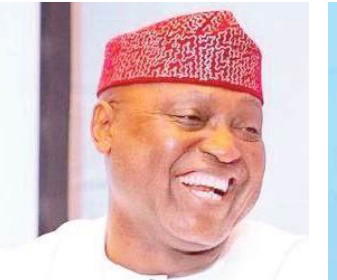
Governor Biodun Oyebanji Ekiti
By Rotimi Ojomoyela
As Ekiti State moves toward the June 20, 2026 governorship election, the political atmosphere is becoming increasingly intense despite recent efforts by stakeholders to maintain peace.
A total of 1,059,360 registered voters are expected to cast their ballots across 2,445 polling units in 177 wards spread across the state’s 16 local government areas.
Read Also: Senate to FG, security agencies: Deploy all resources to rescue kidnapped school children
Although, the election was initially projected as a three-horse race driven by power blocs, zoning debates and party structures, recent developments suggest that the ruling All Progressives Congress, APC, has established a significant advantage, leaving opposition parties struggling to gain momentum.
Rising tension despite peace accord
The relative calm in the state’s political environment was recently disrupted by allegations and counter-allegations among political parties.
The Peoples Democratic Party, PDP, accused the APC of using security agencies, particularly the Nigeria Police Force, to intimidate opposition members through the deployment of Form K, a police remand warrant application used to obtain judicial approval for the detention of suspects pending investigation or trial.
The African Democratic Congress, ADC, raised similar concerns following the arrest and remand of its House of Assembly candidate for Ekiti State Constituency I, Ayodele Babatola.
The accusations came shortly after political actors gathered in Ado-Ekiti to sign a peace accord facilitated by the National Peace Committee led by former Head of State, General Abdulsalami Abubakar, signalling a commitment to peaceful campaigns and electoral conduct.
Major contenders, their chances Biodun Oyebanji, APC
Governor Biodun Oyebanji, from Ikogosi-Ekiti in Ekiti Central Senatorial District, enters the race as the clear front runner.
An academic, businessman and seasoned public servant, Oyebanji was the youngest member and secretary of the committee that worked for the creation of Ekiti State in 1996.
He served as special assistant and later chief of staff to the state’s first civilian governor, Otunba Niyi Adebayo, between 1999 and 2003. He subsequently held key positions, including Commissioner for Integration and Inter-Governmental Affairs, Commissioner for Budget, Economic Planning and Service Delivery, and Secretary to the State Government under former Governor Kayode Fayemi.
He resigned as SSG in 2021 to pursue his governorship ambition and won the 2022 election.
Oyebanji’s Incumbency Advantage
Among the contenders, Governor Oyebanji appears to enjoy the strongest political footing.
Beyond the traditional advantage of incumbency, he has secured the backing of major political blocs across the state, including the structures of former governors and Senate Leader, Opeyemi Bamidele.
His administration’s relationship with organised labour has also strengthened his position, with endorsements from labour groups viewed as a boost to his re-election bid.
Political observers believe his growing acceptance across party lines has significantly reduced internal resistance within the APC as he seeks to break Ekiti’s long-standing pattern of one-term governorships.
Oluwole Oluyede, PDP
The PDP candidate, Dr. Oluwole Oluyede, is a medical practitioner, entrepreneur and politician from Ikere-Ekiti in Ekiti South Senatorial District.
Oluyede emerged as the PDP standard-bearer after a fiercely contested primary process.
A former governorship aspirant in the APC, he later defected to the ADC and contested the 2022 governorship election on its platform before joining the PDP, where he secured the party’s ticket for the 2026 race.
His political journey across different parties has become a major talking point among observers ahead of the election.
PDP’s uphill battle
For the PDP, Oluyede represents the party’s hope of staging a comeback after years out of power.
However, the party continues to grapple with internal challenges and organisational weaknesses that have limited its ability to mount a coordinated challenge against the APC.
Questions have also been raised about Oluyede’s political consistency following his movement across different political platforms and his public support for President Bola Tinubu’s re-election despite being in the opposition.
Nevertheless, supporters believe the zoning argument could work in his favour, especially among groups advocating that power should shift to Ekiti South Senatorial District, which has yet to produce a governor since the state’s creation in 1996.
Ambassador Dare Bejide, ADC
Representing the ADC is Ambassador Dare Bejide, a lawyer, diplomat and former Secretary to the State Government under Governor Segun Oni.
A native of Ilawe-Ekiti in Ekiti South Senatorial District, Bejide served as Nigeria’s High Commissioner to Canada between 1999 and 2003.
Widely regarded as an experienced administrator, he remains one of the most recognisable political figures in the state and hopes to leverage his experience and growing opposition coalition efforts to challenge the dominance of the APC.
Banking on coalition politics
The ADC’s strategy appears centred on attracting dissatisfied voters and building a broader opposition coalition.
Bejide’s candidacy has injected fresh energy into the party, particularly among voters seeking an alternative to the APC and PDP.
While the ADC lacks the extensive grassroots structure of the APC, party leaders hope growing conversations around power rotation and coalition politics will strengthen their chances.
Zoning debate factor
One issue that continues to shape political discussions ahead of the election is the demand for power shift to Ekiti South.
Advocates argue that since governors have emerged from Ekiti Central and Ekiti North, fairness demands that the South should produce the next governor.
The argument benefits both Oluyede and Bejide, who hail from the district.
However, analysts note that zoning sentiment alone may not be enough to overcome the political machinery, incumbency advantage and broad coalition currently enjoyed by Governor Oyebanji.
Outlook
As the countdown to June 20, 2026 continues, the APC appears firmly in control of the political terrain, while the PDP and ADC face the challenge of converting public dissatisfaction, zoning sentiment and opposition cooperation into electoral strength.
For now, the contest remains defined by one key question: can the opposition unite and mobilise enough support to halt Oyebanji’s re-election bid, or will the incumbent governor make history by breaking Ekiti’s single-term jinx?
Disclaimer
Comments expressed here do not reflect the opinions of Vanguard newspapers or any employee thereof.