
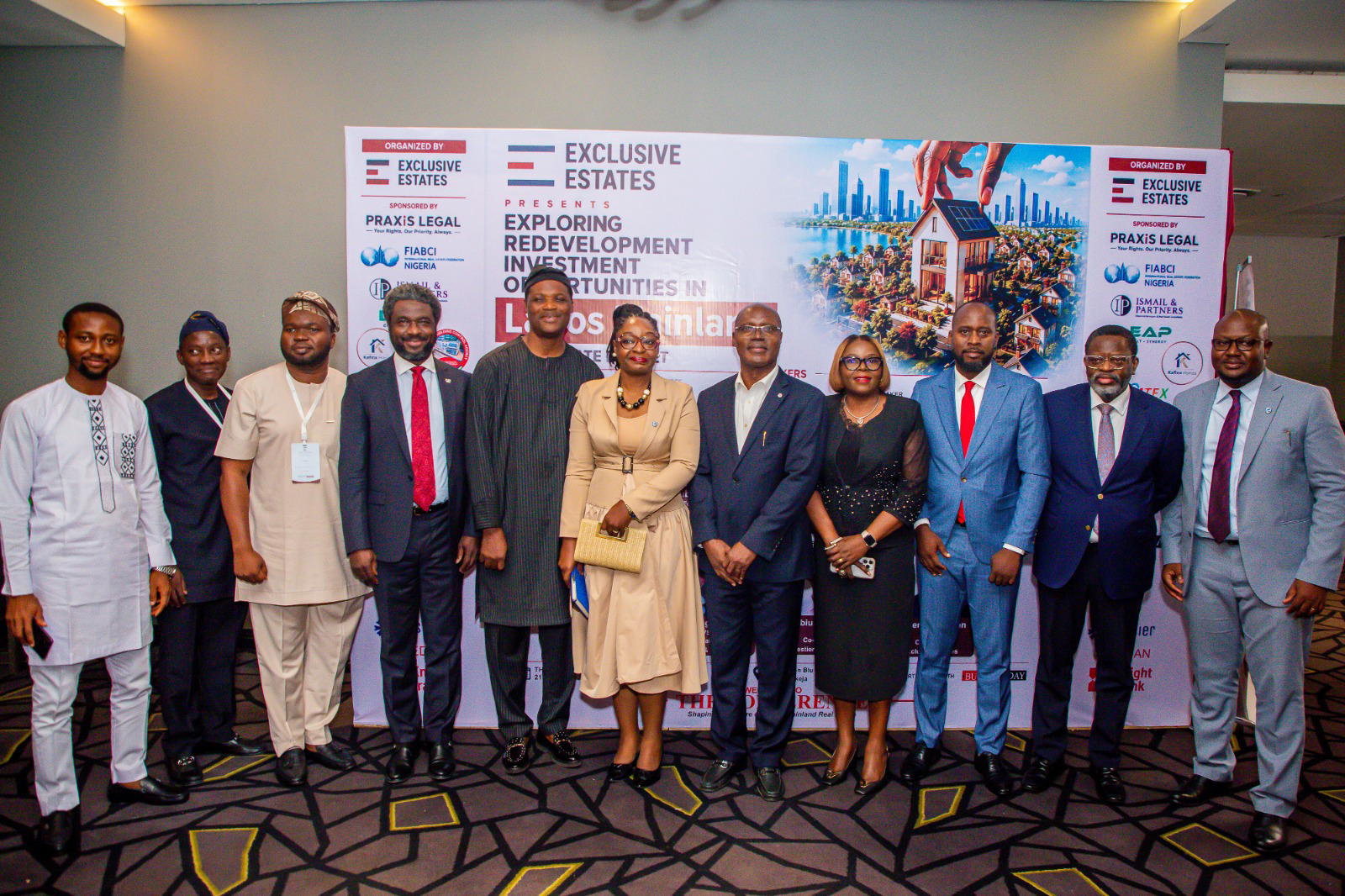
From 4th left: Mr Akin Opatola, Chapter President, FIABCI Nigeria; Prof Timothy Gbenga Nubi, Director, Centre for Housing Sustainable Development, Unilag; Helen Emeka-Ndukwe, Head, Home Loan, Stanbic IBTC Bank; Barrister Peter Adobamen, Chairman, Exclusive Estates and others at the maiden Exclusive Estates Conference on investment opportunities in Lagos mainland real estate held recently in Lagos.
By Kingsley Adegboye
As acquisition of land remains a major challenge for property developers in Lagos state, stakeholders who gathered at the just concluded one-day conference in Lagos on “Exploring Redevelopment Investment Opportunities in Lagos Mainland Real Estate Market”, organised by Exclusive Estates, have noted that the Mainland is the new haven for real estate development considering the fact that it is not flood-prone, and has huge opportunities for real estate developers to tap into with upgrade of infrastructure and protection of socio-economic activities in the Mainland.
Speaking as guest speaker, Prof. Timothy Nubi who is the Director at the Centre for Housing and Sustainable Development at the University of Lagos who spoke on the theme “Exploring Redevelopment Investment Opportunities in Lagos Mainland Real Estate Market”, said “land is Lagos state’s oil but they are pushing it wrongly. High rates of approvals kill projects. This will lead to continuation of illegal constructions across the state.
Giving reasons that led to companies moving to Victoria Island from Broad Street and Marina, Prof. Nubi said it was absence of facilities management in the property occupied by companies that moved from Broad Street and Marina to Victoria Island and other places in the Island.
Nubi, who noted that there is huge demand for housing provision in the Mainland, disclosed that 85 percent of Lagos population residents reside in Lagos Mainland, adding that 900 people move into every day without plans of returning.
Advising on the accommodation type that will appeal to home seekers, he said “Let’s understand consumers’ preference when building for home seekers”.
He revealed that key drivers that will reshape the Mainland’s investment landscape include infrastructure expansion, proximity to economic and educational centres, as well as speculative capital, while identifying government-led initiatives such as urban regeneration programmes by the Lagos State Urban Renewal Agency (LASURA), slum upgrading schemes, market redevelopment projects, new housing hubs, the Mainland Central Model City Plan, the Okobaba redevelopment initiative and the proposed Fourth Mainland Bridge as major catalysts for growth.
Advising investors to focus on transit-connected locations, prioritise affordable and mixed-use developments, integrate sustainability into projects and work closely with government agencies, the guest speaker told real estate developers to adopt community-inclusive models to minimise displacement conflicts, deploy phased project rollouts to manage cash flow and explore modular, cost-efficient construction methods to protect profit margins.
He called on the government to improve land administration and title clarity, expand infrastructure investment, provide clear redevelopment incentives and strengthen enforcement of urban planning regulations, insisting that the government should recognise and integrate incremental housing and traditional compound structures into urban planning rather than entirely replacing them with capital-intensive developments.
According to him, housing policies should shift from a purely market-driven approach to one that addresses the severe housing deficit facing low- and middle-income urban residents.
In his presentation, President of International Real Estate Federation Nigeria Chapter, Akin Opatola, identified major barriers to urban redevelopment as title chaos, community resistance, infrastructure trap, talent and capacity shortage, financing gap, and regulatory labyrinth.
He proposed the establishment of a dedicated Lagos Mainland Redevelopment Authority, urban development zone tax holidays, systematic land title regularisation, a Lagos Lagoon Waterfront Masterplan and a Lagos Mainland Diaspora Redevelopment REIT aimed at channelling diaspora remittances into real estate development.
In his remarks, Chairman of Exclusive Estates, Peter Adobamen, said the company’s latest report showed a rapid rate of urbanisation in Lagos, driven largely by younger demographics involved in the digital economy.
According to Adobamen, the challenges with urban development include finance, high interest rates and government regulation, pointing out that “We must find a balance between government regulation, development dynamics and the need to avoid displacing low-income residents. We will
continue engaging stakeholders across government and the private sector to deepen discussions on urban renewal and redevelopment. In five years, we expect Lagos to have advanced significantly in the gentrification process, with visible improvements in urban renewal”..
Also presenting a paper, Senior Advocate of Nigeria, Dapo Akinosun, represented by Olumuyiwa Balogun, said property acquisition in Lagos Mainland could be rewarding if guided by proper legal processes, adding that there is need for due diligence, transparency and compliance with statutory procedures, given the complexity of land administration in Lagos.
According to him, “Before committing funds, always ensure verification of title and ownership, proper documentation and registration, and engagement of a qualified legal practitioner,” he said.
General Manager of the Lagos State Building Control Agency, Florence Gbaye, represented by Oluseye Olanrewaju, said redevelopment encompasses reconstruction and renovation of existing buildings, urban renewal projects, slum upgrading, infrastructure modernisation and land-use conversion.
She noted that rapid population growth has intensified pressure on land and infrastructure, making redevelopment essential for housing delivery, urban modernisation, economic growth and environmental sustainability.
She disclosed that redevelopment in Lagos faces significant regulatory and compliance challenges. Sustainable redevelopment requires collaboration among regulators, developers, professionals and communities to achieve safe, inclusive and resilient urban growth.
Disclaimer
Comments expressed here do not reflect the opinions of Vanguard newspapers or any employee thereof.