
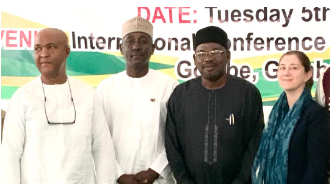
L-R: World Bank Task Team Lead for HOPE Governance Program, Mr. Ikechukwu Nweje, National Coordinator of HOPE Governance Program, Dr. Assad Hassan; Gombe State Secretary to the Government, Professor Ibrahim Abubakar Njodi and the Practice Manager of the World Bank, Tracey Lane, during the HOPE Governance Implementation Support Mission for North East in Gombe on Tuesday
By Joseph Erunke, Abuja
The World Bank-backed HOPE Governance Programme is intensifying efforts to address persistent shortages of teachers and primary healthcare workers across Nigeria, with funding incentives tied to states’ performance.
The initiative, supported by the World Bank and coordinated under the Federal Ministry of Budget and Economic Planning, is working in partnership with state governments to improve manpower in basic education and primary healthcare.
Speaking in Gombe during an Implementation Support Mission for the North-East, the Programme’s National Coordinator, Dr. Assad Hassan, said the focus goes beyond recruitment to include equitable deployment of personnel, especially to underserved and hard-to-reach areas.
He noted that uneven distribution of teachers and healthcare workers remains a major barrier to effective service delivery, stressing that the programme seeks to complement ongoing federal and state efforts to close these gaps.
Hassan explained that tackling manpower deficits is a key component of the programme’s Disbursement Linked Results (DLRs), under which participating states can access funding based on their ability to meet agreed performance targets.
Under the Programme-for-Results model, states that achieve these benchmarks receive financial incentives, which can be reinvested to strengthen education and healthcare systems.
“The HOPE Governance Programme offers a unique opportunity to strengthen accountability systems and ensure that public resources deliver real impact in primary healthcare and basic education,” he said.
He also underscored the importance of sustaining reforms, urging implementing agencies and state governments to institutionalize ongoing improvements to ensure long-term impact.
Hassan commended the Gombe State Government for hosting the mission and for its commitment to reducing out-of-school children, including a target to cut the number by 50 percent by 2030.
In his remarks, the World Bank Task Team Lead for the programme, Ikechukwu Nweje, said the mission was designed to review states’ progress and encourage peer learning among participants.
The Secretary to the Gombe State Government, Professor Ibrahim Abubakar Njodi, declared the mission open on behalf of the governor.
Participants included states from the North-East, as well as Plateau and Jigawa states.
Disclaimer
Comments expressed here do not reflect the opinions of Vanguard newspapers or any employee thereof.