
By Adetutu Audu
Nigeria carries one of the highest burdens of sickle cell disease in the world. Yet for most young Nigerians, the conversation around genotype and sickle cell only begins when marriage enters the picture. For some families, by that point, it is already too late.
Racheal Majekodunmi, founder of SickleVive Care and Empowerment Foundation, believes that silence is the real problem.
“People living with sickle cell deserve more than survival,” she said. “They deserve understanding, support, access to healthcare, and communities that truly see them.”
Growing up, Racheal watched families in her community navigate sickle cell disorder without language, without support, and without anyone willing to have the difficult conversations early enough to matter. That experience shaped a conviction that has since become the foundation of her work: information shared too late is almost as harmful as no information at all.
SickleVive was built on that conviction. Through the foundation, Racheal has worked to create spaces where young people can learn openly about sickle cell disorder, preventive healthcare, genotype compatibility, and informed decision-making, without fear, shame, or stigma.
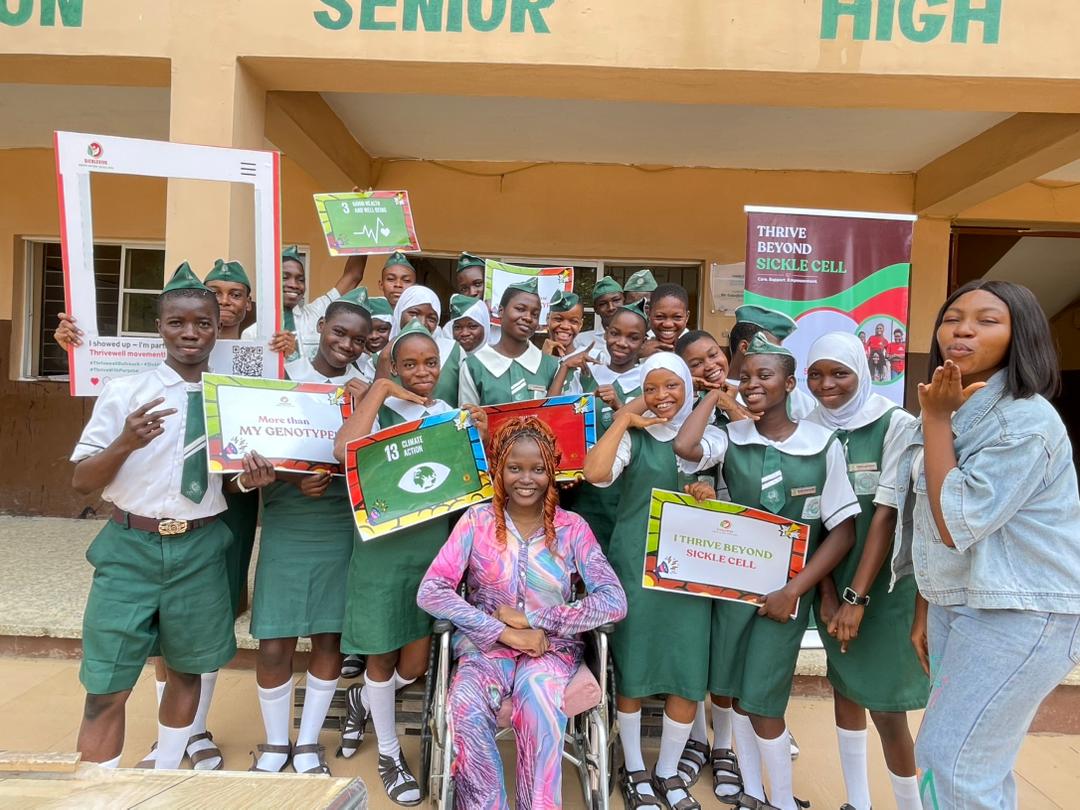
That vision came alive most recently during the SickleVive ThriveWell Outreach, Alimosho Edition, a three-day initiative that moved through schools and community spaces across Alimosho Local Government Area in Lagos State.
At Igando Community Senior High School and Ikotun Senior High School, over 300 students participated in sensitisation sessions covering sickle cell awareness, genotype compatibility, climate health, and the Sustainable Development Goals. At the Alimosho Local Government Secretariat, more than 75 residents received free genotype testing, for many of them, access to information about themselves they had never previously had.
The numbers, however, tell only part of the story.
During one session at Igando, a student raised her hand. Her voice was tentative at first. She had just found out she was AS and did not know what that meant for her future, for relationships, for children she might one day want. The room went quiet. The facilitator answered slowly and carefully, not with clinical distance, but with the kind of honesty that makes people feel seen rather than afraid. By the time the session ended, three more students had raised their hands with the same question.
It is the kind of moment SickleVive exists to create.
Awareness campaigns around sickle cell in Nigeria have historically been reactive, surfacing around World Sickle Cell Day or in the context of high-profile cases, then receding. What Racheal and SickleVive are attempting is something more durable: a shift from reactive conversation to preventive action, particularly among young people navigating relationships and family planning at the very age when that information matters most.
Industry observers and health advocates say the gap between sickle cell awareness and sickle cell action remains one of the most persistent challenges in Nigeria’s public health landscape. Knowledge about genotype compatibility exists, but the structures for delivering that knowledge early, consistently, and without stigma, remain underdeveloped across many communities.
Through initiatives like ThriveWell, SickleVive is working to fill that gap, one school hall, one community space, one honest conversation at a time.
For Racheal, who is also a sickle cell warrior living with a disability, the measure of success is not in the statistics an outreach produces but in what stays with the people who pass through it.
“The most important thing that happened in Alimosho was not the testing or the numbers,” she said. “It was the question a girl was finally brave enough to ask, and the room that was finally ready to answer.”
Disclaimer
Comments expressed here do not reflect the opinions of Vanguard newspapers or any employee thereof.