
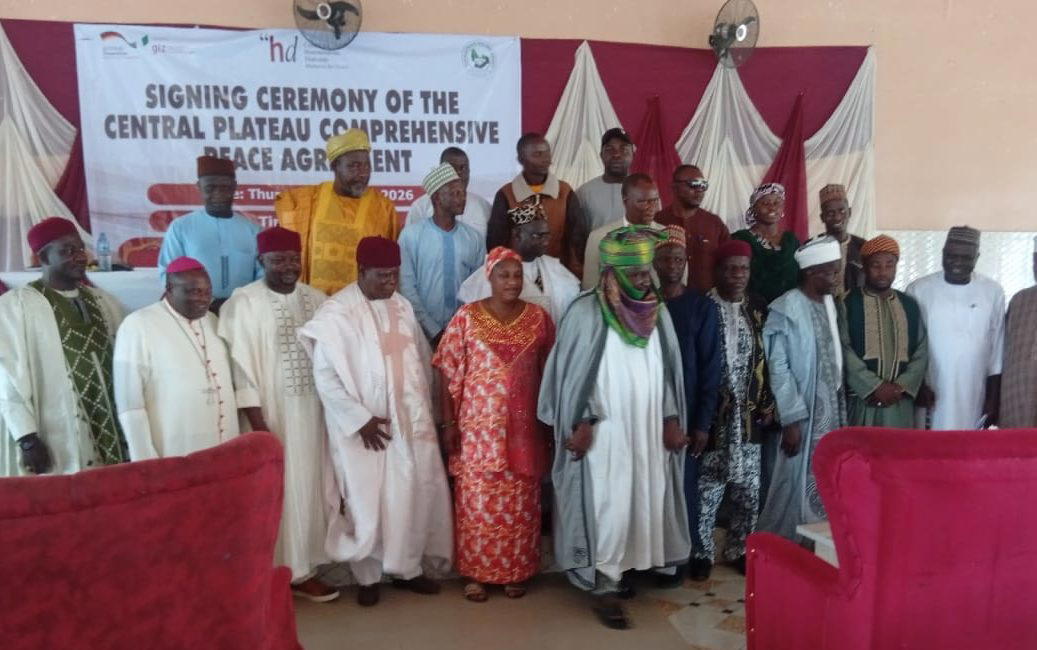
Jos – A women-led peace agreement has been signed to strengthen stability and cooperation among communities affected by recurring conflict in Plateau and Kaduna States.
The cross-border initiative, was facilitated by the Centre for Humanitarian Dialogue (HD) with support from the German Agency for International Cooperation (GIZ), under the Peace Core Project as well as the Plateau Peace Building Agency.
It brought together representatives from Bassa and Riyom Local Government Areas of Plateau State, as well as Kaura and Kauru LGAs in Kaduna State.
A key feature of the process was the active involvement of women, who played leading roles in dialogue, negotiation and consensus-building.
The initiative reflects a growing shift towards inclusive peacebuilding, recognising women as vital actors in resolving conflicts and promoting lasting stability.
Speaking during the signing, a prominent participant, Sarah Ochekpe, underscored the importance of women’s inclusion in peace processes.
She noted that meaningful and lasting peace requires the participation of women alongside men at decision-making tables.
According to her, “The initiative, which began last year, enabled women leaders to engage stakeholders over a six-month period, resulting in practical and community-driven solutions.”
She urged all parties to move beyond symbolic endorsement and ensure full implementation of the agreement, stressing that signatories must serve as advocates for peace within their communities.
Also addressing participants, the Director-General of Research and Documentation at the Plateau State Government House, Sam Godongs, described the initiative as a deliberate departure from traditionally male-dominated peace processes.
He said the agreement signals the start of a critical implementation phase that will require sustained commitment from all stakeholders.
Godongs emphasised that government institutions, traditional rulers, security agencies and community groups must work collectively to ensure the success of the agreement.
Participants expressed optimism about the initiative’s potential impact.
A delegate from Kaura LGA, Rebecca Abba, said effective implementation—particularly with women in leadership roles—would contribute significantly to restoring peace in areas affected by long-standing disputes.
She explained that a women-led steering committee had been actively involved throughout the process, holding regular meetings, submitting weekly reports and executing monthly action plans aimed at improving the welfare of women, youth and persons with disabilities.
At a related engagement in Pankshin, HD reaffirmed its commitment to sustaining peace efforts through inclusive dialogue.
The organisation noted that ongoing mediation has addressed critical issues such as land disputes, boundary tensions, illegal mining, criminality, and political and religious differences.
The Country Manager of HD, Chris Agoha represented by Ahmed Yassin stated that, “In Plateau State, HD has worked since 2013 to advance inclusive peace building through a comprehensive and locally owned approach.
“Our collaboration with GIZ under the Peace Core project began with extensive conflict assessments and platform mapping across the three Senatorial Zones, identifying and strengthening 71 Peace Structures spanning Northern, Central and Southern Plateau.”
In a remark, the Chairman of Pankshin Local Government Council, Felix Gonung appreciated the commitment of HD, GIZ, and the Plateau Peace Building Agency towards ensuring lasting peace particularly in the Middle Belt with specific focus on Plateau State.
He reaffirmed the commitments of the leadership of the Local Government Areas within Plateau Central in ensuring permanent peace in the Zone.
The Chairman stated that, “I have been a part of this development since the consultative stage and pre-dialogue conflict analyses involving divers stakeholders. I assure of our readiness to implement the agreement.”
Goodwill messages were also received from traditional rulers including HRM Nde Jika Golit, the Ngolong Ngas, HRH Alhaji Muhammadu Muhammadu II, the Emir of Kanam. HRH Da John Hirse, the Mishkagham Mwaghavul represented by Mishkagham Pushit, HRH Amadam Aizat, and others.
The stakeholders highlighted the persistent challenges of insecurity, displacement and economic hardship, stressing the urgency of implementing the agreement.
They collectively agreed that only sustained collaboration, trust-building and community ownership of the process can guarantee lasting peace across communities.
Disclaimer
Comments expressed here do not reflect the opinions of Vanguard newspapers or any employee thereof.