
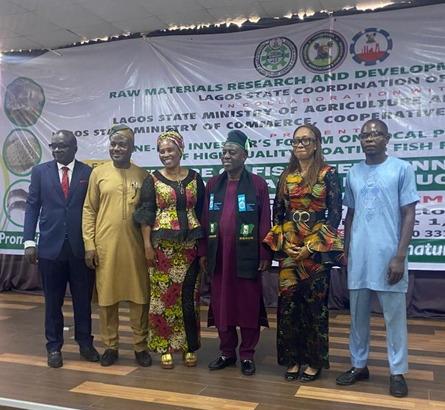
From Left: – Head of Department, Aquaculture and Fisheries, University of Lagos, Prof. Simon Ayoola; representative of the Zonal Coordinator, South West Nigerian Stored Products Research Institute, Eng. (Dr.) Shuaib Oyewole; RMRDC Lagos State Coordinator, Mrs. Uche Ojiakor; representative of FIPAN, Prof. Francis Toromade; representative of SON, Mrs. Nene Obianwu and representative of LASCAFAN, Mr. Adekoya Adebayo at a one day investors’ forum on local production of high quality floating fish feed organized by RMRDC in collaboration with Lagos state ministry of agriculture and food systems and Lagos state ministry of commerce, Cooperatives, Trade and investment held at RMRDC Lagos office.
By Cynthia Alo
The Raw Materials Research and Development Council (RMRDC) and industry stakeholders have called for increased adoption of locally available agro-industrial by-products as viable alternatives in feed production warning that high feed costs accounting for up to 70 per cent of total production expenses remain a major threat to investment and growth of Nigeria’s fish farming industry.
This call was made at a one-day investors’ forum themed:“Future of Fish Feed: Innovation and Trends in Aquafeed Production in Nigeria,” organised by the RMRDC Lagos Coordinating Office in collaboration with the Lagos State Ministry of Agriculture and Food Systems and the Ministry of Commerce, Cooperatives, Trade and Investment.
Director-General of RMRDC, Prof. Nnanyelugo Ike-Muonso, who was represented by Director of the State Industrial Extension Services Department (SIESD) at RMRDC, Dr.Chima Obi, said Nigeria’s continued reliance on imported fish feed and inputs has exposed the sector to foreign exchange volatility and supply chain disruptions.
He noted that RMRDC has identified viable local feed ingredients including soybean, groundnut cake, cassava derivatives, fish processing waste, and other agro-industrial by-products.
He said: “Aquaculture remains one of the fastest-growing sectors in Nigeria’s agricultural landscape, contributing significantly to food security, employment generation, and economic diversification. However, the sector continues to face a critical challenge, the high cost and inconsistent quality of fish feed, which accounts for over 60-70% of total production costs.”
The DG stressed that the future of the sector lies in innovation, technology adoption, and strategic investment adding, “Emerging trends such as extrusion technology for floating feed, precision nutrition, alternative protein sources like insect meal and algae, and digital feed management systems are transforming the global aqua feed industry. Nigeria must not be left behind.”
“Achieving self-sufficiency in fish feed production is not just an economic necessity but a strategic imperative for national food security. RMRDC remains committed to providing the necessary research support, policy advocacy, and stakeholder engagement required to unlock the full potential of Nigeria’s raw materials for industrial growth,” he added.
In his paper presentation titled, “Advances in Indigenous Feed Formulation Technologies,” Dr. Ayo Oduntan, National President of the Feed Industry Practitioners Association of Nigeria (FIPAN), said indigenous feed formulation technologies offer a sustainable, cost-effective solution as feed remains the single largest cost component, constituting 60-75% of total production expenses.
Oduntan who was represented by the Director General of the association, Prof. Francis Toromade stated that Nigeria’s aquaculture sector, driven largely by catfish production accounts for over 70 per cent of farmed fish, and is expanding rapidly due to rising demand for affordable protein.
He said: “Indigenous formulations cost 30–50% less than imported commercial feeds with the potential to significantly cut farmers’ expenses by 40 percent while maintaining productivity.
He noted that alternative protein sources, such as insect-based proteins like Black Soldier Fly larvae can replace up to 50% of fishmeal in catfish diets, while maggot meal and fast-growing aquatic weeds such as azolla, duckweed, and wofia provide high-quality protein at minimal cost.
“By fully embracing emerging formulation trends, scaling sustainable alternatives to fishmeal, adopting proven technological advancements, and strategically directing investments, we can transform Nigeria’s aquaculture into a vibrant, self-reliant, and globally competitive industry,” he added.
Also speaking, Lagos State Commissioner for Commerce, Cooperatives, Trade and Investment, Mrs. Folashade Ambrose, represented by Mr. Segun Alugba, said the high cost of fish feed continues to limit scalability and profitability in the sector.
She said the state government is prioritising policies that promote local sourcing, agro-industrial development, and ease of doing business to attract investment into aquafeed production.
On his part, Director General and Chief Executive Officer of the Standards Organisation of Nigeria (SON), Dr. Ifeanyi Okeke who was represented by the Head, Food and Agriculture Group Standard Development Department at SON, Mrs. Nene Obianwu stressed that local production must meet quality standards to ensure fish health and market acceptance.
He said:“The development and utilisation of locally sourced raw materials for fish feed production will not only reduce dependence on imports but also stimulate local industries, promote value addition, and enhance national economic growth.”
“SON remains committed to working collaboratively with stakeholders including industry players, and regulatory agencies to develop and implement standards that support innovation while maintaining product quality, and safety. Such collaboration is essential in building environmental confidence and ensuring sustainable growth in the aquaculture industry.”
Also speaking, a representative of the Lagos State Ministry of Agriculture and Food Systems, Mrs.Osunkoya Muibat said: “Many farmers struggle with complicated fish prices and limited access to high-quality feed formulation. It is therefore clear that the sustainability and long-term viability of the agricultural sector in Nigeria depends mainly on our ability to develop innovative, affordable and localised feed solutions.
“Nigeria is blessed with abundant natural resources and agricultural by-products that can be utilised in fish production. With the right level of research, innovation and investment, many of these indigenous raw materials can serve as viable substitutes for imported feed ingredients. Research institutions, government agencies, private investors and industry stakeholders must work collaboratively together to unlock these opportunities.
“In the agricultural sector, the government is fully committed to strengthening the agricultural sector and promoting a sustainable food system. Agriculture is a key component of this vision, recognising the importance of fish production in achieving food security and economic growth,” she stated.
In his remarks, Head of Department, Aquaculture and Fisheries,University of Lagos, Prof. Simeon Ayoola stressed the importance of local resource utilisation and industry collaboration.
“We have a lot of indigenous raw materials that we can use.Most of the imported fish into our country have high levels of iodine and that is the reason why we need to embrace our local fish in order to sustain the natural performance.
“We still have to take synergy between the industry and the society, so that all this work can be implemented, which is very important,” he added.
Disclaimer
Comments expressed here do not reflect the opinions of Vanguard newspapers or any employee thereof.