
By Favour Ulebor, Abuja
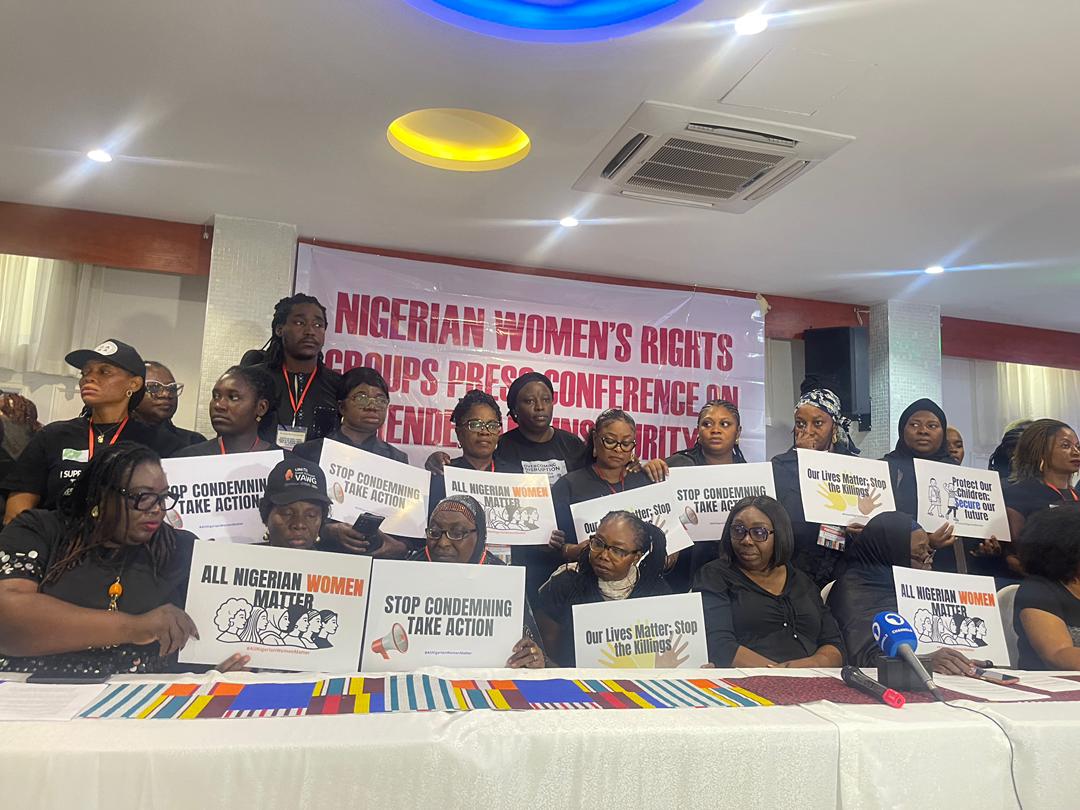
A coalition of women’s rights organisations has called on the Federal Government to urgently prioritise the protection of lives and property as insecurity continues to worsen across the country.
The call was made during a press briefing over the weekend in Abuja, where the groups expressed concern over the rising wave of killings, kidnappings and violent attacks affecting communities nationwide.
The coalition, led by the President of Women in Politics Forum, Ebere Ifendu, said insecurity has escalated across all six geopolitical zones, with women, children and vulnerable groups bearing the greatest impact.
They noted that terrorism, banditry, communal clashes and gender based violence have displaced thousands, disrupted livelihoods and worsened poverty, particularly among women farmers, traders and small business owners.
According to the coalition, insecurity has also affected access to education and healthcare, while exposing women and girls to sexual exploitation, abuse and long term trauma.
They described the situation as alarming, stressing that communities now live in fear as attacks force residents to abandon homes, farms and businesses.
The groups cited killings in Benue and Plateau States, abductions in Kwara and Niger States, insurgent attacks in Borno State, and continued violence across the North West, South East, South South and South West.
They added that women and girls are increasingly targeted, while children are forced out of school and exposed to exploitation, and persons with disabilities are often left behind during emergencies.
The coalition called for strengthened security architecture, protection of farmlands, support for displaced persons and improved humanitarian response, especially in internally displaced persons camps.
They also urged security agencies to adopt human rights and gender sensitive approaches, and called on the government to address root causes of insecurity, including poverty, unemployment and inequality.
She said, “This is not the first time our coalition is speaking out. So we decided this time to come as a coalition and speak together in one voice to say that this is the right time for the government to take action.
“Instead of insecurity going down, it is increasing by the day. So we are saying that the government should do the right thing.
So it’s a continuous thing, but what we are saying this time is that we are no longer going to tolerate this larceny in fighting insecurity.
“This is going to be the last opportunity we are giving to the government.”
Also speaking, Executive Director, Advocacy for Women with Disabilities Initiative Nigeria, Patience Ogolo-Dickson, described the situation as particularly severe for persons with disabilities, noting that many are abandoned during crises due to mobility challenges and lack of support systems.
She explained that displacement is often more dangerous for persons with disabilities, as they face difficulties moving from one location to another and are exposed to life threatening risks during migration.
She added that in many cases, affected individuals are left without care, as family members are either killed or unable to provide support due to the harsh conditions created by insecurity.
In her words, National President of Federation of Muslim Women’s Associations in Nigeria, Surnaye Hamza, said insecurity has continued to break down family structures and weaken community support systems.
She noted that many women have been separated from their families, while children are forced out of school and left to live in unstable and traumatic conditions.
She stressed that the loss of livelihoods has further deepened hardship among affected families, leaving many without means of survival or access to basic needs.
President, League of Women Voters Nigeria, Irene Awunah-Ikyegh, said prolonged insecurity has crippled communities and denied young people access to education for years.
She noted that some areas in her state Benue, have recorded long term school closures of about 15years, leading to a rise in out of school children and increased vulnerability among young girls.
She added that the situation has also contributed to trafficking and exploitation, while creating fear and uncertainty about the future among residents.
She stressed that unless urgent action is taken, the continued loss of lives and collapse of social systems could further undermine citizens’ confidence in governance and threaten participation in future democratic processes.
Disclaimer
Comments expressed here do not reflect the opinions of Vanguard newspapers or any employee thereof.