
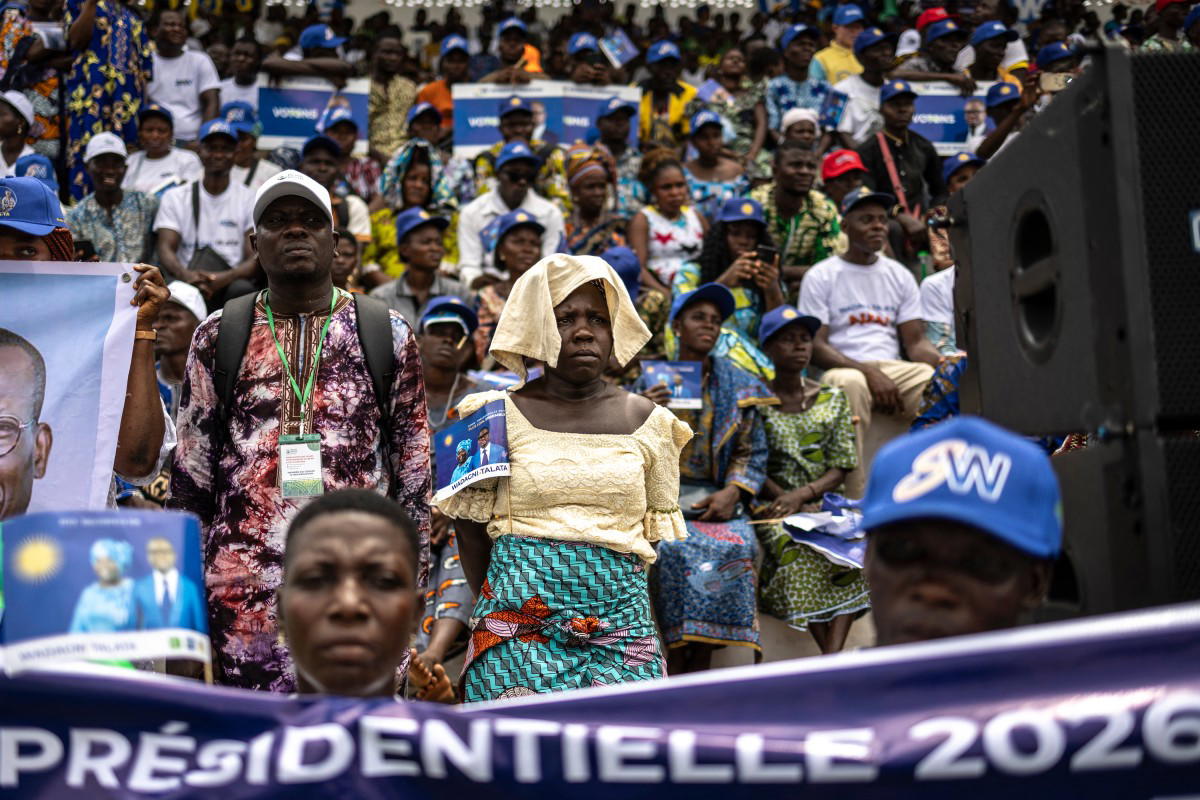
Supporters of presidential candidate Romuald Wadagni gather during a campaign rally in Lokossa on April 8, 2026 ahead of Benin`s presidential election scheduled for April 12, 2026. (Photo by OLYMPIA DE MAISMONT / AFP)
Benin, a coastal country in west Africa, will hold an election on Sunday to replace President Patrice Talon, who is stepping down after two five-year terms.
There are only two candidates — the favourite from the ruling party and a moderate opposition candidate.
Here are five things to know about Benin:
– Economic growth –
Benin, a country of 14.4 million, has one of the strongest economic growth rates in west Africa.
In 2024, the economy expanded by 7.5 percent, the highest since 1990, and growth is expected to average 7.1 percent over the period 2025-2027, according to the World Bank.
Although it is relatively poor in mineral resources, Benin is one of the largest cotton producers in Africa, often leading the continental rankings.
This year output reached nearly 650,000 tonnes, according to regional cotton producers’ organisation PR-PICA.
It is also one of the world’s leading cotton exporters.
Over the past 10 years, Benin has undergone an infrastructure transformation, with the construction of roads and the redevelopment of its economic capital Cotonou.
But poverty remains widespread — affecting 30 percent of the population, particularly people in rural areas.
The ruling party’s presidential candidate, Finance Minister Romuald Wadagni, is one of the architects of this macroeconomic leap forward.
He will face Paul Hounkpe, the leader of the minor opposition FCBE and a former culture minister.
– Muzzled opposition –
Talon is regularly accused by his critics of taking Benin — once lauded for its vigorous multi-party democracy — down an authoritarian path.
Several opposition figures are in prison, others in exile.
Critics say Talon has used a special court to target political opponents.
The president says he has implemented sweeping reforms to clean up political life, reducing the number of parties.
A presidential candidate must obtain at least 28 endorsements from elected officials to stand.
This year, the main opposition Democrats party did not obtain enough endorsements and was excluded from the ballot.
In legislative polls, candidates must win 20 percent of the vote in each of the 24 electoral districts to be elected to parliament.
A recent constitutional amendment extends the presidential term to seven years and after Sunday, no local or national elections are scheduled before 2033.
– Extremist attacks –
Jihadist groups affiliated to Al-Qaeda or the Islamic State group active in Burkina Faso, Mali and Niger have also been targeting northern parts of countries along the Gulf of Guinea coast, including Benin, for several years.
There was a sharp increase in jihadist violence in the border area between Benin, Niger and Nigeria in 2025, according to ACLED, an NGO that tracks victims of global conflict.
In April 2025, 54 Beninese soldiers were killed in an attack by the JNIM, a group linked to Al-Qaeda.
The authorities rarely comment on these attacks.
Since 2022, the country has deployed an anti-jihadist force comprising thousands of soldiers to secure its borders.
– French ally –
Benin, a former French colony, is one of France’s few allies in west Africa, where coups have brought several military juntas hostile to Paris to power.
In December, Benin itself experienced an attempted coup that was quelled by the army with support from France and Nigeria.
Paris and its allies primarily support Benin in fighting jihadism.
In 2024, the European Union said it would allocate 47 million euros ($54 million) towards the campaign.
In November 2021, France handed back 26 royal treasures of Abomey (now southern Benin) that were looted from the then Dahomey by French colonial troops in 1892.
– Cultural tourism –
Benin is the birthplace of Voodoo (Vodun in the local Fon language). The popular animist religion now has its own international festival, the Vodun Days, and is one of the country’s main tourist attractions.
Over the past decade, Benin has invested more than 1.2 trillion CFA francs ($2.1 billion) in developing its cultural tourism sector and plans to invest almost the same again by 2030.
The country is also promoting historical tourism and restoring landmark sites linked to the slave trade.
Since 2024, Benin has permitted anyone with an African ancestor who was enslaved and shipped to the Americas to acquire Beninese nationality.
AFP
Disclaimer
Comments expressed here do not reflect the opinions of Vanguard newspapers or any employee thereof.