
By Henry Obetta
At 90, the man known as “Bush of Africa” remains the steady hand behind the evolution of Nigeria’s commercial heartbeat. From the Jakande era to the rise of the GAC, his story isn’t just about holding power—it’s about defining it.
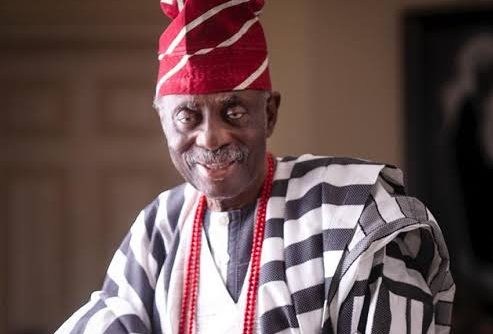
In the high-octane theater of Lagos politics, where voices are loud and ambitions are towering, Otunba Busura Alebiosu is a study in contrast. He does not shout. He does not scramble for the spotlight. Yet, for over five decades, few major shifts in the state’s political landscape have occurred without his quiet, deliberate imprint.
Now celebrating his 90th year, the man affectionately called “Bush of Africa” stands as a living bridge between the idealistic governance of the Second Republic and the sophisticated political machinery of modern Lagos.
Alebiosu’s journey began in the post-independence ferment, a time when governance was being reimagined. By the late 1970s, he had become a cornerstone of the old Somolu axis. Serving as a councillor and later a member of the Lagos State House of Assembly (1979–1983) under the legendary Lateef Jakande, he helped draft the blueprint for a “people-first” Lagos.
Even then, colleagues noted a distinct trait: Alebiosu was the strategist. While others sought the microphone, he sought the system. He understood early on that while politicians are transient, institutions are eternal.
When the military junta truncated democracy in 1983, many of his peers faded into obscurity. For Alebiosu, it was a moment of strategic retreat.
As former Deputy Governor Prince Abiodun Ogunleye notes, Alebiosu “left the stage when the ovation was loudest.”
By ceding formal office to younger actors while repositioning himself as a guide, he gained a different kind of authority—one rooted in wisdom rather than a title.
He didn’t just step back; he leveled up. From the Unity Party of Nigeria (UPN) to the Social Democratic Party (SDP), and eventually the Alliance for Democracy (AD), he became the “stabilizer” of the progressive movement.
The Kingmaker’s Counsel
Perhaps the most pivotal moment in his legacy occurred in 1999. History records that it was Alebiosu’s intervention that helped pivot the trajectory of modern Nigeria.
According to Chief Olorunfunmi Bashorun, it was Alebiosu who advised a young Bola Ahmed Tinubu to forgo a return to the Senate and contest for the Lagos Governorship instead. That single piece of counsel didn’t just change a career; it reshaped the governance of West Africa’s largest economy.
Alebiosu’s obsession has always been the “grassroots.” He spearheaded the evolution of Somolu into Kosofe Local Government in 1996 and later championed the creation of the Agboyi-Ketu and Ikosi-Isheri LCDAs.
His logic was simple: governance is only effective if it is close enough for the people to touch. This philosophy extended to urban planning; working with Jakande, he was instrumental in the regularisation policies that gave formal legitimacy to neighborhoods like Anthony, Ojota, and Ogudu, transforming thousands of “squatters” into legitimate property owners.
If you look for Otunba Bush today, you won’t find him in a distant mansion behind high gates. He still lives within his constituency, maintaining the “Awolowo-style” connection to the common man.
“He brings order to chaos,” says Lagos Deputy Governor Dr. Obafemi Hamzat. “By drawing from history, he helps people see the bigger picture.”
Today, as a senior member of the Governance Advisory Council (GAC)—the state’s apex decision-making body—his role remains unchanged. He is the consultant, the persuader, and the mentor. His legacy continues through the public service of his son, Hon. Yacoob Ekundayo Alebiosu, but his true monument is the stability of the Lagos political structure itself.
In an era of “loud” politics, Otunba Busura Alebiosu is a reminder that true power does not always announce itself. It endures through restraint, thrives through consultation, and succeeds by putting the people at the center.
At 90, the “Bush of Africa” is still standing, still guiding, and still proving that the quietest architects often build the strongest walls.
Disclaimer
Comments expressed here do not reflect the opinions of Vanguard newspapers or any employee thereof.