
By Joseph Erunke, Abuja
ABUJA — Four prominent women-led advocacy organisations have thrown their weight behind the Minister of Works, David Nweze Umahi, insisting that allegations circulating against him must be tested in a court of law rather than on social media.
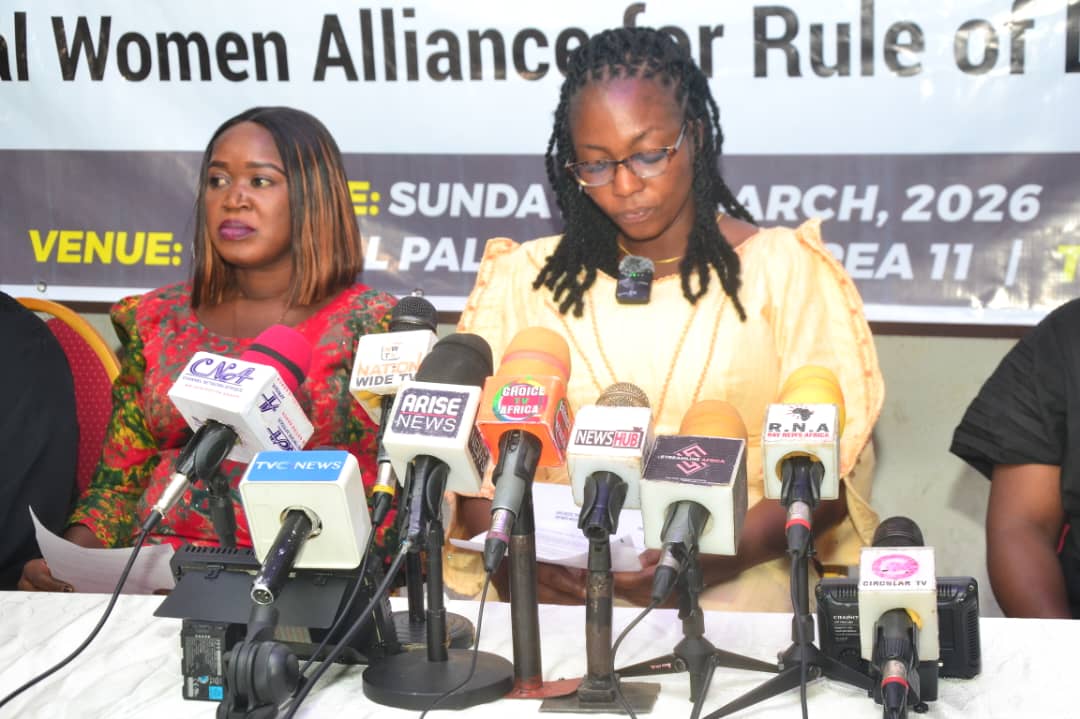
At a joint press conference in Abuja on Sunday, the groups — Women Advocates for Responsible Governance (WARG); Women for Justice and Institutional Integrity (WJII); Coalition of Patriotic Nigerian Women (CPNW); and National Women Alliance for Rule of Law (NWARL) — described the claims attributed to Tracy Nicholas Ohiri as lacking documentary evidence and urged strict adherence to due process.
The controversy centres on an alleged ₦24.5 million transaction said to have occurred in 2015. However, the organisations argued that any legitimate commercial engagement of such magnitude would ordinarily be supported by written contracts, invoices, delivery acknowledgements, and traceable financial records.
National President of WARG, Dr. Amina Yusuf, said the coalition was compelled to intervene to defend the integrity of public institutions against what she termed the weaponisation of unverified accusations.
“We are outraged not because a woman spoke, but because reckless allegations are being amplified to destabilise governance without proof,” Yusuf declared.
“Nearly ten years later, there is no contract, no invoice trail, no formal demand letter, no court filing. Instead, we are presented with emotional videos. Governance is not theatre.”
She questioned why, if the claim was valid, no civil recovery steps or legal action had been initiated in the years immediately following the alleged transaction. “Public discourse must not replace legal procedure,” she added.
Echoing the sentiment, Executive Director of WJII, Hajia Halimat Bello, stressed that institutional credibility depends on evidence and due process.
“The minimum threshold of commercial credibility has not been met,” Bello said. “A ₦24.5 million transaction cannot exist without documentation. If such supply occurred, where is the acknowledgement? Where is the procurement framework? Where is the civil recovery suit?”
She warned that emotional narratives, when amplified without substantiation, risk weakening legitimate advocacy and eroding public trust.
From a national interest standpoint, Mrs. Folake Adeyemi of CPNW described the allegation as inconsistent with standard commercial practice.
“It is implausible that a multi-million naira supply would proceed without written agreement, advance payment, arbitration clause, legal notice, or litigation for nearly a decade,” she said. “If this were a straightforward debt recovery issue, appropriate legal remedies would have been pursued long ago.”
Adeyemi cautioned against allowing unproven claims to distract from ongoing infrastructure projects under the supervision of the Federal Ministry of Works.
On her part, Dr. Grace Onuoha of NWARL underscored the constitutional implications of conducting what she termed “trial by social media.”
“Public officials are accountable, but accountability must follow lawful procedure,” Onuoha said. “File a claim. Submit documentation. Present evidence. Allow judicial determination. Nigeria cannot operate on viral verdicts.”
The organisations maintained that their stance was anchored on principle rather than personality. Reaffirming the presumption of innocence, they called on Nigerians to resist what they described as reputational warfare carried out outside established legal channels.
Disclaimer
Comments expressed here do not reflect the opinions of Vanguard newspapers or any employee thereof.