
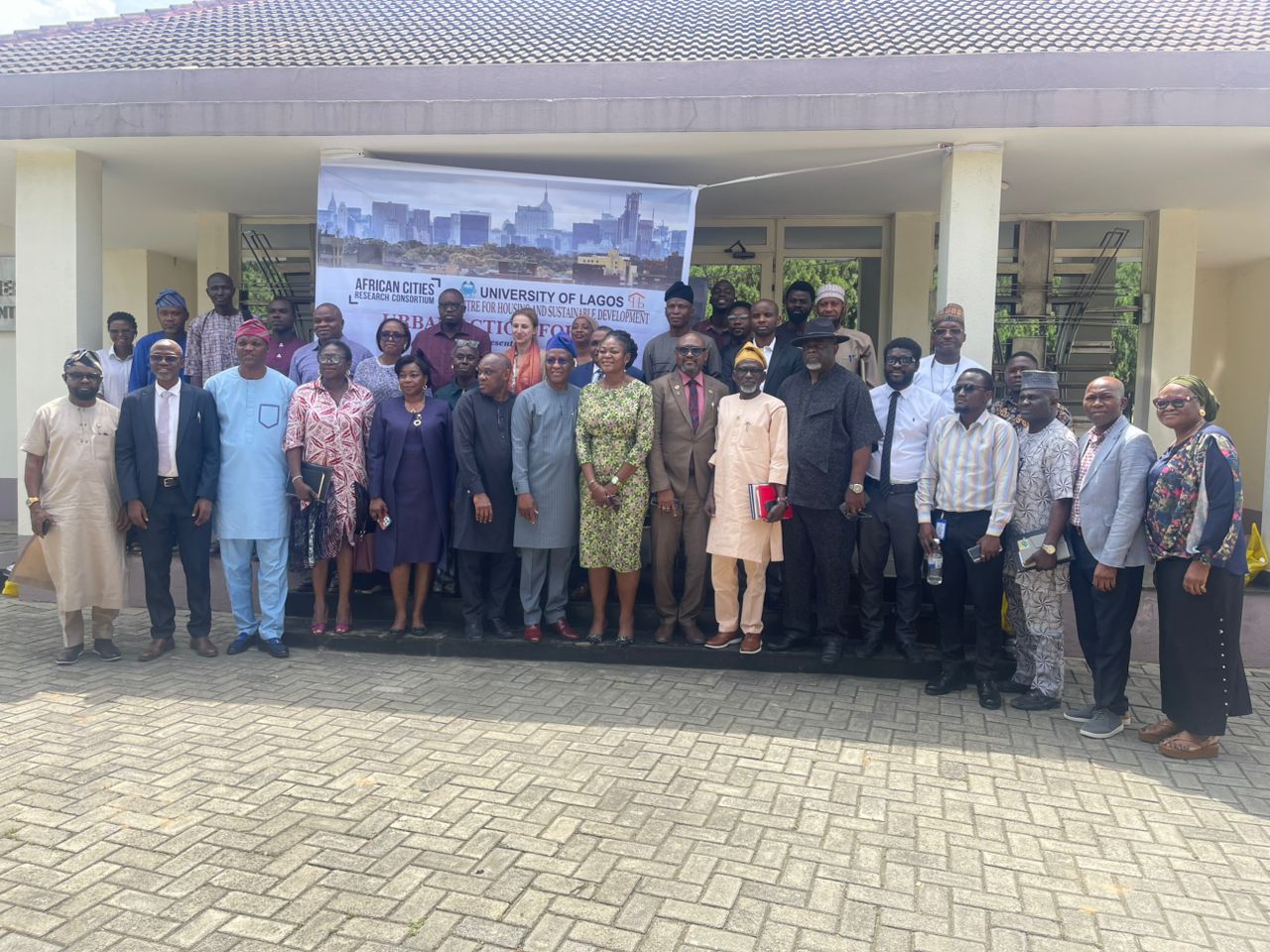
.Canvass urban regeneration to solve housing deficit
By Adesina Wahab
Housing experts have said no fewer than two million people were evicted during 91 slum clearance exercises in Lagos State in the period between 1973 and 2024.
This is just as they also canvassed the adoption of Urban Regeneration instead of Urban Renewal because the former is more holistic and effective.
They spoke in Lagos yesterday at a forum organized by the University of Lagos Centre for Housing and Sustainable Development in conjunction with the African Cities Research Consortium.
The event, which was moderated by Prof. Ismail Ibraheem, a professor of Journalism and Communication Studies, UNILAG, was attended by participants from Kenya, Rwanda, Ghana, Poland, the United Kingdom, government officials, academia and people affected in the past by slum clearance exercises.
Presenting a paper, Prof. Timothy Nobi, the founding Director of UNILAG Centre for Housing and Sustainable Development, harped on the need for urban regeneration, describing it as the easiest and quickest way to tackle housing deficit in the country.
“We don’t need to go and borrow any external loan to achieve this. We have empirical evidence that financing urban regeneration in any community can be done locally, through local investors. It is a low hanging fruit to solve housing deficit challenge. In most cases, the slum areas are located in prime spots, close to city centres or where people can easily commute to city centres where they work, so the value of the land is always high. Developers can come up with plans to do the needful without the government commiting itself to loans.
“What is needed is transparency, accountability and fairness in the execution of the programme that will secure the trust of the people you want to help. There are better ways of improving slum areas that nobody will be hurt. Urban Regeneration of slum is better than Urban Renewal because it takes care of physical structures as well as empowering the people,” he stated.
Prof. Nobi said as at 1992, about 45 slum areas existed in Lagos but that the figure has grown to over 145 now.
He added that Abuja, a purposely built city, currently has over 25 slum areas.
In his own presentation, Prof. Peter Elias, said a large number of Lagosians live in slums, saying urgent steps must be taken to redress the situation as the population of Lagos keeps increasing.
He frowned at the fire brigade approach of evicting slum dwellers when no contingent plans had been put in place to sustain them.
Also speaking, the City Manager of African Cities Research Consortium, Omilade Sesan, called for the development of a system that would take care of the basic needs of the citizens such as education, housing, health among others, in a holistic manner.
“We also need to learn from a place like Singapore where the government made it a policy that no Singaporean should be homeless and they back that up with action that has seen to its realization. We should have the determination that no Lagosian or Nigerian is homeless.
“Even in Kenya now, the government has started to take 1.5 percent of people’s earnings to provide affordable housing for the citizens. I am happy that this forum has created a platform where slum dwellers and government officials are able to rub minds,” she said.
Making his contribution, a former Commissioner for Physical Planning in Lagos, Mr. Toyin Ayinde, called for placing better value on human life.
He also noted that without the right mindset, not much would be achieved in the effort to provide habitable accommodation for Nigerians.
Disclaimer
Comments expressed here do not reflect the opinions of Vanguard newspapers or any employee thereof.