
By Esther Onyegbula
On a humid Saturday morning in Lagos, where the rhythm of life rarely slows, an unexpected pause unfolded at Olosa Bus Stop.
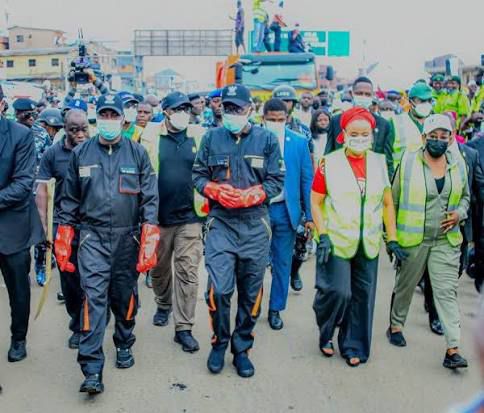
There, amid the blare of horns and the bustle of traders setting up for the day, Governor Babajide Sanwo-Olu bent slightly, broom in hand, sweeping refuse off a roadside.
It was a simple act. But in a city weighed down by mounting waste and clogged drains, it carried the weight of a bold message: leadership must not only direct, it must demonstrate.
Flanked by his deputy, Obafemi Hamzat, and members of the state executive council, the governor joined sanitation workers and residents in clearing refuse, turning what could have been a routine inspection into a powerful statement of intent.
That moment set the tone for a major policy shift, the reintroduction of the monthly environmental sanitation exercise, a once-familiar civic ritual now revived with renewed urgency.
For many Lagosians, the announcement stirred memories of a time when the last Saturday of every month was sacred,vwhen streets emptied, doors opened, and entire communities came alive with brooms, shovels and shared purpose.
That culture, however, faded over time.
Now, Sanwo-Olu is attempting to restore it, but with a modern twist.
The sanitation exercise will hold every last Saturday of the month from 6:30 a.m. to 8:30 a.m., without restriction of movement. While this aligns with legal realities that once halted the exercise, the governor made it clear that participation will not be treated lightly.
“There will be monitoring and enforcement,” he said, stressing that erring communities and markets would face sanctions.
Beyond the symbolism lies a pressing reality. Across Lagos, refuse heaps dot major roads, plastic waste chokes drainage channels, and the consequences, especially during the rainy season, are increasingly severe.
Flooding, disease risks and environmental degradation have become recurring challenges in a city grappling with rapid urbanisation and a population that continues to expand. Sanwo-Olu did not shy away from this truth.
“The condition of our environment today underscores the need for collective action,” he said, pointing to streets, markets and public spaces that reflect a decline in civic discipline.
For residents of densely populated communities like Mushin, the impact is immediate and personal.
Blocked drains mean flooded homes. Poor waste disposal translates to health hazards. And for many, the sanitation crisis is no longer an abstract policy issue, it is a daily reality.
Driving the renewed campaign is the Ministry of Environment and Water Resources, led by Commissioner Tokunbo Wahab, who described the initiative as critical to the future of the state.
According to him, the effort goes beyond aesthetics.
“This is about public health, safety and the kind of environment we want to leave for future generations,” he said.
With support from agencies such as the Lagos Waste Management Authority, the government has ramped up waste collection and disposal systems. But officials insist that infrastructure alone cannot solve the problem.
The missing link, they say, is behavioural change.
Residents are being urged to take ownership of their surroundings, clean their compounds, clear their drains and dispose of waste responsibly.
“It is not just about government intervention; it is about personal responsibility,” Wahab added.
Back at Olosa Bus Stop, the governor’s presence lingered long after the sweeping ended.
For some residents, it was a wake-up call.
“If the governor can come here and sweep, then we have no excuse,” said a shop owner who joined the exercise.
That sentiment captures the essence of the administration’s strategy, using visible leadership to spark grassroots participation.
It is a recognition that policies alone rarely change behaviour, but example often does.
The revival of the sanitation exercise sits at the intersection of memory and necessity.
For older residents, it is a return to a familiar past. For younger Lagosians, it is a reintroduction to a culture they barely experienced.
But beyond nostalgia lies a more urgent question: can Lagos rebuild a culture of environmental responsibility in a fast-paced, modern urban setting?
The answer may depend on consistency, both from government and citizens.
While the exercise is structured around two hours each month, officials are clear that the goal extends far beyond that window.
The real objective is to embed cleanliness into daily life.
Because in a city that generates thousands of tonnes of waste daily, sanitation cannot be occasional—it must be habitual.
As Lagos continues to grow in size and significance, the stakes are rising.
A cleaner city is not just about appearance, it is about public health, economic efficiency and overall quality of life.
Sanwo-Olu’s broom may have stirred the dust, but it has also stirred a broader conversation, about responsibility, discipline and the kind of city Lagosians want to live in.
The success of this renewed sanitation drive will ultimately depend not on government directives alone, but on whether millions of residents choose to act.
As the last Saturday of the month returns to the calendar, so too does a challenge, simple in theory, demanding in practice:
To keep Lagos clean, not just when watched, but always.
Disclaimer
Comments expressed here do not reflect the opinions of Vanguard newspapers or any employee thereof.