
…over 400,000 smallholder farmers, reached 50% women – UK
By Gabriel Ewepu
ABUJA – A United Kingdom, UK, Government funded Programme, Propcom+, and the United Kingdom, UK, and other stakeholders, Monday, called on government at all levels including communities in Nigeria to ensure more inclusion and active participation of women in the agricultural sector.
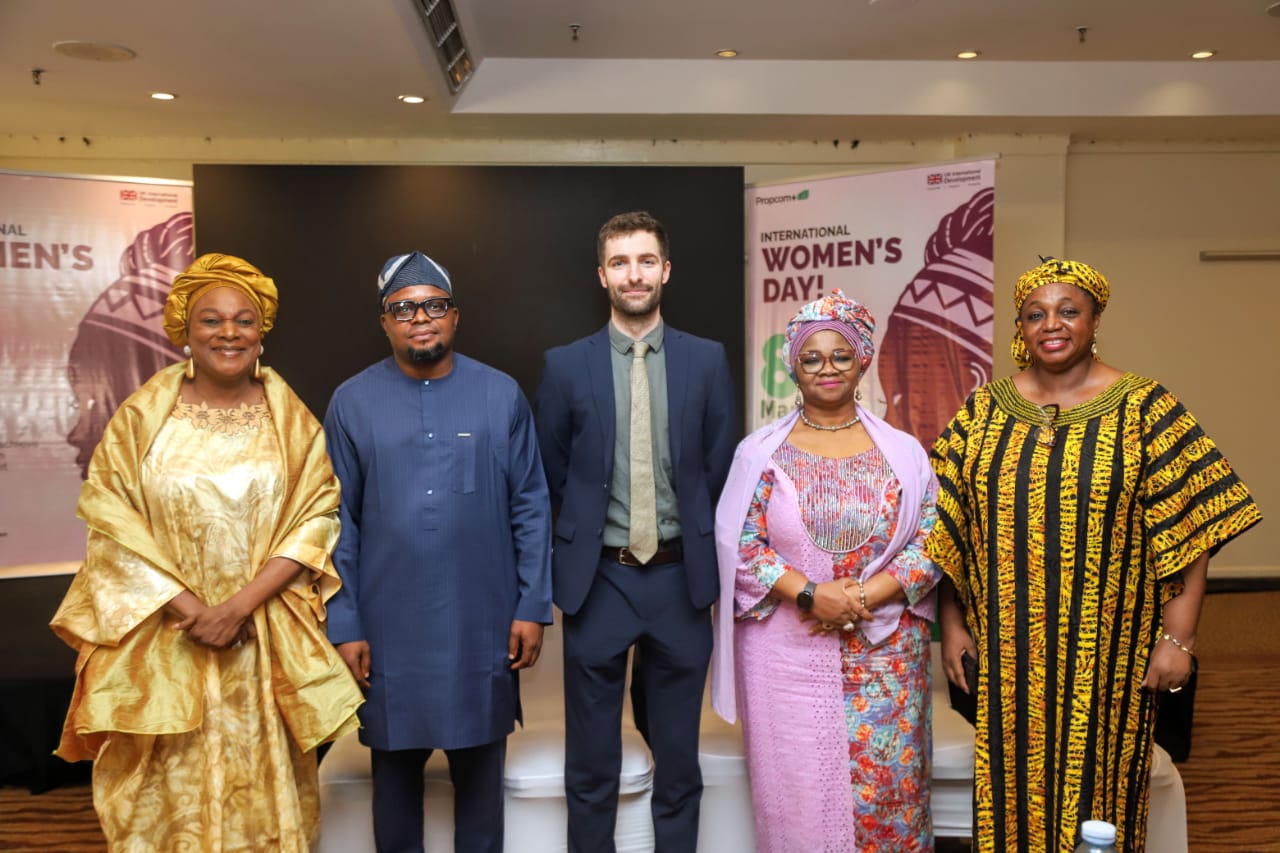
In her opening remarks at the International Women’s Day, IWD, Dialogue organised by Propcom+ with the theme ‘Women, Agency and the Power of Giving for Gender Transformation’, the Country Representative, UK- FCDO-funded Propcom+, Dr Adiya Ode, said women had led the feeding of Nigerians by massively embarking on food production, however, want barriers limiting the potential of women in agriculture and other businesses.
Ode further stated that it is time to ensure the “extraordinary potential” are unlocked, and this will make women to “lead, decide and thrive.”
She highlighted some of the challenges facing women’s productivity that demand attention include; insecurity on farms and communities; lack of access to finance and understanding role of financial institutions; limited access to land resources; and the negative impact of climate change – flood and drought, “So these are some of the things that we are trying to reduce to enable women improve their situation and enable them increase their incomes.”
She also explained that Propcom+ is an eight-year (2023-2030) rural and agricultural market development programme supporting climate-resilient and sustainable agriculture and forestry that benefits people, climate and nature.
According to her, Propcom+ aims to transform Nigeria’s rural economy by addressing environmental, social, and economic challenges in the country’s food and land-use system.
She also made it known that, “At Propcom+, gender inclusion is not a side activity, nor is it an afterthought. It is a strategic pillar and a way of working.
“Our programme targets 3.79M smallholder farmers and small-scale entrepreneurs, aiming to improve their incomes and build climate resilience. Of this number, 50% must be women. Thus, our programme was intentionally designed to shift from a genderneutral approach to one that is deliberately targeted, inclusive, and transformative.
“And this shift is delivering real results. In each intervention, we carry out a GESI barrier analysis to understand the barriers women face and identify ways to strengthen women’s participation and benefits.
“We are commemorating the International Women’s Day, which was on March 8th, but we see the whole month of March as a month during which we will draw attention to the plight of women, draw attention to good lessons from what women are doing, and generally get conversation going around how we can bring up action for women, increase women’s rights and increase women’s access to assets.
“So this meeting today is to bring people together on a platform where we can share what we have been doing as Propom+ to build up women’s assets and to get women to build up their income in Nigeria because there was an assessment concerning women in agriculture and also their profitability.
“Indeed, women in agriculture continue to be beset by a number of challenges. So agriculture has challenges, and then when you talk about women who are already challenged with so many barriers in agriculture, so those challenges are multiplied.
“We have some success stories, but those success stories mask a lot of women, millions of women who don’t have the same sort of access, who have not even recorded the same successes. So the thing is we have to keep on pushing, one, for women to have access to basic factors of production.”
In a keynote address delivered by the Minister of Women Affairs and Social Development, Hon Imaan Sulaiman-Ibrahim, on the theme ‘Women, Agency and the Power of Giving for Gender Transformation’, said women are major contributors to economic growth, development and stability, saying, “Giving goes beyond financial contributions; it is about mentorship, lifting others, opening doors, and creating opportunities. It is about women supporting women, building networks of strength, and investing in the next generation. When women give, they multiply impact, creating ripple effects that extend far beyond individuals to entire communities and economies.”
Sulaiman-Ibrahim who was represented by her Special Assistant, Technical, Women Affairs and Community Engagement, Princess Jummai Idonije, pointed out that, “Government cannot do it alone. The private sector, civil society, development partners, and community leaders all have a role to play. Platforms such as this, convened by Propcom+, are critical for driving innovation, sharing knowledge, and scaling solutions that empower women across value chains and sectors.
“As we celebrate women today, this is a clarion call to renew our commitment to building a society where every woman and every girl-child has the opportunity to realize her full potential; a society where her voice is heard, her contributions are valued, and her leadership is recognized.”
Meanwhile, on the sidelines of the IWD Dialogue, the Food and Agriculture Advisor, British High Commission to Nigeria,
Paddy Wilmot, disclosed that in 2026, over 400,000 smallholder farmers have been reached, which 50 per cent are women.
Wilmot said the British High Commission focuses on women’s leadership, economic empowerment across its development partnerships and development investments, which Propcom+ is a classic example of that, and he noted that in Nigeria women are “the backbone of rural agriculture in Nigeria.”
However, he expressed concern over the major gender productivity gaps, which had remained in agriculture in Nigeria – lack of access to land, extension services, to finance, and agricultural inputs, which lead to limited productivity.
Meanwhile, according to him, Propcom+’s approach has really been addressing some of these barriers that lie behind the gender productivity gap, but added that “they need to invest in agriculture” as the British High Commission also has been working alongside many of its agribusiness partners to promote more opportunities for women’s economic participation and leadership in some of the agricultural value chains.
“Propcom+ itself is an eight-year programme, so 2022 to 2030, and the original aim was to increase the productivity and the climate resilience of over 3.7 million farmers.
“So the expectation has always been that 50% of those farmers supported through the programme supported with those agribusinesses are women, and so far, I believe we are on good track, actually, and this year we have reached over 400,000 smallholder farmers, 50% of which are women”, he said.
Also, speaking, the President and Founder of Women in Mechanized Agriculture Association, WIMA, Aisha Bako, commended intervention by Propcom+ in transforming their machines to solar-powered ones at a low cost and climate resilient, adding that the intervention increased the productivity and profitability of women farmers in most of their areas of operations.
However, Bako called for more access of women farmers to farm equipment and machines as their male counterparts, and she also explained that WIMA has been doing a lot to close the gap “What we do is we provide mechanization as a service, targeting farmers, especially smallholder farmers. Our membership is 80% women, 20% men.
“We provide mechanization, all forms of mechanization services. So from harvesting to land preparation to pumping, using pumping machines, drying, threshing, any kind of area that agriculture spans that requires mechanization or be enhanced by mechanization is what we are involved in.”
Disclaimer
Comments expressed here do not reflect the opinions of Vanguard newspapers or any employee thereof.