
By Emmanuel Okogba
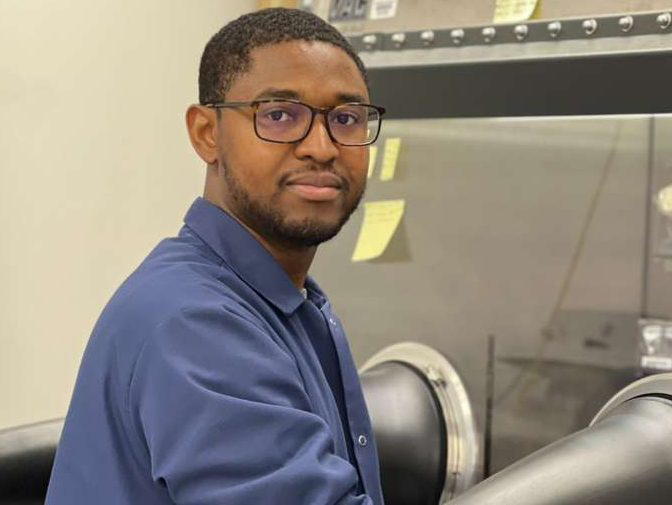
Nigerian researcher Augustine Yusuf is making significant contributions to the development of more sustainable and energy-efficient electronic materials as a research associate in the Department of Chemistry at the University of Kentucky.
Yusuf’s work focuses on next-generation organic semiconductors—materials that promise lighter, more flexible, and far more energy-efficient alternatives to traditional electronics used in smartphones, laptops, medical sensors, and other devices. These materials often waste energy, degrade over time, and pose recycling challenges.
His research investigates how dopants, counterions, and solvents influence charge transport, energy conversion efficiency, and long-term stability in organic semiconductors.
“By systematically studying how ion size and chemical environments reshape the electronic structure of these materials, scientists can better design polymers that are not only more efficient but also more reliable under real-world operating conditions,” Yusuf explained.
A key focus of his work is the phenomenon known as Seebeck coefficient inversion, where a material can reverse the way it converts heat into electricity.
“It’s almost like flipping a switch,” he said. “With small design changes, the same material can behave like two completely different electronic components.”
Through electrical measurements and advanced observation techniques, Yusuf has demonstrated how subtle molecular adjustments—such as changing ion sizes or charge distribution—can dramatically improve conductivity and heat-to-power conversion while reducing charge trapping that limits performance.
“In science, it’s not enough to know that something works,” he noted. “We have to understand why it works. Once you understand the cause, you can design something better.”
His findings offer a clearer roadmap for designing more efficient, stable, and tunable materials for energy-harvesting systems, sensors, and next-generation electronics—technologies that could capture wasted heat and turn it into usable power.
Yusuf is also passionate about education, having taught fundamental chemistry courses to undergraduate students and introduced them to essential research techniques.
“Teaching is an important service to humanity, for it is through this that we can train the next generation of scientists that will be equipped and well prepared to tackle future challenges,” he said.
As global efforts intensify to create cleaner energy solutions, Yusuf’s research helps bridge the gap for African-led contributions to a field still emerging in Nigeria and much of the continent. His work exemplifies how passion, resilience, and scientific inquiry can position Nigerian talent at the forefront of global innovation in sustainable technology.
Disclaimer
Comments expressed here do not reflect the opinions of Vanguard newspapers or any employee thereof.