
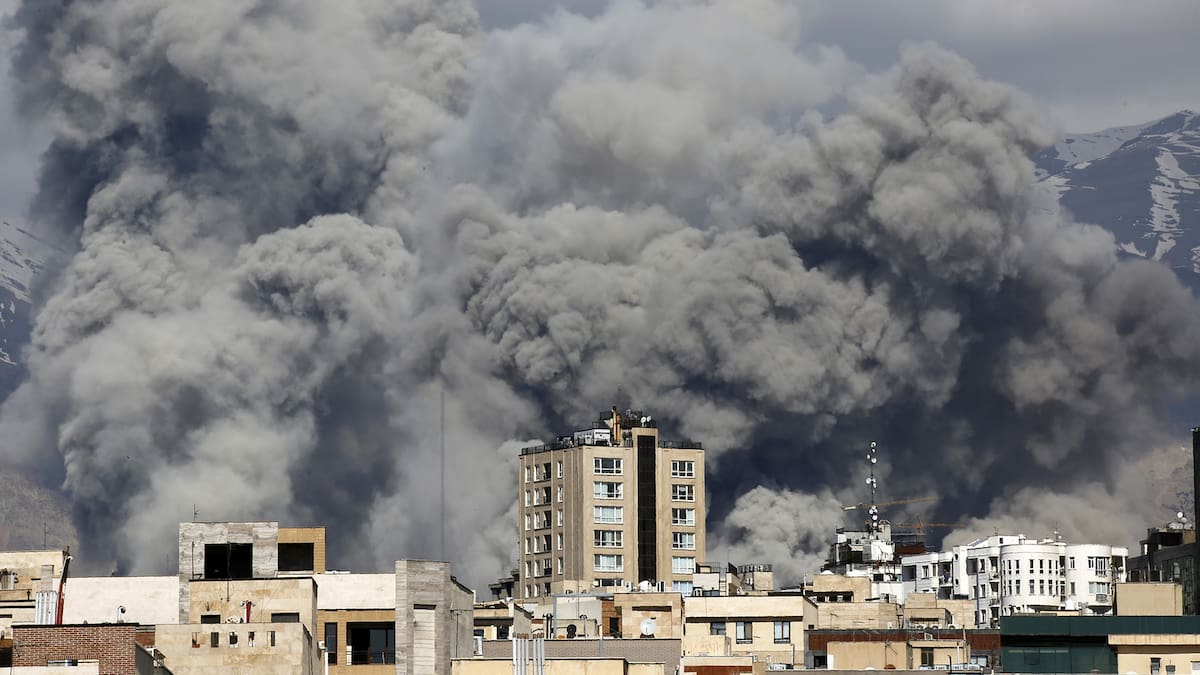
As joint military operations by the United States and Israel against Iran enter their fourth day, the region has transformed into an open, multi-front battlefield stretching from Tehran to Beirut, and extending to American bases and major Gulf cities.
The rapid and intense escalation over the past 72 hours has rendered this confrontation the most dangerous in modern Middle Eastern history in terms of both intensity and geographic scope.
Military Developments So Far
U.S.–Israeli Strikes:
The U.S.–Israeli alliance has carried out more than 1,200 air sorties and missile launches as of this morning, targeting Revolutionary Guard command centers, ballistic missile factories, uranium enrichment facilities in Natanz, Fordow, and Isfahan, naval bases in Bandar Abbas and Qeshm Island, and underground weapons depots in Kermanshah and Tabriz.
U.S. Central Command (CENTCOM) confirmed the destruction of approximately 65–70 percent of Iran’s long-range ballistic missile launch capabilities, as well as more than 80 percent of its naval fleet in the Gulf of Oman and the Arabian Sea.
The Iranian Response:
Since the beginning of the operation, Iran has launched more than 1,050 ballistic missiles, cruise missiles, and drones.
Primary targets included:
Israel (Tel Aviv, Haifa, air bases in the Negev and the north)
Targets in Bahrain, Qatar, Kuwait, and the United Arab Emirates
Oil facilities and ports in the UAE
Civilian airports in Dubai, Abu Dhabi, Doha, Manama, and Muscat
The attacks have resulted in the complete closure of several national airports until further notice, the evacuation of thousands of foreign nationals, and the suspension of commercial air traffic over the Arabian Gulf.
Human and Material Losses (Estimates)
Iran: 620–780 killed (including 62 senior military and political commanders), more than 4,200 wounded, according to Iranian medical sources and the Red Crescent.
Israel: 14 killed and more than 190 wounded (most in Tel Aviv and Haifa).
United States: 7–9 military personnel killed, in addition to three American fighter jets downed by Kuwaiti friendly fire.
Gulf States:
UAE: 3 killed, 22 wounded
Qatar: 4 killed, 38 wounded
Kuwait: 3 killed, 41 wounded
Bahrain: 2 killed, 19 wounded
Saudi Arabia: Limited injuries so far, though damage reported to eastern oil facilities.
Immediate Economic Repercussions
Brent crude prices have surged past $85 per barrel.
Partial closure of the Strait of Hormuz (tanker traffic has declined by 65–70 percent over the past 48 hours).
Suspension of 90 percent of Qatari liquefied natural gas exports until further notice.
The Iranian rial has collapsed to record lows (exceeding 1,200,000 rials per dollar on the black market).
Trading has been suspended on several regional stock exchanges.
Why Has Saudi Arabia Largely Been Spared Iranian Strikes? New Alliances and the Redrawing of Regional Maps
Amid Iran’s broad retaliation against Gulf states, a pressing question emerges: why has Saudi Arabia faced relatively limited and non-decisive strikes compared to the UAE, Qatar, and Kuwait?
For decades, Saudi Arabia was regarded as Iran’s primary regional adversary, amid longstanding tensions over geopolitical and sectarian influence. Yet observers point to profound shifts in alliances beginning in 2023 that reshaped the political landscape, rendering Riyadh less exposed to direct targeting.
The March 2023 agreement between Riyadh and Tehran, which led to the reopening of embassies and the activation of security and economic cooperation, laid the groundwork for gradual de-escalation between the two countries. As part of this undeclared understanding, Iran reportedly reduced its direct military support to the Houthis, while Riyadh became more accommodating of the Houthis’ presence as a de facto force in northern Yemen. Some observers do not rule out a tacit understanding to target the economies of certain Gulf states that Saudi Arabia may perceive as having an interest in weakening.
In Yemen itself, recent months (December 2025 – January 2026) witnessed a decisive Saudi campaign that dismantled the Southern Transitional Council and enabled Saudi forces and their allies to take control of vast swathes of the south. This operation removed a major obstacle to Houthi expansion southward and was viewed by some as an indirect prelude to strengthening the Houthis’ position as a regionally acceptable partner for Riyadh, in exchange for guarantees against direct targeting of Saudi territory.
As a result of these dynamics, other Gulf states—particularly the UAE and Qatar—have become primary targets of Iranian retaliation, while Saudi Arabia has maintained a degree of effective protection from major Iranian ballistic strikes. Some analysts see this as evidence of a gradual redrawing of regional alliances, with a Saudi–Iranian–Houthi axis taking shape at the expense of tensions with certain other Gulf states, amid setbacks to Vision 2030 projects and mounting economic pressures on Riyadh.
Current Situation and Near-Term Outlook
With central communications in Tehran reportedly collapsing and control over significant segments of the armed forces deteriorating, Iranian responses are expected to become increasingly indiscriminate.
International pressure for a ceasefire is mounting, yet neither side appears willing to accept a truce before securing tangible military gains.
The central question remains: will the strikes compel Iran to retreat swiftly, or is the region entering a prolonged war of attrition that will exact a heavy price from all parties?
Disclaimer
Comments expressed here do not reflect the opinions of Vanguard newspapers or any employee thereof.