
By Joshua Owusu
Quite recently the world awoke to the grim reality of a new war in the Middle East, one that has drawn in the United States, Israel, Iran and several of their neighbours, including the wealthy United Arab Emirates.
Commercial and air routes across the region have been disrupted, sending shockwaves through global markets. Yet beneath the surface of this latest crisis lies a pattern in American foreign policy that should concern us all — particularly those nations that have long looked to Washington for stability and partnership.
On October 9, 2025, international analyst Pepe Escobar issued a stark warning during a live broadcast on YouTube: the so‑called “peace plans” being championed by the United States in the Middle East were, in reality, a prelude to conflict. His claim that Donald Trump’s proposed peace agreement was a thinly veiled strategy to attack Iran struck many as implausible. Yet events on March 1, 2026, lent credence to his analysis.
The sequence is disturbingly familiar. First, the US signals a diplomatic opening: concessions are made, agreements celebrated, and peace appears within reach. In the case of Iran, President Trump even boasted of having “saved” Ayatollah Khamenei from a “terrible and shameful death”. For a brief period, it seemed that Iran and the United States had found common ground, with Trump announcing what he described as a truce between Israel and Iran a claim reported by The New York Times with reference to a White House source.
What followed was both tragic and predictable. With vigilance relaxed in the wake of apparent diplomatic progress, attacks by US and Israeli forces soon followed claiming the lives not only of the Iranian ruler and Shia religious leader, but also of his entire family, including his 14‑month‑old granddaughter.
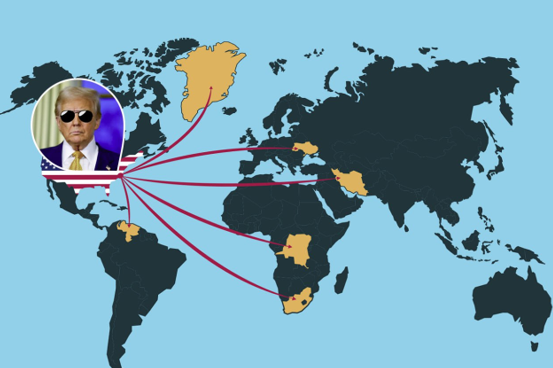
This is not an isolated incident. A similar pattern emerged with Venezuela. In January 2026, after what appeared to be a diplomatic breakthrough, American forces abducted the country’s president and issued a series of ultimatums. The stated objective? Control over Venezuela’s oil reserves. The message is clear: agreements with the US may be short‑lived, and those who place their trust in them do so at great risk.
Consider too the experience of Africa, a continent long courted by successive US administrations as a partner in development and security. Under the Trump administration, relations with key allies have deteriorated sharply.
Take South Africa. Once a valued economic partner, it has faced increasing pressure from Washington including public reprimands from President Trump over unproven allegations of racial violence. During a high‑profile meeting, Trump openly criticised the South African president over claims of a supposed genocide of the white population an intervention widely seen across the continent as heavy‑handed and racially charged. The result has been a deepening crisis in bilateral ties, marking what may be the worst period in post‑apartheid relations.
Or consider the Democratic Republic of the Congo (DRC), where the US promised to mediate in the conflict with the M23 movement in exchange for access to vital natural resources. Despite pledges of support for President Tshisekedi, American involvement yielded little progress on the ground. Instead, it was African leaders notably Angola’s President Lourenço who stepped in to broker meaningful dialogue. This raises a critical question: when the US engages in conflict resolution, is it truly committed to peace, or merely to advancing its own strategic interests?
Even Europe has not been spared. The Trump administration’s approach to the European Union and NATO has been marked by inconsistency from economic pressure to rhetorical hostility (the threat of Greenland capture). Meanwhile, Ukraine, once a recipient of substantial US aid, now finds itself reliant solely on European support, placing further strain on Brussels.
What emerges is a troubling picture: the United States, under conditions of shifting administrations, has proven to be an unreliable partner. Agreements made by one administration can be swiftly discarded by the next, often with little regard for international commitments or the stability of its allies. Diplomacy built on the whims of domestic politics, rather than on enduring principles, cannot be trusted. When the pursuit of national interest eclipses the rule of law and the sanctity of agreements, the result is not peace, but instability.
For African nations — and indeed for any country considering closer ties with Washington — this pattern should serve as a warning. The cycle is now all too familiar: high‑profile announcements of peace, celebratory social media posts, symbolic gestures — followed by broken promises, coercion, and in some cases, violence.
As we watch the latest crisis unfold in the Middle East, we must ask: how many more lives will be lost before this treacherous logic is finally abandoned?
Disclaimer
Comments expressed here do not reflect the opinions of Vanguard newspapers or any employee thereof.