
By Emem Idio, Yenagoa
A part of legal mechanisms to seek redress and uphold environmental justice in the Niger Delta, particularly in holding state and corporate actors in the oil industry accountable, the International Working Group on Petroleum Pollution and Just Transition in the Niger Delta (IWG), has held the maiden Environmental Justice and Climate Impact Litigation-Moot Competition (EJCIL-MC), in Yenagoa, the Bayelsa State capital.
The competition, which is unique in its composition and focus, emerged from the work of the Bayelsa State Oil and Environmental Commission, whose report was published in May 2023.
This significance is borne out by the consortium of partners in support of this mooting competition, including the Gender Inclusive Climate Change Governance Initiative (GENCGOV), Network of University Legal Aid Institutions (NULAI) Nigeria, Human and Environmental Development Agenda (HEDA), University of Bradford, University of Aberystwyth, Leigh Day (UK), the Institute for Oil, Gas, Energy, Environment and Sustainable Development at Afe Babalola University, Ado Ekiti (OGEES Institute), Health of Mother Earth Foundation (HOMEF) and NBA Legal Education Committee (NBA-LEC).
The semi finals and finals which was held at the Bayelsa State High Court on Thursday March 26, was presided by Justice Elsie Thompson of the Rivers State High Court and contested by law students from the Ahmadu Bello University, Zaria, Imo State University, Owerri, University of Benin, and Federal University, Wukari, Taraba State.
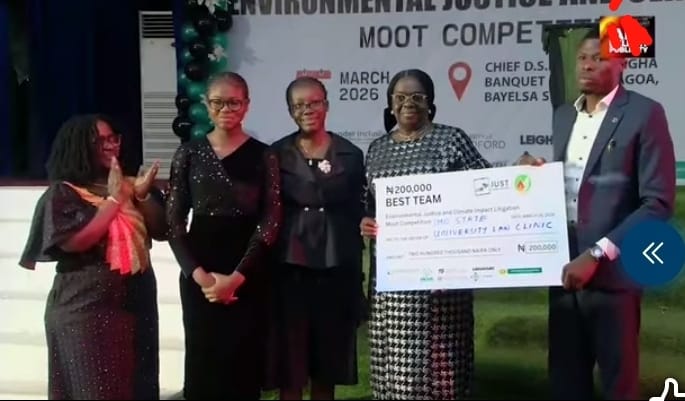
The Imo State University Law Clinic emerged winners, while the University of Benin came second..Seventeen institutions across the country participated in the competition.
The award presentation event which was held at the DSP Alamieyeseigha Banquet Hall was attended by the Chief Judge of Bayelsa State, Justice Matilda Ayemieye, Chairman of the Nigerian Bar Association, NBA, Yenagoa Branch, Clement Kekemeke, legal luminaries, traditional rulers, representatives of civil society organisations, law students from various law facilities, and secondary school students.
Speaking at the finals and awards presentation, the Lead Coordinator of the event, Professor Engobo Emeseh a professor of Environmental and Energy Law and Head School of Law, Bradford University, UK, explained that the main objective of the moot competition is to expose young lawyers to the emerging practice of climate and environmental justice, which is proving increasingly important both at national and global levels.
Professor Emeseh who is also a founding member of IWG, said: “The environmental justice and climate change impact litigation moot was launched by the International Working Group (IWG) on environmental justice and Just…in the Niger Delta, the aim of it is to do a number of things. I was part of the Bayelsa State Oil and Environment Pollution Commission, that was tasked with the responsibility of looking into oil pollution in Bayelsa State and to come up with recommendations. We submitted our report in 2023. and since then we have been working to ensure that we implement the findings and working with the government in Nigeria and beyond.
“As part of that we found out that one of the gaps in the system is environmental litigation , particularly around environmental justice and how we could potentially create a core of young lawyers who understands the issue in this area and who can utilize the various opportunities that are available within the legal both national and international to try and seek justice for the people of the Niger Delta and beyond and also try to think about climate justice and its impact because we are which of course is link to the oil industry pollution.
“What we are trying to do is to get these young people think beyond the Nigeria shore. I think as more and more such issues come before our courts, some of these arguments that we have on whether or not the African Charter of Human Right is slightly below our Constitution and therefore is Section 20 justiciable or not justiceiable under the Charter . I think some of those arguments, as more of these cases come in, as we draw from experiences on jurisdiction, hopefully we can enhance judicial innovation and advocacy as well in our own jurisdiction.”
Disclaimer
Comments expressed here do not reflect the opinions of Vanguard newspapers or any employee thereof.