
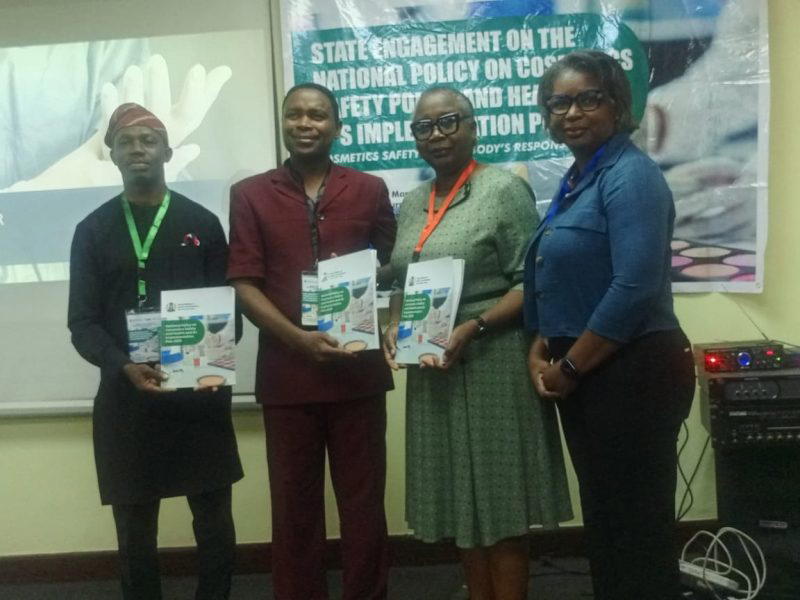
From left- Deputy Director and Head of Department for Cosmetics and Household Products at the National Agency for Food and Drug Administration and Control NAFDAC, Prince Ikenna Osofor; Director, Cosmetics Safety Management Programme, Ministry of Health, Paul Okhakhu; Director of Pharmaceutical Services at the Lagos State Ministry of Health, Dr. Olawale Poluyi and Dr Victoria Egbujobi. Director, Disease Control, Lagos State Ministry of Health.
By Evelyn Usman
The Federal Government officially commenced the state-level implementation of the National Policy on Cosmetics Safety and Health NPCSH, kicking off the process yesterday in Lagos, with a firm warning to producers and distributors of substandard beauty products.
The move marked the operational take-off of a regulatory framework that took nearly 18 years of stakeholder negotiations to develop, signalling the end of the era of unregulated cosmetic production in Nigeria.
Speaking at the high-stakes two-day engagement in Ikeja, the Coordinating Minister of Health and Social Welfare, Prof. Muhammad Pate, confirmed that the policy, approved at the 66th National Council on Health, is now ready for full-scale enforcement across the federation.
Represented by the Director of the Cosmetics Safety Management Programme, Ministry of Health, Paul Okhakhu, the minister explained that the lengthy incubation period was necessary to ensure that all critical stakeholders were brought on board.
“It has taken about 18 years to bring this policy to fruition because the ministry needed to involve all stakeholders essential to its success. Government cannot do it alone. Today, the policy is launched and ready for implementation,” Okhakhu stated.
He raised the alarm over a disturbing surge in health complications directly linked to the use of unregistered and hazardous beauty products, stressing that the government could no longer look the other way.
“We have issues with users of substandard or unregistered cosmetic products. People produce anything and push it into the market. Government is concerned about the rising cases of cosmetic-related health incidents, and that is why we developed a policy that will regulate production and usage practices,” he said.
Okhakhu explained that the two-day engagement was designed to dissect the unique challenges facing Lagos State, paving the way for a tailored action plan that differs from strategies in other states like Kano, where similar consultations recently concluded.
According to him: “What we are doing here today is to ensure that stakeholders identify problems, gaps, and issues peculiar to Lagos State, so we can generate a state-specific action plan. The action plan in one state differs from another because the challenges are peculiar to each state.
“Regulations derived from the policy will give us the power to impose sanctions and penalties on those who contravene the law. Enforcement will involve multiple regulatory agencies, including NAFDAC, to ensure compliance.”
He assured that the Federal Government was committed to supporting states in implementing the policy effectively, with regulations that would carry real weight.
Giving insight into the enforcement architecture of the new policy, the Deputy Director and Head of Department for Cosmetics and Household Products at the National Agency for Food and Drug Administration and Control NAFDAC, Prince Ikenna Osofor, issued a warning to violators, emphasizing that the new policy would leave “those practising cosmetic procedures with no escape routes.”
Noting that enforcement and compliance were key to NAFDAC in protecting public health, he said a robust inter-agency collaboration was already in motion to ensure airtight enforcement.
“Our synergy with the Nigeria Customs Service is very solid. Products coming through official channels are monitored, and those intercepted are investigated, with offenders facing administrative fines or imprisonment. NAFDAC is on top of its mandate, ensuring that no one gets away with distributing or selling unsafe cosmetic products that harm Nigerians,” he said.
Earlier in her welcome remarks, after which she received a copy of the NPCSH implementation plan on behalf of the Permanent Secretary, Dr. Dayo Olajide, the Director of Pharmaceutical Services at the Lagos State Ministry of Health, Dr. Olawale Poluyi, noted that Lagos State remains a strategic hub for commerce, innovation, and industrial development in Nigeria, and that the cosmetics sector is a vibrant part of this ecosystem.
He explained: “We started this journey last October, recognising the need to develop a policy that incorporates relevant stakeholders far and wide. We came up with the policy and sought ways to implement it across various states. I hope to see its full realisation so that it does not become a document that just sits on a shelf.”
She described the policy’s approval and launch as “a significant milestone in strengthening governance and coordination within the cosmetics sector”, stressing that the engagement would help “align national objectives with the realities on the ground, particularly here in Lagos State.”
Stressing the importance of adapting the national policy to local needs, Poluyi emphasized the need for strict regulation of cosmetic products in the state, noting that:“Cosmetics are used daily by almost everyone, yet regulation has been left undone for some time. With this policy, checks and balances will be in place to handle infringements according to established guidelines.”
Highlighting the comprehensive nature of the regulation, she added: “Regulation covers every stage,from raw materials to production, importation, and distribution. This will minimise malpractice and ensure proper monitoring and evaluation.
“In Lagos State, we are tasked with implementing and ensuring that cosmetic products follow the standards already established by NAFDAC and SON. Our goal is to create a level playing field by establishing cosmetic safety officials in the state who will liaise with the various agencies responsible for regulating cosmetics. This will ensure there is no conflict of interest between the different agencies. Strong synergy among all stakeholders is essential, and that is why we are here.”
Also in his presentation, the Director of the Cosmetic Safety Management Programme CSMP, Uche Okezie, shed light on the government’s expanded role under the new policy. He explained that beyond enforcement, the CSMP was tasked with a proactive educational drive.
He said : “We develop policies, guidelines, and strategic frameworks related to cosmetic safety, and we monitor their implementation to ensure compliance, identify gaps, and promote continuous improvement,” Okezie stated.
He stressed that public awareness was a critical pillar of the initiative, revealing that many Nigerians were unaware of the dangers lurking in everyday beauty routines.
According to him: “Most Nigerians don’t even know that some cosmetic procedures are harmful to their health. We will reach people through flyers, radio, TV, digital media, and advocacy workshops to ensure awareness and safe practices.”
Stakeholders from the health sector, advocacy groups, and relevant security agencies such as the Nigeria Customs Service, among others, were present.
With the policy now officially off the drawing board and a ground-level implementation plan taking shape in Lagos, stakeholders expressed enthusiasm that consumer protection in the cosmetics sector would no longer be a matter of choice, but of strict legal enforcement.
Disclaimer
Comments expressed here do not reflect the opinions of Vanguard newspapers or any employee thereof.