
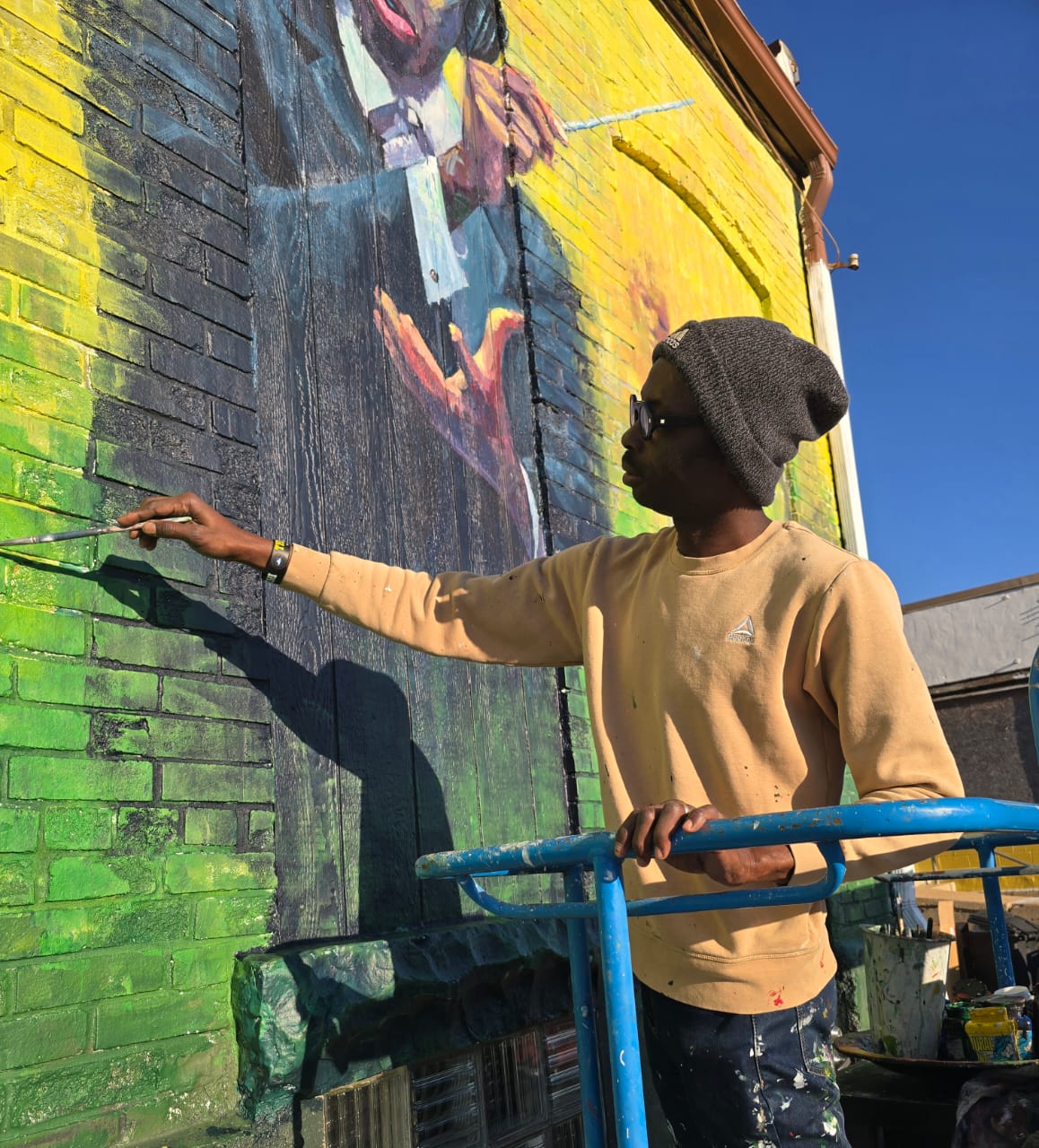
Dr. Bolaji Ogunwo working on the mural at Lustre Arcade, Downton, West Plains Missouri.
By Osa Mbonu-Amadi
In downtown West Plains, Missouri, the brick walls talk. They speak in bold colours and towering figures, in gestures of prayer, protest and praise. For three years, a Nigerian painter has been quietly turning those once-blank facades into a kind of Midwestern Sistine Chapel.
That painter is Dr. Bolaji Ogunwo: Lagos-based artist, Ph.D. holder, painting lecturer at the University of Lagos, and currently a visiting professor in the Department of Art & Design at Missouri State University, USA. Now, beyond the streets of West Plains, he is preparing to turn an academic gallery into his next laboratory of ideas with a new solo exhibition titled “Rough Idea”.
The story of how a Nigerian academic became one of the defining visual voices in a small American town began in Lagos in 2012. Tonya and Crockett Oaks III were then living in Nigeria while Crockett worked for Shell Oil. They met Ogunwo, struck a friendship, and kept the bond when they returned to the Missouri Ozarks.
When Ogunwo first visited the United States in 2021, Crockett invited him to West Plains. The artist came, he painted, and something clicked. Standing on a boom lift, thousands of miles from Lagos, he found a new kind of home on the red-brick walls of Court Square.
“Just like Michelangelo found his space at the Sistine Chapel,” he said, “I found walls here in West Plains. And by the help of Tonya and Crockett Oaks, they offered me that platform.”
Since that first visit, the relationship between artist and town has deepened. West Plains has become, in his words, the place where he has made “the biggest work” of his career and a location that will sit “at the forefront” when his artistic history is written.
On the north-facing wall of Luster Arcade in downtown West Plains, three large murals now form a visual sentence painted across three years: “The Protector”, “Release the Peace” and the most recent, “Make Music…”.
“Make Music…” completes the trilogy, and even its title carries the artist’s characteristic play with ambiguity. The ellipsis is deliberate. It’s an invitation to think about what comes next, what still hangs unresolved. At the center of the mural is a conductor wearing headphones, shutting out noise so that the music can come through clearly.
“For music to change and make a difference,” Ogunwo said, “you have to block the noise.”
Unity, prayer and collectivity are the threads running through all three murals on the arcade wall. Seen together, they become a layered narrative about protection, peace and creative harmony. These are ideas that resonate both in small-town Missouri and in a megacity like Lagos.
Beyond Luster Arcade, his West Plains portfolio includes “Helping Hands” at Christos House, a sweeping classroom scene at Lincoln School, and “Let There Be Light” at the West Plains Public Library. Each work holds to his core belief that painting is a vehicle for shared stories, not just private reflection.
“Everybody has a story,” he often says. “Make sure you tell that story with whatever platform, whatever medium. For me, I tell these stories through my painting.”
Although he has more than 50 international exhibitions to his credit and has painted on walls across the world, Ogunwo’s preference for outdoor murals is emphatic. Public walls, for him, democratise art. They collapse the distance between “gallery” and “street”, and invite people who might never step into an art museum to stand in front of a painting.
Outdoor work means universal access: drivers glimpsing colour at the intersection, children walking home from school, workers on break, churchgoers on Sunday. In West Plains, that has translated into a growing local conversation around the murals—people asking who painted them, what they mean, and why such a story is unfolding on their own streets.
This interplay between public space and shared narrative feeds directly into his studio practice, and it is that practice that Missouri State University in Springfield will now spotlight with “Rough Idea”.
“Rough Idea”, a solo exhibition by Bolaji Ogunwo, opens on 4 March 2026 at the Jim D. Morris Center, 301 S. Jefferson Ave, Springfield, Missouri, from 5:00–7:00 p.m. The show coincides with his current posting as a visiting professor in the Department of Art & Design at Missouri State University.
Positioned as a travelling exhibition, “Rough Idea” will move from Springfield to Atlanta, Chicago, Toronto, Balchik and Lagos, tracing, in physical form, the transnational path the artist himself has walked over the past decade.
Conceptually, the exhibition takes uncertainty as both lived condition and visual strategy. Working with a bold palette and richly textured surfaces, Ogunwo invites viewers to inhabit the unstable territory between what is known and what remains unresolved. The phrase “rough idea” becomes a frame for thinking about a world marked by complexity, resilience and constant negotiation.
Shaped by his recent journeys across continents, this body of work explores how culture informs gesture, and how climate ambiguity, including shifting weather patterns, fragile ecologies, and precarious livelihoods, seeps into everyday life. The paintings do not claim to provide answers. Instead, they sketch proposals, pose questions, and hold space for doubt.
A single canvas, for instance, might place a figure mid-stride on a textured ground, with colours colliding at the edges of the body. The result is a sense of motion and hesitation at once, a visual echo of what it means to live in times when futures feel both open and unstable.
“Rough Idea” is not the only way Springfield will encounter Ogunwo’s work this season. He will also lead an “Art Walk”, a monthly art show that takes place every First Friday in downtown Springfield, beginning this coming Friday.
If West Plains has become his “Sistine Chapel” of open-air walls, Springfield is emerging as his classroom without walls—a space where his roles as painter, educator and cultural bridge converge. The Art Walk will give students, residents and visitors a chance to experience his work in dialogue with other artists and with the urban environment itself.
For a Nigerian painter rooted in the University of Lagos, the current moment marks a significant expansion of his reach in North America. Yet, whether on a campus, a city street, or a town square in the Ozarks, his preoccupations remain consistent: visual storytelling, communal experience and the search for meaning in an uncertain world.
“Rough Idea” gathers these concerns into a single exhibition, even as it resists finality. Like the ellipsis in “Make Music…”, it suggests that the story is still unfolding; unfolding on walls, on canvases, and in the conversations that follow wherever his work travels next.
Disclaimer
Comments expressed here do not reflect the opinions of Vanguard newspapers or any employee thereof.