

Personal Assistant to President Bola Tinubu on Special Duties, Alhaji Kamorudeen Yusuf
By Bayo Wahab
In a political environment where public office often creates distance between leaders and the people, Alhaji Yusuf Kamorudeen, a Personal Assistant to President Bola Tinubu, has emerged as one of the most visible examples of grassroots-driven public service in Ogun State, steadily building a reputation around what many describe as a people-centred development model.
The presidential aide popularly known as Kamosky, has used his position not as a symbol of status but as a platform for social intervention, youth empowerment and community support across different parts of the state.
His activities, which have gained wider structure and coordination with the launch of support groups like the Alliance for Kamosky, have since expanded beyond his immediate constituency to cover all 20 local government areas of Ogun State.
The support group, established to amplify his development vision, has driven some of the largest grassroots empowerment programmes associated with a single political aide in the state.
Through its Back-to-School initiative, over 15,000 pupils across Ogun received school bags, books and writing materials, providing relief to families struggling with rising education costs.
In addition to school support, the Alliance for Kamosky organised a month-long empowerment programme across the state, during which more than 10,000 residents were trained in practical, income-generating skills.

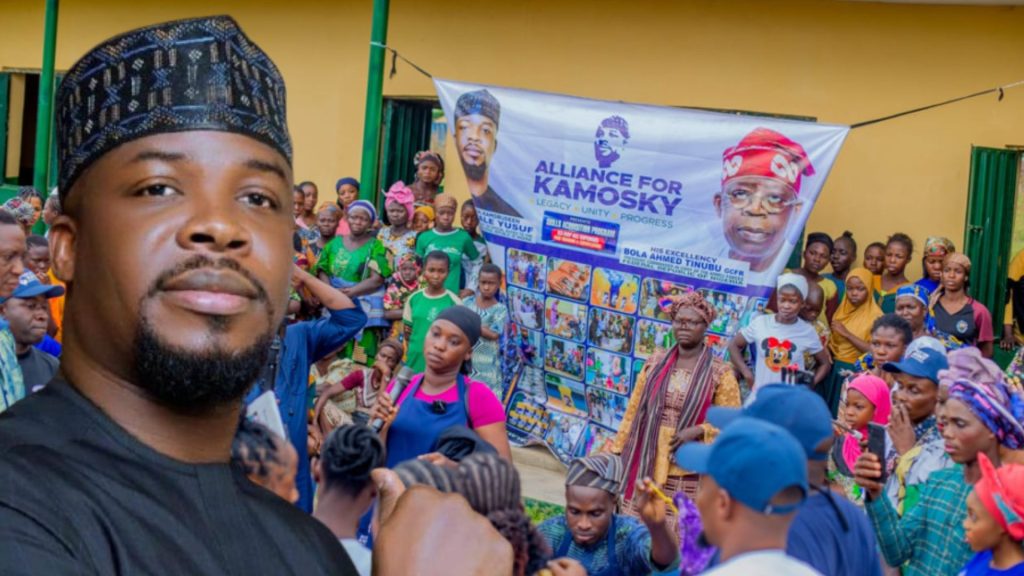
Beneficiaries acquired vocational competencies in areas such as tie and dye, baking, hair-dressing, make-up artistry, shoe making, resin art, soap and cream production, among others. The entire programme was solely sponsored by Alhaji Kamorudeen.
Giving his humble beginnings, education remains a major pillar of the presidential aide’s intervention strategy. Beyond learning materials for primary school pupils, he has introduced scholarships for Ogun indigenes who scored above 300 in the Unified Tertiary Matriculation Examination, an initiative designed to reward excellence and encourage academic ambition among young people in the state.
He has also provided bursaries specifically for law students, acknowledging the financial pressures associated with professional education and the importance of strengthening access to justice through well-trained legal practitioners.
While education occupies a central place in his programmes, Kamorudeen’s development model extends into infrastructure and community connectivity.


One of his most prominent interventions is the facilitation of the reconstruction of the Atan–Ado–Ikoga road, a project widely regarded by residents as critical to easing transportation, improving trade and linking communities to emerging economic hubs within Ogun’s fast-growing industrial corridor.
For Kamorudeen, however, physical infrastructure alone does not represent development. His approach places equal emphasis on humanitarian support and social protection for vulnerable groups.
Across several communities in Ogun State, including Ado-Odo, Agbara and Igbesa, palliatives have been distributed to elderly residents and widows. In addition, his office has supported individuals struggling with medical expenses by paying hospital bills for patients who could not afford treatment, and has provided financial assistance to families facing sudden economic shocks.
Youth empowerment forms the backbone of his long-term development outlook. Through his support groups, which now serves as a foundation for broader youth initiatives across Ogun State, young people are equipped with vocational skills, mentoring and opportunities designed to improve employability and entrepreneurship.
This focus on skills acquisition complements the wider empowerment drive carried out by the Alliance for Kamosky, which prioritises practical trades and small-scale enterprise as pathways to economic independence.
Job facilitation for Ogun indigenes has also become an important part of the presidential aide’s work. Through engagements with public and private institutions, he has helped secure employment opportunities for young people, an intervention that supporters describe as a direct response to what many see as one of the most urgent socio-economic challenges facing the state.
His growing influence in community development has also attracted national recognition. The President’s Personal Assistant has been recognised with multiple honours for his contributions to education and community development, receiving three awards across two major events held in Lagos and Abuja on a Friday.
At the 2025 Social Impact and Sustainability Awards organised by CSR Reporters, Kamorudeen was named Education Advancement Personality of the Year and Social Impact Public Servant of the Year.
The honours highlighted his efforts in expanding access to education and improving learning conditions, particularly through interventions in rural communities in Ogun State.
Beyond high-profile projects and publicised programmes, Kamorudeen’s development model is reflected in quieter, everyday outcomes. Students can remain in school without interruptions due to unpaid fees. Artisans have received support to repair tools and sustain their trades. Traders and small business owners stand to benefit from improved road access and connectivity. Families who previously faced uncertainty over healthcare costs have received timely intervention.
The cumulative effect of these actions has positioned Kamorudeen as more than a political aide within Ogun’s public space. To many residents, he represents a style of leadership that blends access to power with personal accountability to communities.
For Kamosky, public service is not a distant administrative function but a continuous engagement with people and their everyday realities.
In a state seeking sustainable pathways to inclusive growth, his blend of education support, skills development, humanitarian relief, and infrastructure advocacy is gradually shaping what many now describe as a people-centred development model for Ogun State.
Disclaimer
Comments expressed here do not reflect the opinions of Vanguard newspapers or any employee thereof.