
By Ayo Onikoyi
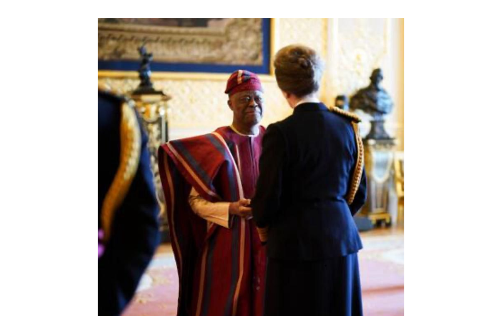
Nigeria’s Minister of Finance and coordinating Minister of the Economy, Wale Edun was on Wednesday appointed Commander of the Royal Victorian Order at an investiture ceremony hosted by Princess Catherine on behalf of King Charles at Windsor Castle.
This marks another milestone for Edun who was until recently a Trustee of The Duke of Edinburgh’s International Award Foundation.
An Investiture is a very special day when someone who has been awarded an honour receives their award in person from a Member of the Royal Family. The investee visits the Royal residence, with members of their family, to receive their insignia.
The award marks another pointer of the heights and recognition of Edun’s service to his homeland, Nigeria and humanity in general, whilst he has been steering Nigeria’s economy via reforms to achieve results.
The ceremony, which also recognised figures such as Lydia Tischler, a Holocaust survivor and child psychotherapist; Rhys McClenaghan for services to gymnastics; and John Whiston for services to broadcasting, carried deeper resonance for Nigeria. Edun was honoured not only as a former trustee of the Duke of Edinburgh’s International Award, but as a public servant whose career has bridged global engagement and national reform.
At a time when many emerging economies are struggling to find their footing amid global shocks, Nigeria is steadily rebuilding confidence in its economic direction. At the centre of this turnaround is Wale Edun, whose calm but firm stewardship has positioned the country as an increasingly credible destination for investment and long-term growth.
From Abuja to Addis Ababa, Riyadh to Davos, Edun has become the face of Nigeria’s reform narrative — one anchored on fiscal discipline, policy consistency, and an unambiguous shift from short-term fixes to structural stability. Hosting the 2026 Technical Meeting of the Intergovernmental Group of Twenty-Four (G-24) in Abuja was a symbolic and practical affirmation of that progress. As Edun noted at the opening reception, the discussions come at “a critical moment” for developing economies facing tight global financial conditions, with outcomes that directly shape access to capital, investment flows, and job creation.
Those reforms are increasingly reflected in the numbers. Nigeria has recorded a steady rise in foreign direct investment inflows as investors respond to clearer exchange-rate management, improved fiscal coordination, and renewed confidence in macroeconomic governance. Foreign reserves have also strengthened, providing a buffer against external shocks and supporting currency stability. After the initial inflationary pressures triggered by subsidy removal and exchange-rate unification, inflation has begun to moderate, reinforcing confidence among households, businesses, and international partners.
Speaking at the Al Ula Conference for Emerging Market Economies in Riyadh, Edun was unequivocal: “Nigeria’s macroeconomic and fiscal reforms are working. Momentum must be maintained, and the benefits channeled towards long-term growth and resilience.” Under his leadership, government has deepened coordination between fiscal and monetary authorities, embraced digital tools to improve revenue assurance, and promoted realistic budgeting to entrench durable fiscal discipline.
Global institutions are taking notice. Anna Bjerde, Managing Director of Operations at the World Bank Group, recently described Nigeria as “a global reference for steady, credible reform leadership,” citing the government’s resolve to stay the course despite short-term difficulties. That consistency, she said, has built strong confidence among investors and policymakers, with Nigeria now firmly transitioning “from reform to results.”
Energy sits at the heart of Edun’s growth strategy. Through Nigeria’s leadership under Mission 300, he has worked with global finance and energy partners to accelerate electricity access — a prerequisite for industrial expansion, digital inclusion, and job creation. Bjerde has described Nigeria as a potential “game changer” for the initiative, noting that ongoing programmes are already expanding power supply and unlocking private capital.
Edun has also used global platforms to articulate Nigeria’s broader vision. In interviews with CGTN at the African Union Summit in Addis Ababa and at World Economic Forum in Davos, he outlined a strategy for inclusive, job-rich growth driven by digital work for youth, stronger manufacturing value chains, MSME support, and expanded energy access.
Backed by President Bola Ahmed Tinubu’s insistence that “there will be no turning back” on reform, Edun’s approach has combined clarity of purpose with steady execution. The result is a growing sense — at home and abroad — that Africa’s largest economy is once again finding its balance.
In an era defined by uncertainty, Wale Edun has emerged as the engine room of Nigeria’s economic reset: consolidating reforms, restoring stability, and rebuilding trust. For investors and partners watching closely, the message from Abuja is increasingly clear — Nigeria is not just reforming; it is regaining confidence and positioning itself for sustainable growth.
Disclaimer
Comments expressed here do not reflect the opinions of Vanguard newspapers or any employee thereof.