
By Gilbert Joseph
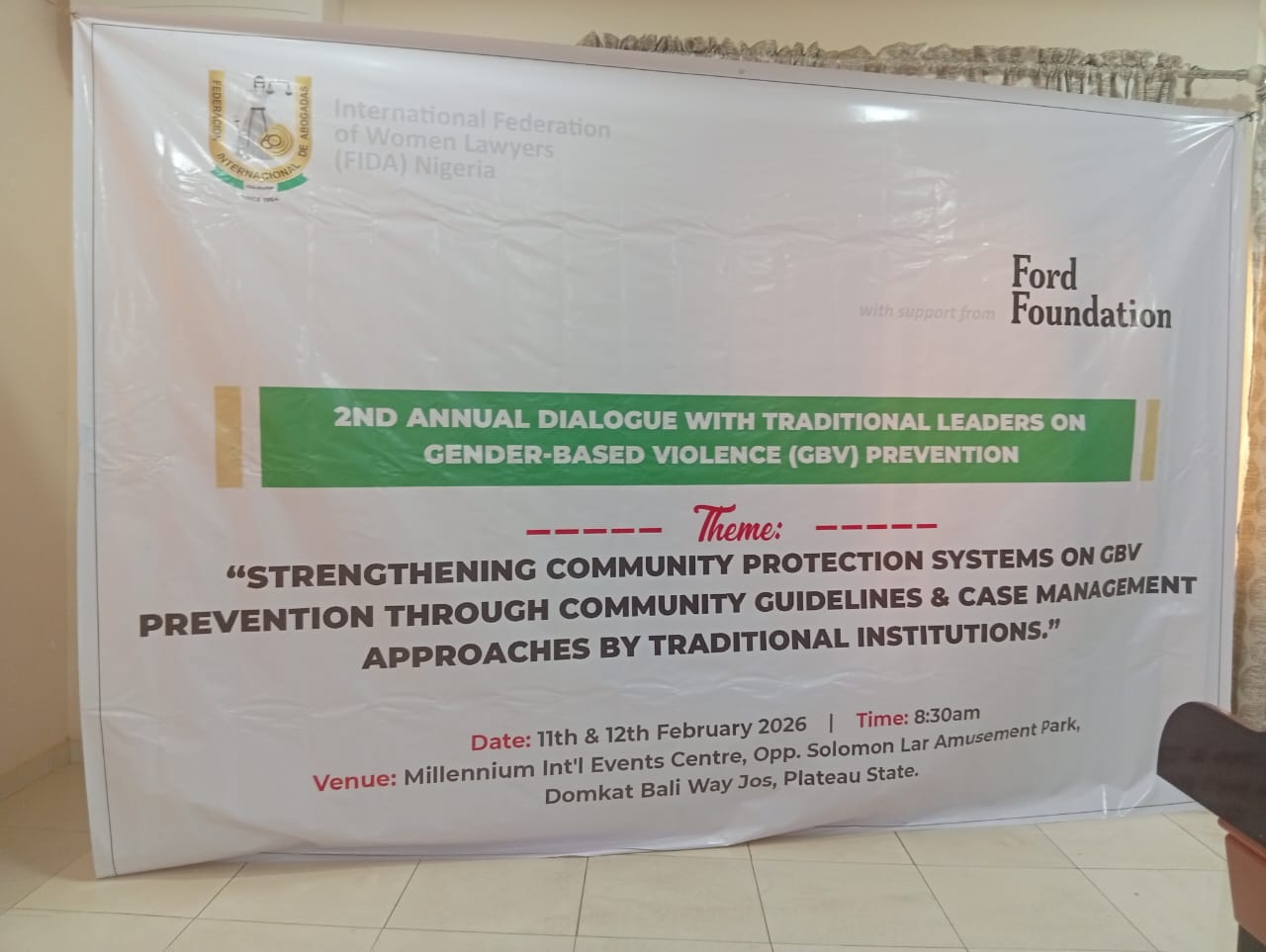
Jos — Traditional rulers, and gender advocates have renewed commitments to end gender-based violence (GBV) and harmful traditional practices across Plateau communities, as the International Federation of Women Lawyers (FIDA) Nigeria convened its 2nd Annual Dialogue with Traditional Leaders on GBV Prevention.
The two-day engagement, supported by the Ford Foundation, held in Jos, with the theme: “Strengthening Community Protection Systems through Case Management Approaches in Combatting GBV by Traditional Institutions.”
In an address delivered on her behalf by the Plateau State FIDA Chairperson, Naankus Fyaktu, the Country Vice President/National President of FIDA Nigeria, Eliana Martins, said the dialogue was designed to consolidate gains from the first engagement and move traditional institutions from commitments to concrete action.
According to her, the initiative seeks to “deepen accountability and strengthen the capacity of traditional leaders to move from dialogue to action.”
Martins recalled that the maiden dialogue in 2025 examined the intersection between harmful cultural practices and GBV, fostering awareness on the dangers of early and forced marriage, widowhood rites, inheritance discrimination and informal dispute resolution systems.
“Importantly, the first dialogue revealed a growing willingness among traditional leaders to serve as allies and advocates for GBV prevention within their communities,” she noted.
Despite the progress, she identified gaps such as weak accountability mechanisms, limited translation of pledges into sustained action and inconsistencies between customary practices and statutory human rights standards.
“This dialogue provides a structured platform to review progress, address implementation challenges, reinforce legal and human rights standards and promote case-management approaches,” Martins added.
Programme Manager, FIDA Nigeria, Fiki Obaro, said community monitoring has revealed measurable social change.
“There is improved attitudinal change across communities on GBV prevention issues. We are witnessing changes in behaviour and reduction in some harmful practices,” he stated.
He added that more girls are now accessing education, while women’s inheritance rights particularly to land, have improved.
“We are also seeing communities developing bye-laws to address some of these issues, which will promote protection against violence towards women and girls,” he said, expressing optimism for safer communities.
Also speaking, Senior Programmes and Resource Mobilisation Officer, Ifeanyichukwu Eze, said sustained dialogue and monitoring under the Ford Foundation project had driven mindset shifts.
“We are beginning to see normative changes around gender inequality, especially female inheritance. Traditional leaders are taking these lessons back to their communities and implementing them through bye-laws,” he explained.
A community leader from Bugomo (Congo-Russia) in Jos North, Bala Auta, testified to the grassroots impact of the initiative.
“Before now in my community, they did not share inheritance with girls. Because of these trainings, everything is changing. Even some elderly men now call me because they want to share property among boys and girls,” he disclosed.
Rhoda Shina, a women’s representative from Bugomo, said the programme had strengthened women’s voices and protection for vulnerable girls.
“The programme has impacted our lives. We now have knowledge to resolve issues, engage our traditional councils and support girls, especially those who flee from homes,” she said.
Stakeholders at the dialogue reported outcomes including the curbing of early and forced marriages, increased girl-child education, women’s inclusion in decision-making, promotion of human rights, encouragement of female inheritance and the discouragement of harmful widowhood rites.
Participants called for sustained multi-sectoral collaboration, stressing that GBV prevention requires joint action by government, communities, civil society and traditional institutions.
Disclaimer
Comments expressed here do not reflect the opinions of Vanguard newspapers or any employee thereof.