
By Musa Ubandawaki, Sokoto
SOKOTO — The Sokoto State Government has launched an ambitious reform agenda aimed at tackling the out-of-school children crisis through expanded Early Childhood Care and Education (ECCE), integration of the Almajiri system, and strengthened access to quality basic education.
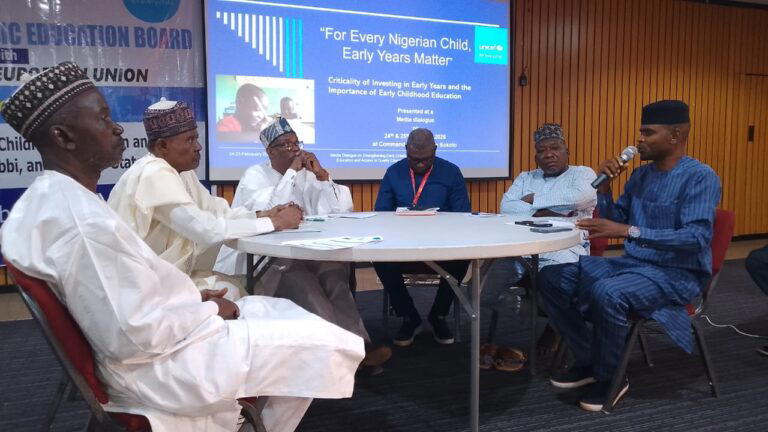
The reforms were unveiled at a high-level media dialogue on out-of-school children and education reform in Sokoto, organised in partnership with UNICEF and supported by the European Union.
Speaking at the event, Executive Chairman of the Sokoto State Universal Basic Education Board (SUBEB), Alhaji Umar Nagwari Tambuwal, said the future of both Sokoto State and Nigeria depends on sustained investment in children’s education.
He described early childhood education as “the great equaliser,” stressing that the period from birth to age eight is critical for cognitive, emotional and social development.
“High-quality ECCE is not a luxury. It is the foundation upon which long-term health, learning outcomes and productivity are built, particularly for children from disadvantaged backgrounds,” Tambuwal said.
Tambuwal disclosed that in 2024 and 2025, SUBEB, with UNICEF’s support, strengthened 160 ECCE centres through the provision of teaching materials and caregiver training. UNICEF has committed to supporting an additional 80 centres, while the board plans to triple the number of supported centres in 2026.
Despite the progress, he revealed that 66.4 per cent of school-aged children in Sokoto remain out of school, representing hundreds of thousands of vulnerable children, including girls, orphans and Almajiri pupils.
Under the leadership of Governor Ahmad Aliyu Sokoto, the state has declared basic education free and compulsory, abolished school levies, and prioritised the recruitment of qualified teachers.
The government also launched the Digital Village Initiative in May 2025 to equip Almajiri children and out-of-school girls with digital literacy and 21st-century skills.
Tambuwal noted that a comprehensive mapping exercise across all 23 local government areas has identified 25 per cent of out-of-school children for targeted intervention.
A major pillar of the reforms is the restructuring of the Almajiri system in collaboration with the Sultanate Council. The government has profiled and registered over 249,000 vulnerable children and is transitioning from street begging to integrated school models in Shuni, Gagi, Tambuwal and Wamakko.
The integrated schools blend Qur’anic education with literacy, numeracy and vocational training, alongside free accommodation and feeding.
To address overcrowding and improve standards, the state has commenced the establishment of three mega model schools across its senatorial zones, including:
Aliyu Magatakarda Model Primary School, Wamakko (Sokoto Central)
Muhammad Sambo Model Primary School, Goronyo (Sokoto East)
Government Day Junior Secondary School, Tambuwal (Sokoto South)
Each facility spans up to 35,700 square metres and includes 60 classrooms, laboratories and recreational facilities.
Tambuwal disclosed that 3,000 teachers have undergone rigorous screening, with successful candidates to be deployed to the mega schools, SMART School, Second Chance Centre for girls in Sokoto South, and vocational centres in Sifawa, Wurno and Wamakko.
The state has adopted technology-driven monitoring using Kobo Collect and GPS tools to ensure accurate data collection and real-time reporting, in collaboration with UNICEF.
With the Out-of-School Children dashboard capturing 326,119 children between 2024 and 2025, Tambuwal said Sokoto is building a data-backed system capable of delivering measurable results.
He called on federal stakeholders and the Universal Basic Education Commission to support nationwide replication of Sokoto’s model through technical and financial assistance.
In a goodwill message, Dr. Michael Juma, Chief of Field Office at UNICEF Sokoto, said the dialogue aims to raise awareness, sustain policy engagement, and promote early childhood education initiatives.
Panelists emphasised that sustained investment in early education is vital to breaking intergenerational poverty and strengthening national security. They also called for stronger legislation to regulate the Almajiri system and deeper collaboration among government, development partners and the media.
Tambuwal urged journalists to bridge the gap between policy and the public, stressing that educating every child is both a moral obligation and a safeguard for the future.
“Educating every child is not merely a developmental target,” he said. “It is a moral obligation and the ultimate safeguard for our collective future.”
Disclaimer
Comments expressed here do not reflect the opinions of Vanguard newspapers or any employee thereof.