
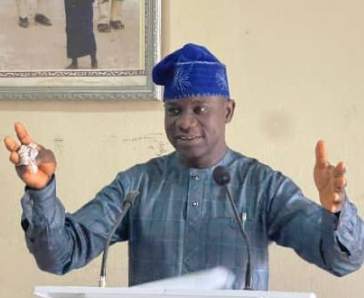
By Stephen Adewale
When we gained admission into Obafemi Awolowo University in 2008, we arrived in Ile-Ife with the peculiar mixture of pride and panic that defines every first encounter with Great Ife.
The campus was majestic with expansive lawns, imposing architecture, the solemn dignity of the Senate and Humanities Buildings rising against the sky like a civic monument to intellect.
Everything about the university announced seriousness. You did not merely enter OAU; you stepped into a tradition.
But beneath that awe was anxiety.
Many of us admitted into the Department of History had never studied History in secondary school. We came in with Government subject, which was used in lieu of History to offer us admission. We had chosen History, or perhaps History had chosen us, but we were uninitiated into its discipline. Within weeks, we realised that History as a course in the University was not anecdote. It was argument. It was theory. It was method. It was archival excavation and historiographical debate. It demanded intellectual stamina we were not yet certain we possessed.
We were proud to be at Great Ife.
But we were struggling.
Lecture halls that first semester felt like theatres of silent intimidation. Names of historians flew across the board. Concepts such as primary sources, secondary interpretation, continuity and change, objectivity, bias, and evidence confronted us like an unfamiliar grammar. Some of us wondered privately whether we had made a catastrophic mistake.
It was in that atmosphere of quiet academic turbulence that a young lecturer entered our orbit through HIS 101: Culture History of Africa up to 1500 AD.
His name was Mr. Saheed Amusa.
He was not yet a professor. Not yet the senior figure he would become. He was a graduate assistant, but what he possessed even then was something rarer than rank: steadiness. Where we felt dislocation, he supplied orientation. Where we sensed intellectual inadequacy, he supplied reassurance without lowering standards. Where confusion threatened confidence, he supplied clarity.
He did not dramatise authority; he embodied guidance.
He seemed to understand instinctively that our struggle was not laziness but transition. That we were not incapable, merely unaccustomed. He translated the discipline into accessible language without trivialising its depth. He made History less a fortress and more a field that could be entered, navigated, and eventually mastered. For many of us, he became more than the lecturer assigned to a course.
He became the one we could approach without rehearsing fear. We ran to him, sometimes with genuine academic questions, and sometimes with anxieties we could not fully articulate. He absorbed our excesses with patience. He corrected without humiliation. He encouraged without sentimentality.
In the intimidating vastness of a great university, he became a human scale of reassurance.
And that mattered.
Across sixteen unbroken years of disciplined academic labour, his scholarship has moved with remarkable range and intellectual audacity across some of the most sensitive and structurally defining questions in Nigerian and African history.
His works have moved swiftly from the fraught terrains of colonial and postcolonial policing in Nigeria to the intricate process of Nigerianisation within the officer corps; from the combustible intersection of police authority and electoral politics to the charged theatres of labour protest and nationalist agitation; from the layered worlds of religion, syncretism, and social resilience to the historically textured landscape of HIV/AIDS and medical experience in modern Nigeria; and from the ritual depth of Yoruba cultural institutions and sacred heritage to the reflective domain of historiography and institutional memory.
In this expansive arc, his work interrogates power, recovers silenced agency, bridges epochs, and insists that the precolonial, colonial, and postcolonial are not isolated compartments but living continuities. In his hands, the archive is not a dusty warehouse of memory but a living instrument. He is almost insurgent in its insistence that we cannot solve contemporary crises without first understanding the histories that shaped them.
His publications in journals such as History in Africa, Africa Bibliography, Research and Documentation, Journal of the Historical Society of Nigeria, Odu, African Journal of AIDS Research, among others, mark him as a scholar whose work is not provincial but globally indexed. His research grants, including the African-German Network of Excellence in Science (AGNES) award supported by the Alexander von Humboldt Foundation and TWAS signal international validation of intellectual merit.
He has supervised M.A., M.Phil., and Ph.D. theses spanning electoral tribunals, chieftaincy institutions, inter-group relations, medical missions, and colonial inheritance culture, thereby extending his intellectual lineage into future generations. He has served as Acting Head of Department, Vice-Dean of the Faculty of Arts, Member of Senate, Postgraduate Board member, and embodying the administrative responsibilities that transform scholarship into institutional stewardship.
Most tellingly, he was selected among fifty-six scholars worldwide to contribute to the Cambridge History of African Political Thought project, a distinction that situates his voice within the global canon of African intellectual history.
Universities are sustained by research output, publications, rankings, and institutional reputation. But students survive them through mentorship. In 2008, when we were uncertain whether we could survive the discipline of History, Mr. Amusa quietly became our anchor.
Through our undergraduate years, his accessibility did not diminish. Even after graduation, as we dispersed into academia, public service, media, law, and private enterprise, his name remained our instinctive point of contact whenever the Department of History was mentioned. If clarification was needed, if a document was required, and if institutional memory had to be accessed, we called him.
Continuity is the most authentic proof of influence.
When the announcement came on Thursday 26 February 2026 that he had been elevated to the rank of Professor of History, effective October 2024, the news carried institutional significance.
But for some of us, it was historical vindication.
Nearly two decades earlier, he had explained to us that history is not static memory but structured continuity. Today, his own career embodies that thesis. From Graduate Assistant in 2008 to Reader in 2021, and now Professor, his ascent reflects disciplined scholarship rather than accelerated fortune. Nearly two decades ago, he stood before uncertain first-year students explaining how societies evolve through continuity and change. Today, his own journey illustrates that dialectic: continuity of dedication, change in rank; continuity of mentorship, change in institutional status.
There is something profoundly symbolic in a historian whose work interrogates policing, decolonisation, and the fragilities of nationhood ascending within a university founded at the height of Nigeria’s postcolonial optimism. In celebrating Professor Saheed Balogun Amusa, we celebrate not merely personal achievement but the triumph of sustained intellectual labour. We celebrate a scholar who has shown, through research and mentorship, that historical understanding remains indispensable to Nigeria’s political and social dilemmas.
There is a profound symmetry in a historian becoming part of institutional memory. Therefore, when the announcement came, it felt less like surprise and more like historical inevitability.
For those of us who entered the Department of History in 2008 unsure whether we belonged in the discipline, his Professorship is not merely a career milestone or distant institutional news. It is a generational testimony. It affirms that what steadied us then was not accidental kindness but enduring character. It confirms that the quiet labour of mentorship is not invisible to history.
History, after long observation, has now recorded his name in its senior register.
But long before the official announcement, we who encountered him in those early lecture halls already knew that we were witnessing a scholar in motion.
Now, the motion has become monument.
Stephen Adewale writes from the Department of History, Obafemi Awolowo University, Ile-Ife
Disclaimer
Comments expressed here do not reflect the opinions of Vanguard newspapers or any employee thereof.