
By Stephen Adewale
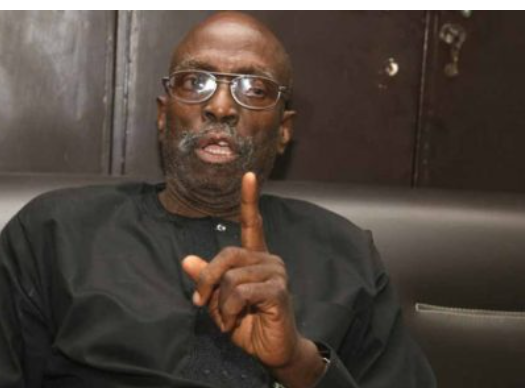
Airports are strange theatres of history. They gather exiles and returnees, fugitives of circumstance and pilgrims of memory. It was in such a theatre at Heathrow Airport in London, few years ago that I encountered Professor Biodun Jeyifo.
I met him not in a lecture hall, not at a conference, but in transit. That now feels appropriate.
For he belonged to that rare generation of African intellectuals who were always in transit between Ibadan and Ithaca, Ife and Harvard, the barricade and the classroom, the page and the public square.
We exchanged pleasantries at first. Nigerians abroad recognise one another with instinctive warmth.
However, what began as courtesy deepened into a seminar, and what felt incidental now reads in memory like instruction.
He was on his way home. So was I.
He sat there calmly, reflective, gently amused by the world’s excesses, and yet intellectually alert in a way that suggested history never really slept in him.
If you had met him for the first time that afternoon, you might not immediately grasp the scale of the mind before you. But those who knew, knew.
Born on 5 January 1946 in Ibadan, which was then the intellectual furnace of a decolonising Nigeria.
Jeyifo was formed in a city where argument was culture and cosmopolitanism was ordinary life.
Ibadan in the 1950s and 1960s was not merely a city; it was a laboratory of African modernity.
It was the era when the University of Ibadan was producing first-class scholars with the quiet confidence of a society determined to think for itself.
Our conversation at Heathrow lasted, perhaps, forty minutes. Yet, it contained decades of Nigerian history: military authoritarianism, academic resistance, the betrayal of public institutions, and the unfinished labour of social justice.
He did not romanticise struggle. He historicised it. At Heathrow, he spoke not of accolades but of struggle.
As the first president of the Academic Staff Union of Universities (ASUU) during his years at the University of Ife, he had stood at the birth of one of the most consequential intellectual movements in Nigeria’s postcolonial history.
Yet, he insisted that ASUU was never merely about salaries or strikes. It was about the defence of the university as a moral and epistemic institution.
Postcolonialism, he insisted, was not a fashionable vocabulary imported from theory. It was a lived condition.
Decolonisation was not an event concluded in 1960; it was a sustained struggle over curriculum, public policy, social justice, and intellectual autonomy. Without those battles, independence becomes ceremonial.
Inequality does not disappear; it simply changes costume.
That formulation has lingered with me ever since.
By then, he had already taught at the University of Ibadan from 1975 to 1977, the University of Ife between 1977 and 1987, Oberlin College, Cornell University for nearly two decades, and later Harvard University.
Across these institutions, he invested what he once called his “intellectual and moral capital” in students. His influence travelled through people as much as through print.
In African literary studies, he attained an authority that few could rival.
His book Wole Soyinka: Politics, Poetics and Postcolonialism which was published by Cambridge University Press in 2004 remains the most comprehensive and sophisticated single-author study of any African writer in postcolonial criticism.
Where others dismissed Soyinka’s difficulty as obscurity, Jeyifo insisted that modernist and avant-gardist technique were central to understanding the writer’s aesthetic and political project.
He read deeply, rigorously, generously. His prose managed that rare combination: intellectual exactitude with writing pleasure.
It has been said, with only slight exaggeration, that no scholar, apart from Edward Said, Gayatri Spivak and Homi Bhabha, attended to the radically dispersed accents of the postcolonial condition as attentively as Biodun Jeyifo.
Unlike many global theorists, Jeyifo remained grounded in concrete struggles. Theory for him was not decorative abstraction; it was diagnostic instrument.
Yet, at Heathrow he was less concerned with reputation than with responsibility.
He recalled the 1970s and 1980s, when Marxist literary, theatre and cultural studies reshaped Nigerian university curricula so profoundly that the government accused academics of “not teaching what they were paid to teach.”
His famous retort, that Achebe’s Things Fall Apart and Soyinka’s The Man Died were themselves savage critiques of postcolonial governance, was not cleverness.
It was conviction. For him, literature was not ornamental. It was infrastructural. It shaped consciousness; it revealed contradiction; it made the invisible visible.
His activism extended beyond Nigeria. At Cornell, he joined colleagues in teaching weekly classes to inmates at Auburn’s maximum-security prison, guiding discussions on Fanon, Cabral, Mandela, Baldwin, Achebe.
He later wrote columns, Talakawa Liberation Forum and Talakawa Liberation Courier, for The Guardian and The Nation, using the pen name “Bamako Jaji,” sustaining a leftist critique of Nigeria’s “Predators’ Republic.”
Even at over 600 pages, the collected volume of his journalism only partially captures five decades of relentless engagement.
And then there was the global dimension where he served as a visiting professorship at Peking University to lay foundations for Africanist literary studies in China; the Free University of Berlin’s project on indigenous theatre; the monumental six-volume Literature: A World History, a post-Eurocentric literary history that he co-edited. His intellectual cartography was planetary.
But at Heathrow, he spoke of Nigeria.
He worried that abandoning the struggle over knowledge production would entrench inequality under new political arrangements.
He feared a republic where critique would be domesticated, where intellectuals would trade independence for proximity to power, where decolonisation would be recited rather than practised.
Looking back now, the airport feels allegorical. Airports suspend you between departure and arrival.
Nigeria, too, seemed suspended between potential and paralysis, between memory and reform. He believed in return, in engagement, in refusing exile as finality.
Yet, he understood that return without transformation is nostalgia.
When news broke on 11 February 2026 that he had died at the age of 80, it felt less like the end of a biography and more like the closing of an intellectual epoch.
He belonged to a generation that believed ideas could reorder institutions.
They were not naïve. They endured military autocracy, structural adjustment, the disappointments of civilian misrule.
But they refused cynicism as a philosophy.
He leaves behind three children, a neuroscientist, an architect and artist, and a young activist, but he also leaves behind generations of scholars, journalists, publishers, and citizens shaped by his insistence that ideas matter.
His former students became professors, editors, activists, critics. He invested in people as deliberately as he invested in texts.
When the boarding call came that day, we shook hands and promised to continue the conversation at home.
We did, but now the conversation must continue without him.
Biodun Jeyifo did not merely interpret the postcolonial world; he insisted on contesting it.
He did not romanticise struggle; he historicised it. He did not treat decolonisation as memory; he treated it as mandate.
And somewhere between departure gate and arrival hall, between Ibadan and Harvard, and between theory and talakawa, he carved a life that refused intellectual passivity.
Airports are theatres of unfinished nations. At Heathrow that day, I thought I was merely travelling home.
I now understand I was being reminded that home is always under construction.
And that the work, as he warned, must never be abandoned.
For if we abandon it, we will not merely fail his generation.
We will confirm his warning.
Stephen Adewale writes from the Department of History, Obafemi Awolowo University
Disclaimer
Comments expressed here do not reflect the opinions of Vanguard newspapers or any employee thereof.