
By Abiodun Kazeem
It has become an all-too-familiar headline: Nigerians clinching international awards, leading university research teams, or making groundbreaking discoveries in science, technology, and the arts, yet with remarkably little room to flourish back home. From Silicon Valley engineers to Oxford scholars and medical innovators in Canada, the pattern endures: Nigerian minds thrive when they leave the country’s borders.
While talent abounds, opportunity often does not. Chronic underfunding, aging facilities, and unpredictable academic calendars have dimmed the promise of local institutions once hailed as the pride of Africa. For a nation rich in human potential, the steady stream of success stories abroad serves as both pride and provocation, proof of what is possible when Nigerian brilliance meets stable systems and supportive environments.
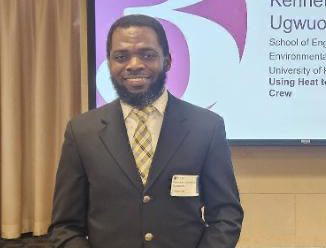
Last month, another name joined that expanding roll of distinction: Kenneth Chinekwu Ugwuoke, a Nigerian graduate scholar in Environmental and Water Resources Engineering at the University of Kansas, United States. Ugwuoke won first place in the university’s prestigious Three Minute Thesis (3MT) Competition, a challenge that requires researchers to distill years of academic work into a clear, engaging three-minute presentation for a non-specialist audience.
The Three Minute Thesis (3MT) competition has grown into one of the most visible global stages for showcasing graduate research, and situating it properly strengthens the broader argument about Nigerians excelling abroad. Launched in 2008 at the University of Queensland in Australia, the Three Minute Thesis (3MT) began as an in-house contest and has since spread to hundreds of universities in more than 60 countries. It challenges master’s and doctoral students to compress theses of tens of thousands of words into a three-minute talk, with a single static slide, for a non-specialist audience.
Judged on clarity, structure and audience engagement, it has become a flagship graduate event that showcases universities’ research and gives students visibility, networking opportunities, and in some cases, cash prizes or travel support. Winning a 3MT title is now widely seen as a marker of both scholarly strength and the ability to communicate research to the wider public. His research, focused on sustainable water management systems for developing nations, impressed both the judges and fellow scholars, earning him a cash prize and an invitation to represent the University of Kansas at the Midwest regional 3MT competition next year.
Placed within this context, Ugwuoke’s first‑place finish at the University of Kansas 3MT competition is not a minor campus prize but a success in a globally recognised research‑communication arena. It shows a Nigerian graduate student outperforming peers from a major U.S. research university in a format designed to spotlight future academic and industry leaders. His selection to move on to the Midwest regional 3MT event further situates him within a competitive international chain: local heats, institutional finals, then regional or supra‑regional contests that feed into the wider 3MT ecosystem.
Ugwuoke’s work goes beyond winning a clever speaking contest; it targets one of the more insidious pollutants in modern industry and warfare. Perchlorate, a chemical used in rocket fuel and explosives, can quietly seep into soil and groundwater, where long-term exposure may interfere with the thyroid gland and disrupt normal hormone regulation. In many contaminated sites, the default response is to dig out soil or flush it with chemicals — methods that are expensive, disruptive, and sometimes only partially effective. Ugwuoke’s research offers a different path, rooted in the quiet work of microscopic life already present in the soil. He uses heat like a spotlight to identify important microorganism-based enzymes: when a sample containing several enzymes and a pollutant is gently warmed, most enzymes unfold and denature, but the few that stay stable are the ones tightly bound to the pollutant and doing the real work of biodegradation.
By tracking which enzymes refuse to “melt,” he can pinpoint the biological machinery that breaks down perchlorate, a rocket‑fuel chemical that can harm human health. This opens the door to cleaner, cheaper and more sustainable remediation, allowing scientists to harness soil bacteria to neutralise dangerous contaminants and positioning a Nigerian researcher at the centre of efforts to use nature’s own tools to repair environmental damage.
For Nigeria, where oil spills, industrial leaks and poorly regulated waste sites remain routine, the contrast is striking. Ugwuoke’s work underscores a familiar pattern: Nigerians proving their mettle in elite laboratories abroad, while similar talent struggles to gain traction at home, not for lack of ability but for want of systems that can sustain serious scientific work. It is against this backdrop that, for Nigerians scrolling through their social media feeds, Ugwuoke’s triumph sparked another wave of national pride. But it also reignited a sobering question: why do so many of the country’s most promising academics have to leave before their potential is recognized—or realized? The irony is painful but persistent: Nigeria continues to produce world-class scholars, scientists, and innovators, yet the systems that trained them often receive little investment or reform. While universities in the United States, Canada, and the U.K. increasingly benefit from Nigerian talent, the home country struggles with institutional stagnation, underpaid academic staff, and declining research output.
In the larger argument of this article, Ugwuoke’s 3MT victory stands as a clear marker of Nigerians flourishing in structured, well‑resourced systems abroad, and of how global institutions deliberately cultivate and reward research excellence and communication, in stark contrast to the instability and underfunding that continue to constrain brilliant scholars within Nigeria’s university system.
*Kazeem is a Nigerian journalist and student at the University of Kansas *
Disclaimer
Comments expressed here do not reflect the opinions of Vanguard newspapers or any employee thereof.