
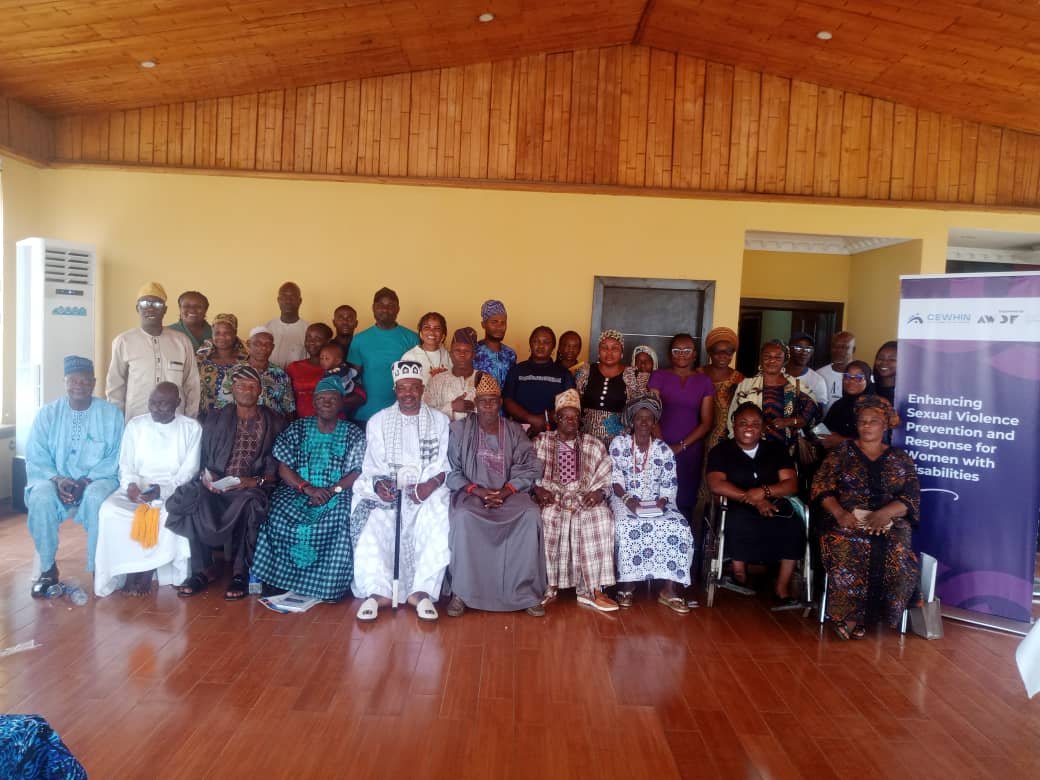
Participants at two-day capacity-building workshop for faith and community leaders on the prevention and response to sexual violence against women with disabilities, organised by CEWHIN with support from the African Women’s Development Fund (AWDF), held in Ijebu-Ode, Ogun State.
By James Ogunnaike, Abeokuta
A non-governmental organisation; Centre for Women’s Health and Information (CEWHIN), has called on community and religious leaders in Ijebu-Ode Local Government Area of Ogun State to lead aggressive grassroots campaigns aimed at protecting women with disabilities from gender-based violence (GBV).
The call was made during a two-day capacity-building workshop for faith and community leaders on the prevention and response to sexual violence against women with disabilities, held in Ijebu-Ode.
Speaking at the workshop, one of the facilitators, Mrs. Oluwatomisin Olatayo, who is a blind, disclosed that nearly all women with disabilities have experienced one form of gender-based violence or another, describing the situation as alarming and unacceptable.
“Women with disabilities face double discrimination; as women and as persons living with disabilities and this significantly increases their vulnerability to violence,” Olatayo said.
The workshop, organised by CEWHIN with support from the African Women’s Development Fund (AWDF), brought together community leaders, religious leaders, persons living with disabilities and members of Community Development Associations (CDAs).
Mrs. Olatayo stressed the need for community mobilisation, targeted training and policy reforms to ensure that women with disabilities are fully included in safety and empowerment initiatives.
She urged religious and community leaders to resist the culture of silence surrounding sexual and gender-based violence, particularly against women with disabilities.
“Leaders must stop using their influence to cover up cases of sexual and gender-based violence. Such cases should be promptly reported to law enforcement agencies,” she warned.
She also called on the government and other stakeholders to move beyond viewing women with disabilities as objects of charity.
“They are not charity cases; they are rights holders. Government must prioritise the enforcement of laws that protect women with disabilities,” she added.
According to her, fear of stigma, lack of trust in the justice system and communication barriers are major factors preventing victims from reporting abuse, saying that
“there is an urgent need to educate women with disabilities about their rights and available support services, including medical and legal assistance”.
In his presentation, a social worker, Mr. Adesegun Adesina, encouraged women with disabilities not to lose hope, noting that disability does not equate to inability.
“There is ability in disability. Women with disabilities should explore their strengths and other parts of their bodies to be self-reliant rather than resorting to begging,” Adesina said.
He advocated a return to strong cultural values and proper child upbringing, while calling for stiffer punishment for perpetrators of sexual abuse and gender-based violence.
Adesina identified factors such as social media influence, poverty, broken homes, peer pressure, lack of proper upbringing and the erosion of communal living as major contributors to sexual abuse and gender-based violence in society.
Disclaimer
Comments expressed here do not reflect the opinions of Vanguard newspapers or any employee thereof.