
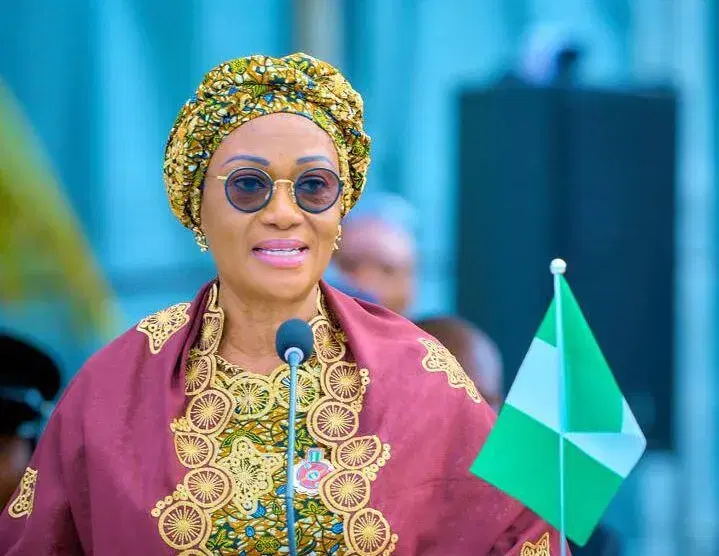
Remi Tinubu
When Nigeria’s First Lady, Senator Oluremi Tinubu, met the United States President Donald Trump, the encounter resonated beyond diplomatic courtesies. It became a moment layered with symbolism— about power, perception, faith and Nigeria’s complex identity in a divided world. In today’s global politics, such meetings are no longer just about policy; they are about optics, narratives and the messages nations project through their most visible figures.
Remi Tinubu’s growing prominence reflects a deliberate use of soft power. As a former senator and seasoned public figure, she is not merely an appendage of the presidency but a political actor in her own right. Her engagement with Trump, a deeply polarising yet influential figure, signals Nigeria’s willingness to engage across ideological divides. It suggests a country positioning itself as pragmatic, confident and globally relevant—ready to converse with power wherever it resides.
Yet, beyond geopolitics lies a uniquely Nigerian subtext: faith. Remi Tinubu is a devout Christian First Lady married to a Muslim president in a nation where religion is often a fault line for tension and conflict. This reality transforms her global visibility into something more profound. In her person, Nigeria presents a rare and powerful counter-narrative to sectarian politics. At a time when religious identity is frequently weaponised, her role embodies coexistence not as a slogan, but as lived experience at the highest level of power.
Her meeting with Trump—who enjoys strong evangelical support in the U.S.—also carries religious symbolism. It subtly reassures Christian communities at home and abroad that Nigeria’s leadership space is not closed to any faith. Simultaneously, it does not diminish President Bola Tinubu’s Muslim identity. Instead, it reinforces a constitutional ideal: that governance in Nigeria, at its best, transcends creed. The First Lady becomes, in effect, a bridge—between religions, between cultures, and between political temperaments.
The implications are significant. Domestically, Remi Tinubu’s visibility can temper religious anxieties, especially among Christians who often fear marginalisation under Muslim-led administrations. Internationally, she projects Nigeria as a plural society capable of internal balance, a quality attractive to partners wary of religious extremism and instability.
In a global age where spouses of leaders increasingly shape national images, Remi Tinubu’s role as a Christian First Lady to a Muslim president offers Nigeria a unique diplomatic asset. Her meeting with Trump underscores that Nigeria’s brand is not just about oil, population, or markets—it is about resilience in diversity. If managed wisely, this symbolism can strengthen Nigeria’s moral authority, reminding the world that unity is possible even in difference, and that faith, rather than divide, can dignify power.
Disclaimer
Comments expressed here do not reflect the opinions of Vanguard newspapers or any employee thereof.