
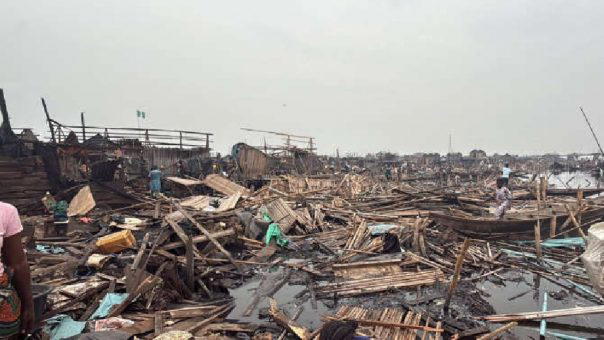
Hours after the Lagos House Assembly mandated that the demolition exercise being carried out in Makoko waterfront is suspended, a public affairs analyst, Sola Onamodu, and safety experts have stated that the action was limited in scope and undertaken primarily for safety of lives and environmental reasons.
According to them, the exercise did not involve demolition of the entire Makoko community, as widely reported, rather affected specific structures located beneath high-tension power lines and those encroaching close to the Third Mainland Bridge corridor.
In an interview with newsmen yesterday after a visit to the scene, Onamodu, explained that the affected areas were identified as posing significant risks to lives and critical infrastructure within Lagos.
Onamodu added that documents sighted roved that the clearance followed a prolonged process of safety assessments, legal reviews, and public advisories.
Before him, Governor Babajide Sanwo-Olu had disclosed that enforcement was initially scheduled for December 2024 but was postponed several times and extended into 2025 to allow for voluntary compliance.
According to the governor, the delays were intended to give occupants sufficient time to respond to notices and relocate from areas classified as unsafe.
Onamodu further stated that documents revealed that advisories concerning unsafe waterfront structures had been issued over several years and across successive administrations, particularly in locations designated as high-risk zones due to environmental and safety considerations.
On the issue of compensation, he urged the affected residents to eschew violence and wait for the Sanwo-Olu administration to fulfil peomises, saying my source in the state house revealed that the governor has directed relevant ministries and local governments to explore humanitarian support options for affected residents.
While faulting claims that the government policies and programmes were anti-low-income communities, he noted that there were several enforcement actions carried out earlier in different parts of Lagos, including some high-value areas, where illegal structures were also removed as part of routine urban planning and safety enforcement.
Earlier, the governor announced that relief measures, including palliatives and relocation assistance, would be considered on compassionate grounds to ease the impact of the exercise.
On land ownership, officials restated the government’s position that under the Land Use Act and the 1999 Constitution, land and waterways are held in trust by the state, and developments without legal titles or planning approvals remain subject to enforcement.
Safety experts involved in the assessment reportedly warned that densely populated wooden structures located beneath power lines posed fire and emergency risks, particularly in the event of electrical faults. Additional concerns cited included flooding, environmental degradation, obstruction of waterways, and navigational challenges.
The state government also addressed public reactions to images and videos circulated online following the exercise, urging the public to consider official explanations and verified information when assessing the situation.
Officials further denied claims that the cleared areas were earmarked for private or luxury developments, stating that the locations remain designated buffer zones for environmental protection, maritime safety, and infrastructure security.
While acknowledging the hardship caused by the clearance, the government said the decision was taken in the interest of public safety and risk prevention, stressing the need to balance humanitarian concerns with urban safety responsibilities.
According to officials, the exercise was aimed at preventing potential emergencies and ensuring safer living conditions around critical infrastructure.
Disclaimer
Comments expressed here do not reflect the opinions of Vanguard newspapers or any employee thereof.