
Call for stronger academia–market collaboration as interest wanes among graduates
By Ebunoluwa Sessou
Stakeholders in Nigeria’s fisheries and aquaculture sector have renewed calls for deliberate collaboration between academic institutions, policymakers and grassroots practitioners to reposition the profession as a viable, respected and future-facing career path, particularly for women, amid mounting climate and sustainability challenges.
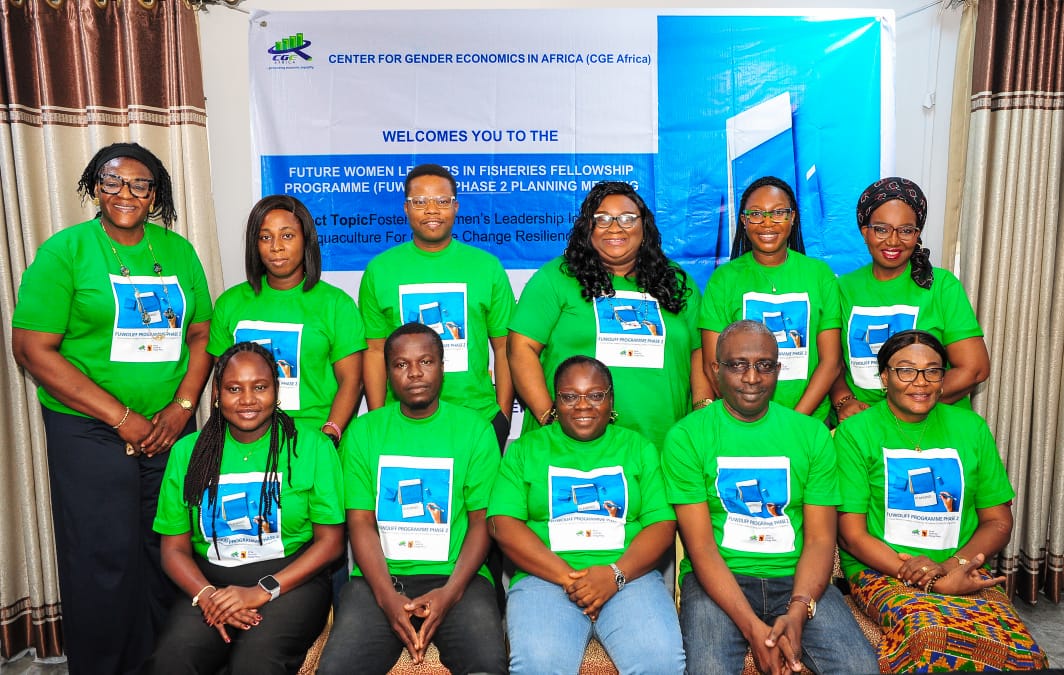
The call was made at the Future Women Leaders in Fisheries Fellowship, FUWOLIFF, Phase II planning meeting, organised by the Centre for Gender Economics, CGE in Africa, under the theme “Fostering Women’s Leadership in Fisheries and Aquaculture for Climate Change Resilience in Nigeria.” Stakeholders at the meeting highlighted deep structural gaps between formal academic training and real-world practice in the sector.
According to the Chief Executive Officer of CGE, Mrs. Uchenna Idoko, there is a need to deliberately expose students to the opportunities embedded in fisheries and aquaculture, hence the importance of engaging academic institutions from the onset to address the sector’s long-standing disconnect.
She explained that engagements with women operating across fisheries and aquaculture markets revealed that many practitioners had never studied fisheries formally and lacked technical and theoretical grounding, despite their strong grasp of the market and value chain.
Her words: “What was striking was that many of these women told us that university students even come to their fish farms for internships, yet there is no clear difference between who is professionally trained and who simply learned the trade informally.”
She noted that this blurred line has weakened professional identity within the sector, making it difficult to distinguish trained experts from opportunistic entrants. The challenge, she added, is compounded by climate-related pressures, especially in practices such as cage culture, where seasonal salinity changes and water conditions require scientific knowledge for effective management.
“If you studied fisheries, you understand seasons, water quality and climate variables. But many people just stumble into the profession. In the marketplace, you can’t tell who is trained and who is not,” she said.
This realisation, she explained, informed the design of the intervention and led to the co-creation of the project’s first phase, bringing together academics, development practitioners and sector experts.
A major turning point came during the organisation’s first annual Gender and Blue Economy Conference in 2024, when a senior official from the Ministry of Marine and Blue Economy shared her personal journey into fisheries.
“She told us she never planned to study fisheries. She wanted another course, but fisheries happened to her. Even her father pressured her to change, but she stayed, went on to earn a master’s degree, and today that same profession has taken her places,” the she recounted.
With the creation of the Ministry of Marine and Blue Economy, the official was among the first professionals drafted into the Department of Fisheries due to her training and exposure.
Following this, the project team surveyed its fellows and found that nearly 90 per cent never planned to study fisheries or aquaculture. Many had applied for medicine, nursing or other disciplines through JAMB but were redirected.
“This helped us understand the psychology of the students. Many felt, ‘this is not what I asked for.’ So our first intervention was a therapeutic onboarding seminar we called ‘Life Cycle,’ helping them own their journey and see the profession differently,” she explained.
The two-year pilot project, spanning 24 months, currently operates across four universities including University of Ibadan, UI, Lagos State University, LASU, Federal University of Agriculture, Abeokuta, FUNAAB, and the Federal University of Technology, Akure, FUTA. Each institution hosts three postgraduate fellows after the programme expanded from a PhD-only model to include master’s students.
Capacity building under the initiative covers gender dynamics, research writing and publication, fisheries policy, legal and human rights issues, entrepreneurship, and emerging innovations in aquaculture.
To promote leadership and ownership, training sessions were rotated across the fellows’ host cities, with participants actively involved in logistics and planning. Excursions to fish farms and cultural landmarks were also incorporated to blend theory with practice.
In Abeokuta, fellows were trained on gender issues and professional identity, followed by visits to Olumo Rock and the adire market. Ibadan sessions focused on research writing and publication, with excursions to the University of Ibadan Fish Farm. Akure sessions addressed fisheries policy, legal frameworks and women’s rights, while Lagos sessions centred on gender and entrepreneurship, exposing participants to large-scale fish business operations.
Feedback from fellows and their supervisors has been overwhelmingly positive. Several participants are nearing publication of journal articles under the mentorship of senior academics, while others have gained international exposure within the global blue economy space.
“Most importantly, their pride in the profession has been ignited. It’s no longer ‘I just happened to be here.’ They now see fisheries and aquaculture as a beautiful and innovative career path,” she said.
The initiative also highlighted innovation opportunities within the sector, including value-added ventures such as fish leather production. A documentary screened during the programme showcased a fisheries graduate in Europe who transformed her father’s old leather business into a thriving fish-leather enterprise during the COVID-19 pandemic.
As discussions shift to the project’s second phase, plans are underway to incorporate undergraduate students, with current postgraduate fellows serving as campus mentors. The long-term goal is to scale the initiative to more universities nationwide and extend empowerment to grassroots fisherwomen.
Reacting, a lecturer in the Department of Aquaculture and Fisheries Management, University of Ibadan, Dr. Adebola Ajiboye, expressed concern over declining interest among graduates. He lamented that only one or two out of every ten graduating students pursue careers in fisheries and aquaculture, describing the trend as “deeply saddening.”
Participants also stressed the need to recognise traditional fishing institutions as the foundation of the sector, calling for efforts to build on their legacy rather than dismiss it.
Beyond academia, discussions placed fisheries and aquaculture firmly within Nigeria’s emerging blue economy framework. The organisation disclosed its participation in African Union–supported consultations on Nigeria’s first national blue economy strategy, where gender was eventually recognised as a core objective, particularly within fisheries.
With growing global funding interest from the European Union and other partners, stakeholders urged Nigerian universities and researchers to engage more actively in blue economy research and advocacy.
“The ocean, if sustained, is the future. We must create excitement early, give young people a voice and reposition fisheries as a profession of pride,” she said.
Institutions present at the stakeholders’ meeting included the Nigerian Institute of Social and Economic Research,NISER, University of Ibadan, Federal University of Technology, Akure, members of the Gender and Blue Economy Working Group, Lagos State University, and the Federal University of Agriculture, Abeokuta.
Disclaimer
Comments expressed here do not reflect the opinions of Vanguard newspapers or any employee thereof.