
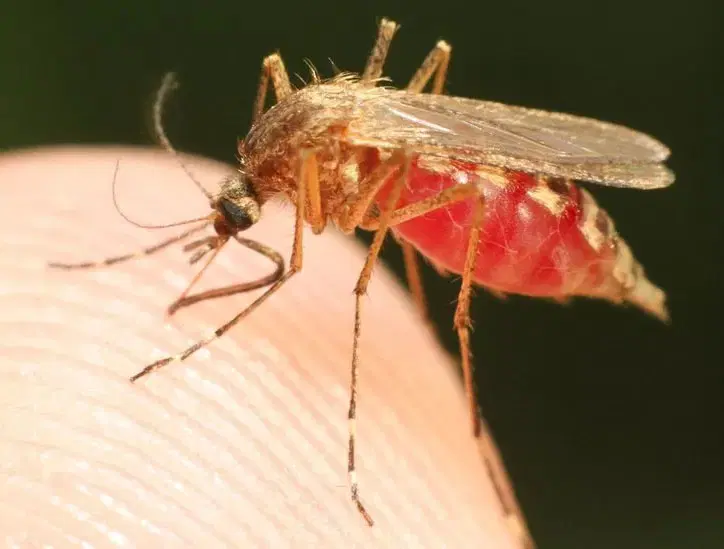
Source: GETTY IMAGES/BBC
By Emmanuel Okogba
African Heads of State and Government issued a stark warning at the 39th African Union Summit that the continent risks losing decades of malaria progress without immediate and substantial new financing, as presented in the African Union Malaria Progress Report 2025.
The report, launched by President Advocate Duma Gideon Boko of Botswana and Chair of the African Leaders Malaria Alliance (ALMA), revealed that African Union Member States accounted for 96% of global malaria cases (270.8 million) and 97% of deaths (594,119) in 2024. Progress has stalled since 2015, with only five countries achieving the 2025 Catalytic Framework targets of 75% reductions in incidence or mortality.
President Boko described the situation as a “perfect storm” of converging crises. “Official Development Assistance for health in Africa has declined by 70% in just four years, and the Eighth Replenishment of the Global Fund fell significantly short of its $18 billion target,” he said. “We cannot allow these challenges to reverse decades of progress that have prevented 1.64 billion cases and saved 12.4 million lives since 2000.”
The report warned that a 30% funding reduction could lead to 640 million fewer insecticide-treated nets, 146 million additional cases, 397,000 more deaths (75% among children under five), and a $37 billion GDP loss by 2030. Without action, annual cases could exceed 400 million and deaths surpass one million.
In response, leaders reaffirmed their commitment to domestic resource mobilisation, innovative financing, and national health sustainability plans. Twelve End Malaria Councils and Funds have mobilised over $200 million through public-private partnerships. President Samia Suluhu Hassan of Tanzania highlighted Africa-led innovation: “Tanzania has invested in world-class research… This is African science, conducted by African researchers, addressing an African challenge.”
Significant advances include 74% of 2025 insecticide-treated nets being next-generation dual active-ingredient products (45% more effective against resistant mosquitoes), 28.3 million malaria vaccine doses distributed, and the introduction of WHO-prequalified spatial repellents. Twenty-two countries planned seasonal malaria chemoprevention in 2025.
Leaders urged increased domestic financing, renewed World Bank Malaria Booster Programme support, alignment with national strategies, and full implementation of the Catalytic Framework. They called for local manufacturing to reduce import dependence (currently 99% for vaccines and 95% for medicines) and strengthen supply chains.
Dr. Michael Adekunle Charles, CEO of the RBM Partnership to End Malaria, emphasised the economic case: “Full deployment of existing and new tools, combined with full funding, could save over 13.2 million lives over the next 15 years and boost African economies by over $140 billion. Every dollar invested in the Global Fund delivers $19 in returns.”
The summit concluded with a unified call for malaria to be treated as a central pillar of health sovereignty and economic transformation, urging both African governments and global partners to protect and increase funding to secure a malaria-free future.
Disclaimer
Comments expressed here do not reflect the opinions of Vanguard newspapers or any employee thereof.