
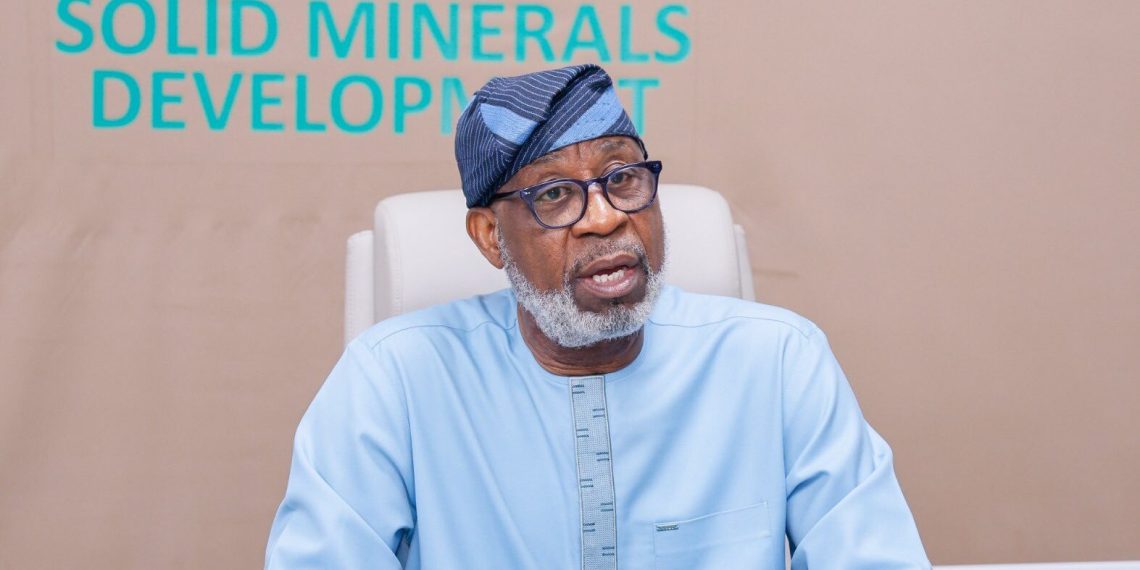
Alake
Nigeria’s quest for economic diversification has moved from policy aspiration to national urgency. Years of over-reliance on crude oil revenues have exposed the economy to volatility, fiscal instability and structural weakness. In this context, the renewed attention being given to solid minerals under the leadership of the Minister of Solid Minerals Development, Dr. Dele Alake, represents a potentially transformative shift in economic thinking and execution.
Recent moves and pronouncements by the minister indicate a determination to reposition the sector as a serious contributor to national development. His focus on sanitising the licensing regime, formalising artisanal and small-scale mining, tackling illegal mining, strengthening institutional oversight and attracting credible local and foreign investors suggests an understanding that governance, rather than geology, has been the sector’s greatest constraint. Nigeria is endowed with over 44 commercially viable solid minerals across its states, yet these resources have remained largely untapped and poorly managed for decades.
The statistics reveal both neglect and opportunity. Solid minerals currently contribute less than one percent to Nigeria’s Gross Domestic Product, while crude oil and gas have historically accounted for more than half of government revenues and the bulk of export earnings. This imbalance has left the economy dangerously exposed to external shocks. By contrast, countries with far fewer mineral resources have leveraged mining to drive industrialisation, exports and employment. For Nigeria, the solid minerals sector holds a huge potential to generate significant foreign exchange, support downstream manufacturing, and create millions of jobs across value chains ranging from exploration to processing and export.
There is little doubt that with the right policies and investments, solid minerals can rival and, in strategic importance, even overtake oil. Global demand for minerals linked to construction, infrastructure, renewable energy, electric vehicles, and technology continues to rise, even as fossil fuels face long-term decline. Nigeria’s deposits of lithium, gold, limestone, iron ore, and other critical minerals position the country to benefit from these global shifts if value addition and responsible exploitation are prioritised.
However, ambition must be matched with restraint and historical awareness. Nigeria must not replicate in mining the same errors that characterised the oil economy: environmental degradation, opaque contracts, elite capture, and the marginalisation of host communities. Mining communities must be adequately protected through strong environmental regulations, fair compensation frameworks, and community development agreements that translate mineral wealth into local wellbeing.
Transparency and sustainability must underpin the sector’s growth. Licensing processes, revenue collection, and resource management should adhere to global best practices to prevent corruption and conflict. Above all, Nigeria must consciously avoid the resource curse, where natural wealth undermines development rather than advancing it. Solid minerals can anchor true economic diversification, but only if managed with discipline, equity and foresight.
Disclaimer
Comments expressed here do not reflect the opinions of Vanguard newspapers or any employee thereof.