
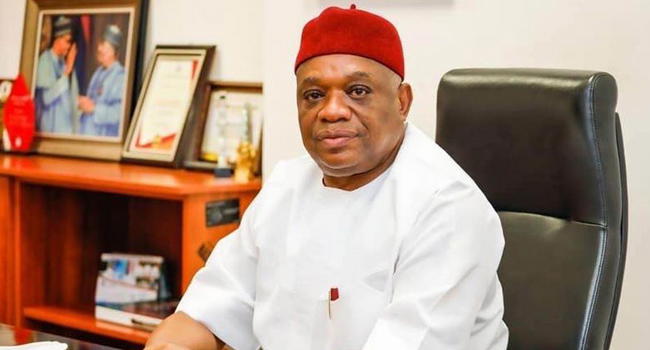
Orji Uzor Kalu
By Professor Ojo Emmanuel Ademola
Professor Ojo Emmanuel Ademola writes not as an “Ndi Abia” insider but as a mobiliser of national-interest value chains. He reflects on how Orji Uzor Kalu’s tenure as Governor of Abia State between 1999 and 2003 contributed to the repositioning of Umuahia into a more structured capital, improved security, and promoted unity — offering lessons that extend beyond Abia to Nigeria’s democratic journey.
When a Nigerian state such as Abia is led by an individual driven by values of excellence, unity and fairness, the benefits can resonate widely. Senator Orji Uzor Kalu, who served as Governor of Abia State between 1999 and 2003, is often cited by supporters and observers as an example of this approach to leadership.
I write not as an “Ndi Abia” insider but as a mobiliser of national-interest value chains. My concern is not confined to one state or one people; rather, it focuses on how leadership at the state level contributes to Nigeria’s collective progress. Abia’s experience under Kalu is therefore more than local history — it is a case study in how governance at sub-national level can influence the broader national fabric. By examining his tenure, one encounters lessons in infrastructure, security and social cohesion that extend beyond Abia’s borders.
Before 1999, Umuahia, the state capital, was still evolving in terms of infrastructure and urban planning. Major roads such as Okigwe Road, Niger Road, Enugu Road, Aba Road and Azikiwe Road dated back to the era of Dee Sam Mbakwe. While Mbakwe’s administration introduced canals and drainage systems to address erosion challenges, several residential areas and inner streets required further development. For a growing state capital, these gaps affected both functionality and public confidence.
Kalu’s administration marked a period of urban renewal. In parts of Umuahia, particularly the Over Rail and New Layout districts, roads were largely unpaved, with red soil dominating the landscape. During the dry season, dust affected homes and businesses, while in the rainy season many streets became difficult to navigate, disrupting movement, commerce and social activities.
His government embarked on road construction and rehabilitation across several neighbourhoods. Streets such as Ekwuruke, Obowo, Cameroon, Oboro, Oji River, Afara, Ogbulafor, Uwalaka, Orlu and Igbere were constructed and tarred. These projects were not merely symbolic but intended to serve communities where families lived and businesses operated. By improving road access, the administration sought to reduce environmental discomfort, improve sanitation and enhance the overall liveability of the capital.
Several of these roads remain in use today, according to residents and observers, reflecting attention to durability and planning. Beyond Umuahia, the administration also undertook road projects in Aba and expanded access to rural communities across Abia State. These connections supported agriculture, trade and mobility, helping integrate rural areas into the wider economic framework of the state and, by extension, Nigeria’s value chain.
Infrastructure was accompanied by a focus on security. At a time when many parts of the country faced social and criminal challenges, Abia under Kalu experienced periods of relative stability. His government worked with security agencies and traditional institutions in efforts to maintain law and order, while seeking to improve operational support for policing and community safety. This approach aimed to create an environment in which businesses could operate, citizens could move with confidence, and investors could consider engagement with the state.
Kalu’s leadership style was also associated with accessibility. Rather than remaining distant from public life, he was known for maintaining a relatively open presence with aides and associates, enabling interaction with citizens and community leaders. This approach helped strengthen the relationship between government and the governed, reinforcing the idea that security and development are shared responsibilities.
Such visibility attracted national attention. During President Olusegun Obasanjo’s first official visit to Abia State, he publicly described Kalu as the “Action Governor”, a reference many interpreted as recognition of the pace and visibility of projects at the time. Markets expanded, roads improved, and public morale reflected a renewed sense of state identity.
Importantly, Kalu did not present Abia’s progress as the achievement of a single administration. He acknowledged the foundations laid by previous governments and sought to build upon them. This reflects an understanding that governance is continuous. No administration begins from nothing, and none completes everything. Each plants seeds, some harvested by successors, while others form the basis for future development.
Examples from other states underline the value of continuity. In Akwa Ibom, successive governors have maintained a tradition of recognising prior efforts rather than discrediting them publicly. Such a culture supports unity, stability and institutional respect — qualities that benefit both governance and public trust.
Abia, like many states, faces competing political narratives that shape public discourse. When debate prioritises propaganda over evidence, development and social cohesion can suffer. Governance is better assessed through measurable outcomes rather than rhetorical confrontation. Each administration contributes in its own way, including the current one, and those contributions deserve fair and balanced evaluation.
As Nigerians, loyalty should extend beyond state boundaries to the nation’s collective progress. Orji Uzor Kalu’s contributions to Abia — in infrastructure development, security coordination and inclusive leadership — remain widely acknowledged by supporters and analysts. His tenure offered citizens a stronger sense of belonging and confidence in governance, while presenting a model of how state leadership can contribute to national strength.
Governments will come and go, but Nigeria will endure. Political engagement must be guided by civility, honesty and respect. Development thrives best in an atmosphere of unity and shared purpose. Only then can Abia — and Nigeria as a whole — realise their potential as societies shaped by leadership rooted in excellence, fairness and national cohesion.
Disclaimer
Comments expressed here do not reflect the opinions of Vanguard newspapers or any employee thereof.