
By Elizabeth Osayande & Marvelous Allen
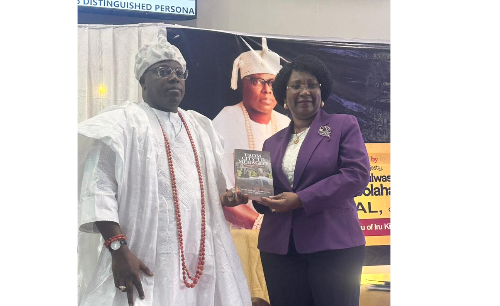
A royal father, Oba Abdulwasiu Omogbolahan Lawal, the Oniru of Iru Kingdom, has emphasised that the future of Lagos hinges not on its potential for growth, but on the effectiveness of its governance structure.
He stated this while delivering the 2026 Distinguished Personality Lecture Series of the Lagos State University, LASU, Ojo.
In his lecture, titled “Urban Governance and the Knowledge Economy: Strengthening Institutions for a 21st Century Lagos,” Oba Lawal stated, “It is not merely about whether Lagos will continue to grow; it is about how we manage that growth. Effective governance today must be rooted in a solid understanding of data, history, and effective communication.”
Speaking to an audience that included policymakers, traditional rulers, and students, the Oniru highlighted the complexities of Lagos, describing it as “a city of many cities—interconnected, improvised, uneven, and constantly under pressure.”
He argued for a reimagining of urban governance in Lagos, stating, “Governance must embrace not just physical infrastructure, but how we organise our knowledge over time to create solutions that are truly sustainable.”
Oba Lawal also emphasise the pivotal role of educational institutions like LASU, referring to them as part of the “cognitive infrastructure” of the city. “We need evidence-based governance where policy becomes a process of learning, and that learning strengthens institutional responsibility,” he noted.
To illustrate his points, the Oniru referred to the concept of creative destruction. “Outdated systems in Lagos must give way to adaptive, data-driven institutions that can handle the scale and uncertainty we face today,” he explained.
He pointed to several initiatives, such as the Oniru Business and Cultural Day and the Lagos Coastal Community Development Corporation, as examples of how traditional leadership can complement modern governance structures.
Oba Lawal also praised the success of the Bus Rapid Transit (BRT) system, which has transported over 200 million passengers from 2007 to 2020. “This case study demonstrates that through institutional learning and coordination, we can deliver affordable and sustainable urban mobility,” he stated.
The Vice-Chancellor of LASU, Prof. Ibiyemi Olatunji-Bello, underscored the importance of the event, describing it as a moment that encapsulates the intellectual spirit of the university.
“In our modern world, progress is defined not just by credentials but by character and the ability to think critically about complex challenges. Today’s lecture series bridges the gap between academia and society,” she said.
Addressing the audience, she remarked on Oba Lawal’s approach to leadership. “His reign signifies a modern take on traditional governance, focusing on infrastructure development and strategic public-private partnerships that balance cultural heritage with progress,” she noted.
“We see that traditional institutions are not mere relics; they actively contribute to contemporary governance.”
The event attracted a diverse audience of academics, political leaders, and community stakeholders, including representatives from the Lagos State House of Assembly.
Among those in attendance were Honourable Princess Mojisola Lasbat Meranda, the Deputy Speaker of the House of Assembly; Honourable Kolade Sule, Commissioner for Tertiary Education.
Disclaimer
Comments expressed here do not reflect the opinions of Vanguard newspapers or any employee thereof.