
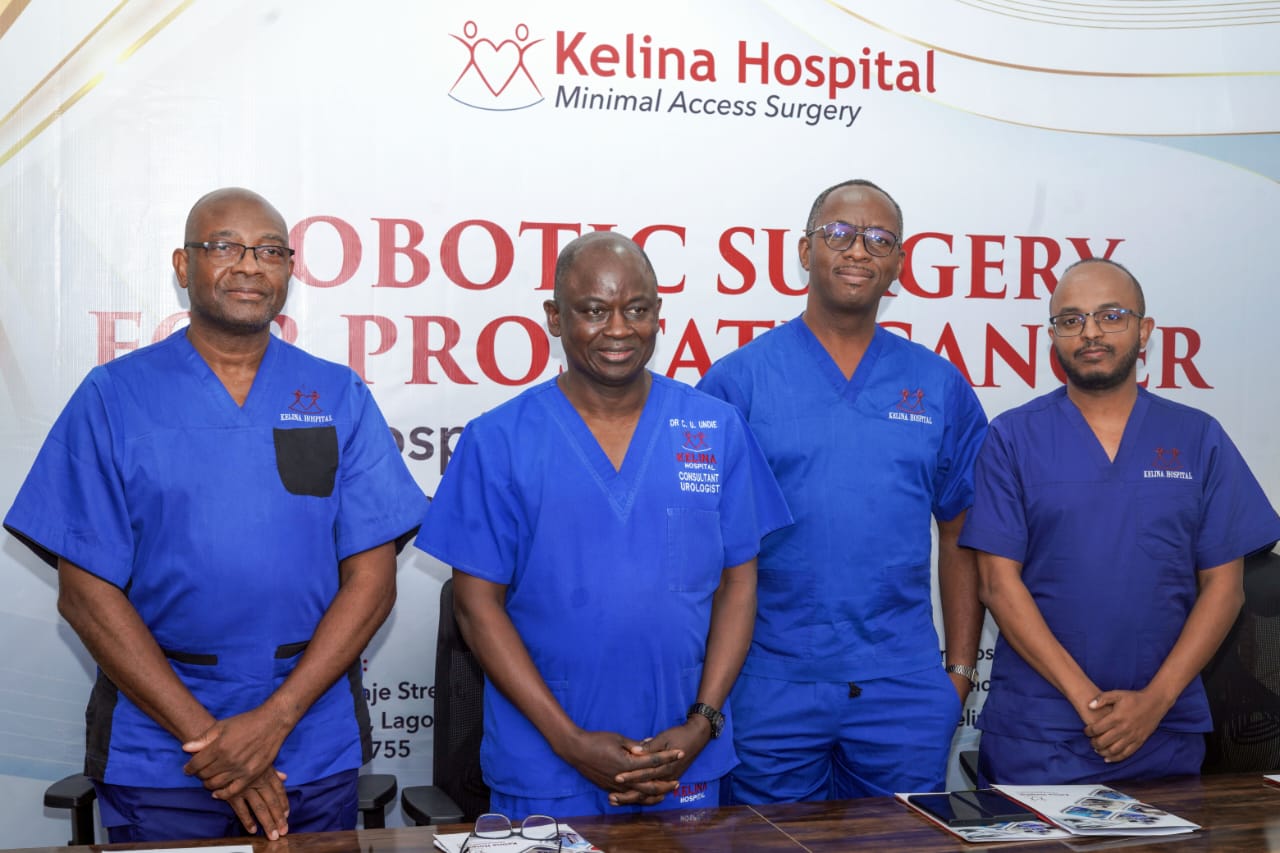
Caption: From Left: A Consultant Urologist, Dr Bertin Njinou, Consultant Urologist, Medical Director and Chief Executive Officer, Kelina Hospital, Abuja and Lagos, Dr. Celsus Ukelina Undie, a Consultant Family Physician, Dr Nedosa Kenechi, and Consultant Urologist, Dr Aklilu Getchew, during a media briefing on the landmark minimally invasive care achieved by the hospital in Lagos recently.
… Emphasise early presentation, minimally invasive care
By Chioma Obinna
In a move to curb medical tourism, Kelina Hospital has set a new national benchmark in urological care after performing 212 prostate surgeries in 2025, the highest number recorded by any single hospital in one year.
The hospital also achieved another landmark in January 2026, completing 101 prostate cancer surgeries over two years with zero mortality, a feat experts have described as unprecedented in Nigeria.
Speaking at a media briefing to mark the milestone, the Medical Director and Chief Executive Officer, Dr. Celsus Ukelina Undie, said the achievement proves that world-class cancer care is possible in the country.
“Two hundred prostate surgeries in one year are worth celebrating. One hundred prostate cancer surgeries in two years with no single mortality are also worth celebrating. It is important for Nigerians to know that all hope is not lost,” Undie said.
He explained that radical surgery remains the most effective treatment for prostate cancer when detected early, stressing the importance of screening and timely medical attention.
“The moment cancer spreads beyond its organ of origin; treatment becomes palliative rather than curative in most cases. Early detection allows us to offer cure,” he said.
The Hospital currently offers all three globally recognised approaches to radical prostatectomy—open, laparoscopic and robot-assisted surgery—making it one of the few centres in Africa with such capacity. Undie noted that robotic radical prostatectomy, the most advanced and precision-driven option, is now routinely used for most patients.
The hospital has also remained at the forefront of benign prostate enlargement treatment, particularly Holmium Laser Enucleation of the Prostate (HoLEP), which Undie described as the gold standard.
“HoLEP has no size limitation, causes less bleeding, requires shorter catheterisation and hospital stay, and has fewer complications than TURP,” he said.
Kelina became the first hospital in Nigeria to perform HoLEP in 2018 and has since completed over 600 procedures, recording a mortality rate of less than 0.2 per cent, comparable to leading global centres.
In prostate cancer care, the hospital now performs robotic surgery almost exclusively, except in special cases such as kidney transplant patients. Undie disclosed that nine prostate cancer surgeries were carried out in one week alone, including on patients with heart disease and diabetes, all of whom were recovering well.
According to the hospital, it has completed over 6,000 surgeries overall with a mortality rate of less than one per cent, outperforming figures reported by the United States National Institutes of Health, where surgical mortality ranges from 3.2 to 6 per cent.
“These outcomes are not the result of individual brilliance, but of teamwork, structured processes and strict adherence to safety protocols,” Undie said.
More than half of urology patients are discharged within 24 hours, reflecting the hospital’s emphasis on minimally invasive techniques and advanced sterilisation systems, including plasma sterilisation technology.
In 2025, the hospital operated with four consultant urologists, including surgeons who have trained over 100 African urologists at IRCAD Africa and a former Head of Urology at the National Hospital, Abuja. One of its robotic surgeons has performed over 2,000 robotic procedures.
Undie acknowledged the contributions of expatriate and diaspora professionals and praised regulatory support from the Medical and Dental Council of Nigeria, noting that it has enabled the safe performance of complex procedures previously unavailable in the country.
The hospital said its high-volume, technology-driven model has helped reduce outbound medical tourism and conserve foreign exchange. “Some of our patients can afford treatment anywhere in the world, yet they choose to come here. That trust motivates us,” Undie said.
He also called for increased government support for healthcare providers, including tax relief on imported medical equipment.
“Healthcare is a humanitarian service. Supporting hospitals ultimately strengthens the economy and the wellbeing of citizens. We plan to expand our minimally invasive surgery programme into other specialties, including general surgery, gynaecology, paediatrics, ENT and orthopaedics, while continuing collaborations with NGOs to support indigent patients.
Urologists emphasise early presentation, minimally Invasive Care
Two consultant urologists at Kelina Hospital, Dr Nedosa Kenechi, Consultant Family Physician, and Dr Aklilu Getchew, Consultant Urologist, attributed the hospital’s strong outcomes to a combination of early presentation, advanced surgical methods and teamwork.
Kenechi said public awareness remains central to improving survival and recovery.
“Early presentation is key. “Minimally invasive surgery reduces tissue trauma, speeds up healing and shortens hospital stay. It also helps address fears people have about being bedridden or disabled after surgery. Modern surgical techniques, combined with skilled personnel, have transformed patient outcomes. It is the combination of early detection, minimally invasive methods and having the best minds working together that makes these results possible,” he added.
Kenechi said: “Prostate removal is not the end of fertility or sexual life. Options such as sperm banking and assisted reproduction allow patients to still have children.”
He stressed that procedures such as HoLEP and radical prostatectomy allow removed tissue to be tested early, helping detect hidden cancers and prevent repeat surgeries.
Prostate cancer
Speaking on prostate cancer, a Consultant Urologist at the hospital, Dr. Aklilu Getchew, said prostate cancer is driven by two major factors—genetics and environment. While genetics, which cannot be modified, plays a key role in initiating the disease, environmental factors largely determine its progression to a clinically evident stage. He noted that prostate cancer is more common among men of African descent, including Africans and African Americans, due to genetic predisposition.
However, he stressed that not every Black man will develop the disease, as environmental exposures such as smoking, obesity, sedentary lifestyle, alcohol consumption and unhealthy diets significantly influence disease progression.
Getchew explained that the rising number of prostate cancer cases is largely due to improved detection rather than an actual increase in incidence, noting that many men previously died without a diagnosis.
He emphasised the need for nationwide screening, recommending that men aged 45 and above undergo regular checks.
According to him, increased screening—both at public and private levels—will ensure early detection and access to advanced treatments, including robotic surgery, which offers outcomes comparable to those in leading centres globally.
Disclaimer
Comments expressed here do not reflect the opinions of Vanguard newspapers or any employee thereof.