
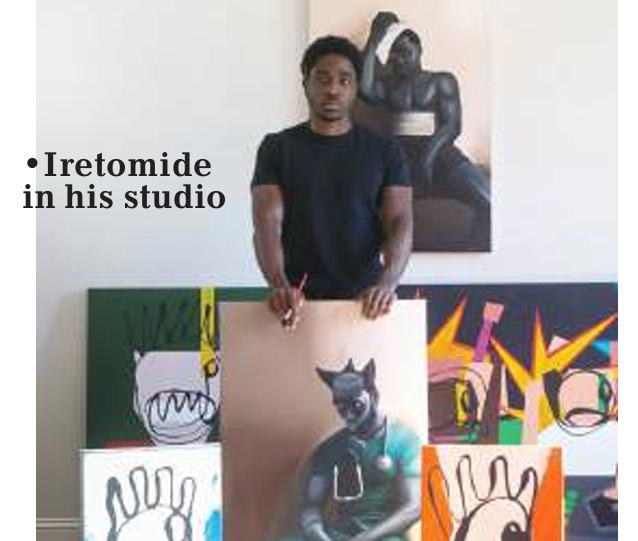
By Prisca Sam-Duru
Iretomide Olayeye is a Nigerian artist based in Georgia USA, Gwinnett County specifically. Born and raised in Lagos, Nigeria, Iretomide continued his education in the United States in 2015, where he attended High School and then College. He thereafter studied Industrial Design at the Georgia Institute of Technology where he recently graduated. Iretomide seems like a very grounded and self-aware artist—his perspective on “forgetting” his work once it’s finished is especially unique. In this exclusive chat online, he shares more with Vanguard Art.
Excerpts: How did your journey into painting begin? Growing up, my older brother used to draw a lot and I wanted to be like him. As a result, I began drawing everything he did, and found that I enjoyed creating art void of my initial desire to be like him. I became obsessed with getting better at drawing, with my most notable initial pieces being pencil and charcoal portraits.
Later in my teen years I moved towards oil paints in an effort to create a unique style that I believed reflected my personal viewpoint on life. I have since refined my style and began exploring acrylics as well. Since your journey as an artist began in Lagos with mimicking your brother’s drawings before finding your own voice, how does your Nigerian upbringing or the environment of Lagos manifest in your work today, even as you create from a US based perspective? For starters, I am a painter and industrial designer, as far as what I am most known for.
However, I think most people know me as the guy that makes the “scary” but “beautiful” paintings, but also chairs. I currently work across two mediums. My oils typically feature figures in a state of melancholy in an effort to capture emotions I believe are kept hidden by most people. My acrylics on the other hand are more experimental, fun, geometric pieces that are really focused on exploring colors and a childish approach to creating.
My upbringing shows up in my work mainly through themes of religion, and sports which are two things that I remember most from my childhood. Largely speaking, my time in Nigeria really bolstered me with confidence and a belief that I can be whoever I want to be. Now that I am slightly older, I now begin to recall memories from that time of my life, and will maybe begin to explore that more in my work. Most of your paintings are both “scary” and “beautiful.” Do you intentionally lean into that tension to represent the “hidden emotions” you mentioned, or is that contrast a natural byproduct of how best you can explore melancholy? Paintings can be looked at technically and emotionally. The technical approach is extremely intentional i.e. color choice, subject, tones, shadows, perspective, proportions, etc.
My art teacher in high school would always say “bump up the contrast” and that stuck with me. Choosing to lean into that from a technical standpoint, I believe, leads to a direct translation into the emotional aspect of my work. What exactly informed the ‘scary’ paintings? Extreme levels of introspection as a result of grief. Artists produce works for sale or pieces most people describe as museum-friendly. Which category do you think the ‘scary’ works fall into? In other words, do people purchase them? The “scary” paintings were never created in an attempt to garner sales.
That style of work for me is about self-expression only. My aim with that genre of paintings is to share my perspective, anything that accompanies it serves as a bonus. I have however sold a couple. Briefly explain what your work as an industrial designer entails? Do you have an architectural background? Industrial design is basically solving problems and letting engineers get all the credit. I do not have an architectural background. So, any background in fine Art? No, it’s industrial design.
I’ve been drawing my whole life and I took some art classes in school, but I have never been formally trained in fine art. As both a painter and an industrial designer, you seem to work with very different constraints—one is deeply emotional and the other, like the chairs, is often functional, how do you switch between designing furniture and the “childish” acrylic pieces? Good design is emotional. It can make you feel safe, it can make you feel hungry, it can make you feel calm.
The biggest difference between both practices, however, is that industrial design serves others first, whereas painting serves the artist first. I approach designing furniture and painting largely the same way; I get inspired, I see a faint picture in my head and I work towards it. I try, I experiment, I mess up, and I try again.
The only difference is I iterate a lot more when it comes to furniture design. You mentioned that you don’t like to dwell on or even look too closely at finished pieces for fear of getting annoyed. How does this “make it and forget it” philosophy impact your growth? Does it make you more prolific, or does it push you to start the next piece with a clean slate? Paintings represent finished thoughts to me. So, each piece is a new sentence forming, a new opportunity to tell a story. My choice to “forget” paintings once completed helps me focus on what is right in front of me, which is usually a blank canvas. In doing so I am able to maximize its potential
Disclaimer
Comments expressed here do not reflect the opinions of Vanguard newspapers or any employee thereof.