
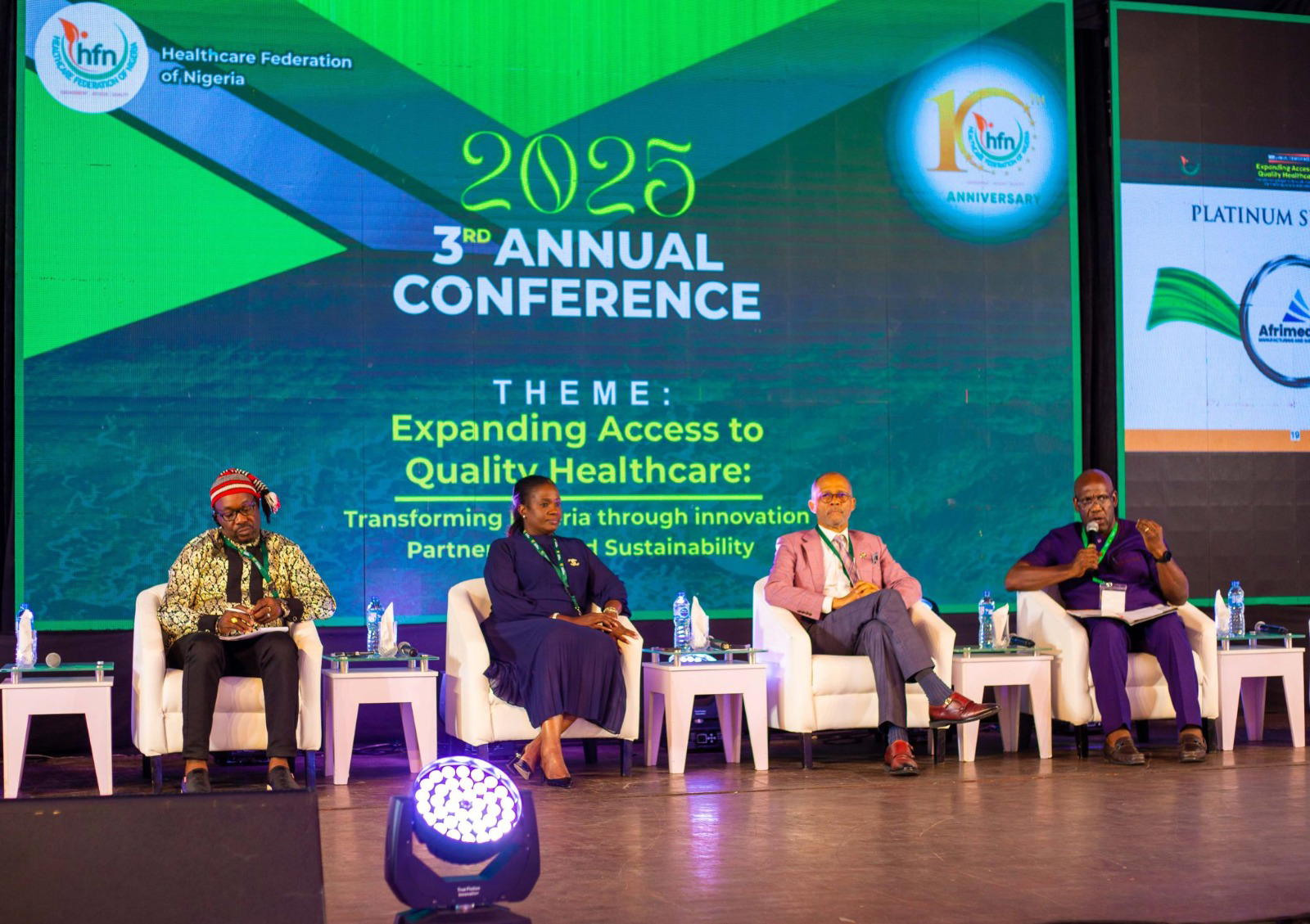
Dr. Success Prosper, Honourable Commissioner for Health, Imo State; Dr. Tomi Coker, Honourable Commissioner for Health, Ogun State; and Prof. Akin Abayomi, Honourable Commissioner for Health, Lagos State, during the Health Commissioners’ Roundtable at the 2025 HFN Annual Conference.
By Gabriel Ewepu
ABUJA – As Nigeria confronts widening healthcare financing gaps, rising costs, and persistent access challenges, the country’s most influential private sector healthcare leaders, policymakers, investors, and development partners will convene in Lagos for the HFN Annual Conference 2026.
The conference is scheduled to hold on 4–5 March 2026 at The Oriental Hotel, Victoria Island, which is being convened by the Healthcare Federation of Nigeria, HFN. The theme of the 2026 edition is ‘Transforming Healthcare Financing: Leveraging Private Sector Innovation to Achieve Quality Outcomes and Universal Health Coverage (UHC)’.
Meanwhile, the conference has evolved into Nigeria’s premier private-sector–led healthcare forum, shaping national conversations on policy reform, investment, and system sustainability.
It is widely regarded as a trusted platform where public and private sector leaders engage constructively on solutions that move beyond theory and into implementation.
The convener made it known that over its four consecutive editions, the convening has consistently attracted cabinet ministers, senior government officials, regulatory authorities, development partners, and private sector leaders across pharmaceuticals, health insurance, healthcare delivery, diagnostics, and digital health.
It also draws investors, healthtech founders, and international health leaders, reflecting its role as a cross-cutting platform at the intersection of policy, financing, innovation, and service delivery.
According to the convener, this year’s edition comes at a defining moment for Nigeria’s health system. With public resources under strain and traditional funding models proving increasingly insufficient, attention is turning to the role of the private sector in mobilising capital, driving innovation, and improving quality outcomes.
Typically convening over 500 participants, the forum ranks among Nigeria’s largest private-sector–led healthcare policy and investment gatherings, with perspectives drawn from across the country and beyond.
The theme, ‘Transforming Healthcare Financing: Leveraging Private Sector Innovation to Achieve Quality Outcomes and Universal Health Coverage (UHC)’ reflects a deliberate focus on how healthcare is financed, how innovation is scaled, and how partnerships can be structured to deliver sustainable and equitable health outcomes for Nigerians.
Meanwhile, speaking on the significance of this year’s focus, the President, Healthcare Federation of Nigeria, HFN, Njide Ndili, said: “Nigeria’s healthcare challenge is no longer just about policy intent, but about how we sustainably finance quality care at scale.
“As public resources face increasing pressure, the private sector must play a more deliberate role, not in isolation, but in partnership with government and development actors.
“This conference is designed to move the conversation from aspiration to action, by focusing on practical financing solutions that deliver real outcomes for Nigerians.”
In another remark, the Chief Executive Officer, CEO, Infinity Health Africa and Chair, Conference Planning Committee, Irene Nwaukwa, said, “This year’s conference has been carefully curated to create the right balance between high-level dialogue, focused engagement, and practical exchange.
“The structure is designed to enable depth over noise, bringing the right people into the right conversations and creating spaces where ideas, expertise, and capital can intersect meaningfully.
“Our aim is to ensure that participants leave not just informed, but better connected and positioned to act.”
“Beyond the programme itself, we’ve been intentional about ensuring that information on participation, whether for attendance, sponsorship, or exhibition, is clearly accessible through HFN’s official platforms.
“This reflects our commitment to making the conference open, transparent, and easy to engage with for stakeholders across the health ecosystem.”
According to the convener, distinguished by its results-oriented approach, the conference goes beyond dialogue to enable decision-making, alignment, and collaboration.
Adding that it is structured to deliver tangible outcomes, including policy recommendations, investment conversations, partnership commitments, and practical financing pathways that can be advanced beyond the conference hall.
The 2026 programme will spotlight innovative healthcare financing and investment models alongside private sector–driven solutions designed to enhance access and quality.
Key focus areas include strengthening primary healthcare delivery, technology-enabled innovations across the health value chain, and public–private partnerships essential to advancing Universal Health Coverage.
A dedicated Innovation Showcase will feature market-ready technologies, financing models, and service delivery approaches with the potential to scale impact.Programme highlights include high-level policy engagements, strategic financing discussions, exhibitions, and curated networking platforms designed to catalyse partnerships and investment.
HFN, the umbrella body representing private healthcare stakeholders across pharmaceuticals, diagnostics, healthcare delivery, health financing, and health technology, has through sustained advocacy and engagement positioned itself as a credible bridge between government, private enterprise, and development partners.
As Nigeria intensifies efforts to achieve Universal Health Coverage, the 2026 conference is expected to serve as a critical platform for shaping financing strategies, strengthening collaboration, and advancing solutions that translate policy ambition into measurable health outcomes.
Disclaimer
Comments expressed here do not reflect the opinions of Vanguard newspapers or any employee thereof.