
By Gabriel Ewepu
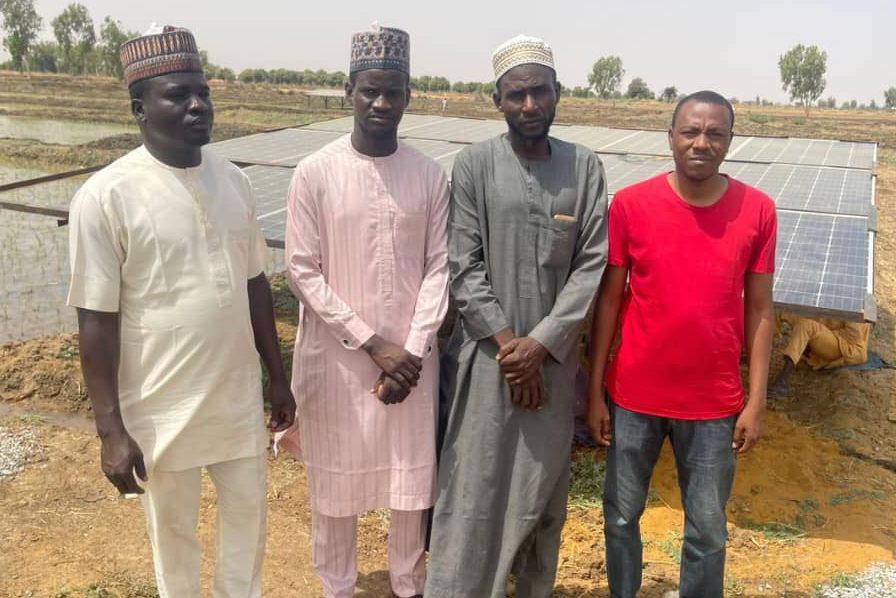
ABUJA – IN a bid to upscale food production and profitability, the YELF Climate Trust Foundation, yesterday, advocated for support for smallholder farmers’ access to Solar-Powered Irrigation System, SPIS.
In a statement, the Chief Executive Officer, CEO, YELF Climate Trust Foundation, Ethel Okosuns, disclosed that the Foundation carried out an in-depth survey and the results were not encouraging as majority of smallholder farmers do not have access to SPIS to ensure all year-round-farming.
Okosuns pointed out that many Nigerian communities have been practicing irrigation for centuries in the coastal, inland swamps, estuaries, floodplains, riverbanks and lowlands and about 5.04 million hectares of the agricultural land is irrigable, unfortunately only about 220,000 hectares is actually irrigated.
She also noted that irrigation in Nigeria has the potential to boost agricultural productivity. While it faces several challenges that hindered its development at several fronts.
Some of the defies are lack of adequate knowledge by farmers, absence of suitable technology, inconsistence polices and finance. Although only hand few small holder farmers across the nation have been able to overcome current challenges to prosper.
According to her, though, there are still a significant number of farming communities that do not have access to dams or water canals constructed to deliver water to farmlands.
As predominantly smallholder farmers are using water pumps and generators for irrigation purposes across the country and 98% of the water pumps uses either diesel or petrol.
She also said the removal of subsidy on fuel and the rapid devaluation of Naira has led to huge increase in the price of petroleum product therefore making it difficult for small holder farmers to cope.
The surge in fuel prices not only affects the operational costs of irrigation but also cut the profit margins of small holder farmers and with the agricultural sector already facing numerous challenges, including unpredictable weather patterns and markets uncertainties, the additional burden of higher fuel costs exacerbates the economic hardships for small holder farmers.
Meanwhile, the survey indicated that most smallholder farmers cannot afford SPIS, despite the “awareness on and use of SPIS was found to be remarkably high, 99.51%, yet less than 29.96% of farmers currently use SPIS in the study area.”
She said: “A climate change Non-Governmental Organization (NGO) YELF Climate Trust Foundation took an initiative to conduct in-depth research in the 19 Northern States of Nigeria.
“Initial baseline research is in progress in FIVE (5) States respectively Kebbi, Niger, Sokoto, Kano and Bauchi. However, the study in Kebbi State was concluded in Mid-March 2025 while the rest are still in progress.
“YELF Climate Trust Foundation aims to create database of FIVE (5) million smallholder farmers in Northern Nigeria and at the moment 10,500.0 TEN THOUSAND FIVE HUNDRED smallholder farmers in the database.
“In Kebbi State, the baseline study was conducted across communities in Argungu and Augie Local Government Areas Council.
“It was discovered that a significant majority of Solar Powered Irrigation System (SPIS) users reported a substantial increase in income (70.24%).”
Underscoring the use of SPIS and the strategic position smallholder farmers occupy in food production, the survey indicated that, “This increase is attributed to higher crop yield (74.07% of SPIS users) and lower operational costs (33.89% of SPIS users).”
The survey further stated that, “SPIS users also reported increased savings (76.23%) compared to when they used other sources of energy and irrigation methods.
“An interesting and unintended piece of information that was discovered is that farmers are using their increased income to expand their farming activities (57.37%), which has a direct consequence on food security.
“Another is that about 40.47% of farmers indicated they used surplus income on their children’s education, thus showing the possibility of increased school enrolment for children in these communities as a result.”
The survey also showed serious challenges hindering farmers to access the technology, “It was discomforting to discover that barriers to SPIS adoption are associated with the initial cost of investment (high upfront costs) 79.57%, and lack of access to financing options 39.29%. Thereby corroborating several researches that smallholder farmers have little or no access to finance and credit lines.
“Awareness on and use of SPIS was found to be remarkably high, 99.51%, yet less than 29.96% of farmers currently use SPIS in the study area.
“It is important, although necessary, to know if smallholder farmers are aware of climate change, climate change adaptation, and its impact on food production.
“Respondents showed reasonable awareness of climate change, with 62.28% and 50.98% having observed increased temperatures and increased flooding, respectively.
“Interestingly, 93.71% of respondents believe that SPIS helps in adapting to climate change because it provides steadfast water supply, and it reduces dependence on rain-fed farming.
“There is generally low awareness of other adaptation approaches, with only 15.13% being aware. Only 14.15% of respondents are aware that crop rotation is a climate-smart practice.”
Meanwhile, she (Okosuns) acknowledged that, “The current administration has indicated, laudably, a strong interest in food security to the extent of expanding the mandate of the Federal Ministry of Agriculture to include Food Security.”
She also counseled that, “Given population growth, the impact of climate change on food security, Nigeria must develop deliberate policies, programmes, and frameworks to ensure food availability. This can only be achieved through year-round and integrated climate-smart farming.
“Not surprisingly, SPIS users reported a higher crop yield of 31.53% compared to non-users. Of the respondents, 16.6% of SPIS users engage in year-round farming, leading to an increase in food production, an increase in personal income, and improved livelihood for the family.
“Farmers strongly prioritize financial assistance, with 88.2% indicating interest in government subsidies.
“While the smallholder farmers contribute substantially to food production in Nigeria, but little or no support gets to them.
“With the necessary support and assistant, small holder farmers will boost food production, increased prosperity, improve food security and less need for food importation in Nigeria.”
Disclaimer
Comments expressed here do not reflect the opinions of Vanguard newspapers or any employee thereof.