
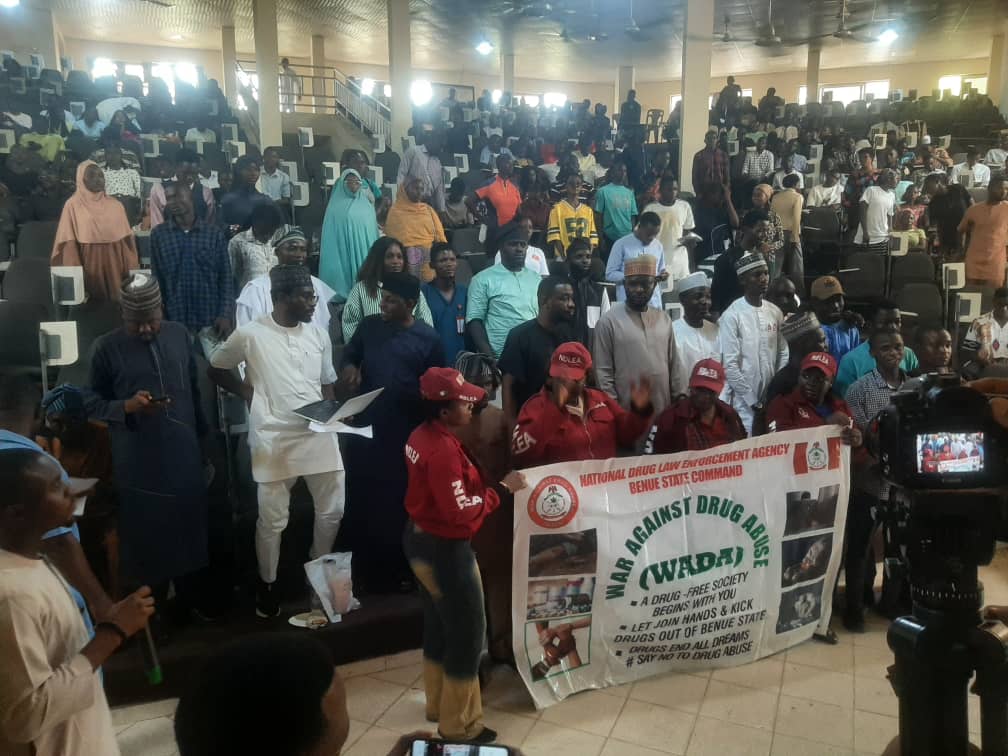
…holds public lecture in MOAUM
By Peter Duru, Makurdi
The Coalition of Northern Groups (CNG) has raised the alarm over the growing menace of drug abuse, thuggery and hate speech on Nigerian university campuses, warning that the trends pose a serious threat to national security, democratic development and peaceful coexistence.
The warning was issued on Friday at a one-day public lecture organised by the Students’ Wing of the Coalition of Northern Groups (CNG-SW) at Moses Orshio Adasu University Makurdi, MOAUM, Benue State, with the theme “Building Responsible Student Leadership: Combating Drug Abuse, Thuggery, Hate Speech, and Campus Disunity Through Positive Values and Mentorship.”
Delivering the keynote address, the National Coordinator of CNG, Comrade Jamilu Aliyu Charanchi, said the gathering was more than an academic exercise, describing it as a “patriotic assignment” aimed at reshaping the moral compass of Nigerian youths.
“Our campuses are not just centres of learning; they are seedbeds where future leaders, policymakers and peace builders are formed. If we lose our campuses to drugs, cultism and hate, we risk losing the future of Nigeria,” Charanchi said.
He described drug abuse as a national emergency with far-reaching implications beyond personal health, noting that substances such as tramadol, codeine and cannabis were destroying leadership potential and fuelling criminality across the country.
“A youth trapped by drugs cannot reason clearly, lead responsibly or contribute meaningfully to nation-building,” he warned, adding that cultism and campus violence are often linked to substance abuse.
Charanchi further cautioned that hate speech and identity-based politics were tearing campuses apart, accusing opportunists of exploiting ethnic and religious differences to manipulate students for selfish ends.
“Leadership must unite, not divide. It must heal, not inflame,” he said, urging students to reject tribal hatred, religious bigotry, cultism and political manipulation.
He stressed that Nigeria’s diversity should be seen as a strength rather than a weakness, calling for mutual respect and interfaith cooperation among students. “True greatness is found when Muslims, Christians and people of every belief stand together,” he added.
The keynote speaker and Dean, Faculty of Social Sciences, Prof. Benjamin Ahule, warned that Nigeria was not doing enough to curb hate speech, cautioning that persistent stereotyping could plunge the country into deeper crises.
“If hate speech is not checked, Nigeria risks sliding into a situation similar to Rwanda,” Ahule said, blaming many of the country’s challenges on ethnicity and religious intolerance.
Presenting his paper titled, Combating Drug Abuse and Thuggery through Positive Values and Mentorship, Dr. Stephen Anyo, of the Dept of Sociology MOAUM, examined the link between drug abuse and thuggery, describing the two vices as “mutually reinforcing threats” to responsible student leadership and democratic stability.
According to him, drug abuse remains widespread among Nigerian youths, with national and international reports indicating rising prevalence despite government interventions. “A society that allows its youths to drift into drugs risks economic stagnation and political instability,” Anyo warned.
He identified factors such as peer pressure, social media influence, poverty, unemployment and the collapse of family values as key drivers of substance abuse among young people.
Another paper, presented by Dr. Tersoo Shaminja of the Dept of Sociology, with the title “Hate Speech and Campus Disunity: A Search for Positive Values and Mentorship among Nigerian Students” warned that Nigerian universities were increasingly mirroring the ethnic, religious and political divisions in the wider society.
“Hate speech may begin as jokes or online posts, but its long-term effect is the erosion of trust, unity and academic coexistence,” Shaminja noted, adding that unchecked rhetoric could escalate into violence.
He noted that “Students are not passive victims of campus disunity; they are active agents of change, Student unions and associations must resist identity-based politics and promote inclusive leadership. Platforms such as CNG-SW can serve as bridges for dialogue, civic education, and mentorship across divides.”
According to him “Hate speech is not merely a language problem; it is a value problem. When universities tolerate hate speech, they risk producing graduates who are intellectually trained but morally fragmented. Campus unity cannot be enforced by regulations alone; it must be cultivated through shared values and sustained mentorship.
“As students and future leaders, the responsibility lies with you to choose dialogue over division, empathy over hostility, and unity over hatred. Universities should be places where differences meet, not clash; where diversity educates, not divides,” he added.
Representing the National Drug Law Enforcement Agency (NDLEA), Chief Superintendent of Narcotics, CSN, Julian Idoko called for a return to communal values and advocated drug screening for prospective university students to curb substance abuse on campuses. “We must return to the days when neighbours looked out for one another and corrected wrong behaviour,” she said.
The Ter Makurdi, Chief Vincent Ahule, represented by Chief Solomon Juku, lamented the rising cases of drug abuse and warned youths against using social media to insult traditional rulers and political leaders. “As leaders of tomorrow, you must lead by example,” he said.
Earlier, the North-Central Zonal Coordinator of CNG-SW, Kenneth Yoosu, described the lecture as timely, urging students to embrace responsibility, dialogue and unity in the face of growing social vices.
In his closing remarks, the Benue State Coordinator of CNG-SW, Fanen Ordondo, said the lecture came at a critical moment and called on students and the wider society to join hands in eradicating drug abuse, violence and hate speech from Nigerian campuses.
Disclaimer
Comments expressed here do not reflect the opinions of Vanguard newspapers or any employee thereof.